Kukulkán
K'uk'ulkan, “feathered serpent” in Yucatec Maya
not scary at all
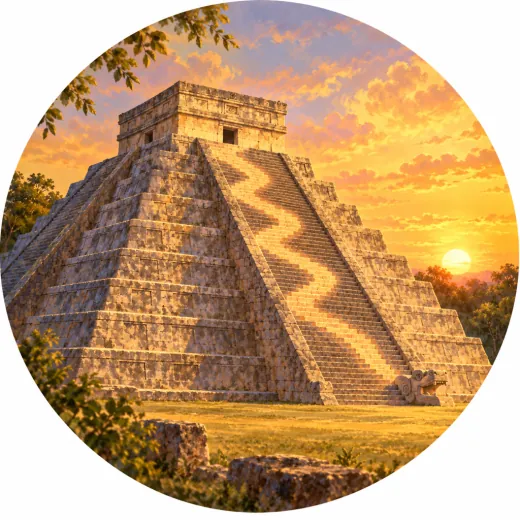
Kukulkán was the feathered serpent of the Maya of Yucatán, very similar to the Quetzalcóatl of the Aztecs: his name means the same thing. At Chichén Itzá the great pyramid called El Castillo was dedicated to him, with four staircases and a temple at the top. At the foot of the north staircase there are two great stone serpent heads. He was linked to wind, to rain and to the power of kings. The friar Diego de Landa, in the 16th century, remembers him above all as a great lord who ruled at Chichén Itzá and who, after he left, was honoured as a god.
Did you know? At the spring and autumn equinoxes, at sunset, the shadows of the pyramid draw a serpent on the staircase that seems to slide down towards its stone head; scholars debate whether the builders really intended it.
The story
In the first days of spring, at about four in the afternoon, something strange happens at Chichén Itzá: people stop talking.
There are hundreds of them, sometimes thousands. They have straw hats, bottles of water, cameras. They have all gathered in the same spot, in front of the great stepped pyramid, and they are watching the staircase on the north side as if something were about to happen. They have been standing on the grass for an hour, the sun on the backs of their necks, and nobody complains any more. A little boy in a hat that is too big tugs at his mother's sleeve. “When does it start?”
“Hush and watch.”
The light sinks. All day the pyramid has been a pale, flat mass. Now, slowly, along the edge of the staircase, something new appears: a strip of jagged shadow, like a saw or the back of an animal. Then another. Then a whole row of dark triangles, one after another, running down the stone, and at the bottom, at the foot of the stairs, there is a great carved serpent head, its mouth open and its fangs bared.
The shadows creep down. It looks as if the body of a serpent were uncoiling from the temple at the top, step by step, and moving towards its head.
Someone claps. Someone has goosebumps. An old woman wipes her eyes with the back of her hand, and could not say why. The light on the stone is the colour of honey. The little boy has stopped tugging at the sleeve.
That serpent, made only of light and stone, is called Kukulkán.
In the Maya language the name already says everything: kukul means “feathered”, like the feathers of the quetzal bird, whose green tail is nearly a metre long, and kan is serpent. The feathered serpent. For the Aztecs, in central Mexico, he went by a closely related name, Quetzalcóatl, which means the same thing. He was linked to the wind, to the rain that makes the maize grow, to the power of kings.
But who was he really? A creature? A god? A person?
Ask a Spanish friar of the 16th century, and he will give you a different answer from the one you expect.
The friar's name was Diego de Landa, and he reached Yucatán a few decades after Cortés arrived. He was a Franciscan, not a scholar like those of today, and he wanted to convert people. But he took the time to listen. He asked the Maya elders about the history of their ancestors, and wrote it all down in a book that has come down to us. They told him that at Chichén Itzá, when the Itzá settled there, a great man ruled, a leader who had come from far away, from the west. His name was Kukulkán.
Landa does not say he was a monster. He does not say he had wings. He tells of a lord who ruled together with the Itzá. He describes the great stepped building at Chichén Itzá, with a staircase on each side, a temple on top and serpent heads at the foot of the stairs: the building that, according to tradition, was dedicated to him.
Then Kukulkán went away. Landa says so in a few lines, without any drama.
The elders did not really know why. They said he had gone back where he came from, to the faraway land. But his people did not forget him, because after he left they began to think of him as a being higher than a man. They honoured him as a god. They built temples to him. At Mayapán, another great city, they dedicated a round one to him, bearing his name.
So, says Landa, the man became a god. And inside the god stayed that name, which spoke of a serpent with feathers.
Other books, written later by the Maya themselves after the conquest, tell the same things from another side. They are called the Chilam Balam, after a priest-prophet, and they are full of prophecies, calendars, stories of wars and of exiles. In those books Kukulkán's name keeps appearing next to Chichén Itzá, as if the two could not be kept apart.
So there are two Kukulkáns, and it is not easy to choose. One is a lord who came from far away, led a people and then vanished. The other is the feathered serpent, who brings the rain and the turning of the year. Perhaps they were the same figure: a man to whom, once he was gone, people began to pray. Perhaps they were two stories woven together by people who, for centuries, needed to explain why a city born in the forest had risen so high.
What remains of the city is the pyramid, which the conquerors called El Castillo, the castle. It has four staircases, one on each side, and scholars count ninety-one steps on each: with the platform at the top, that makes three hundred and sixty-five, like the days of the year. It is not certain the builders had this in mind. It is certain that counting them makes you smile.
And then there is the shadow.
No ancient text says the serpent's shadow was designed. Landa does not mention it. Today the archaeologists of the Mexican institute that looks after the site see the shadow every spring and every autumn, and they know when it will come, and at what time. Whether the builders were looking for it, or found it by chance and then fell in love with it, nobody can say for sure.
But at four in the afternoon, on the right day, the serpent of light reaches the foot of the staircase. It joins its stone head. For a few minutes it looks whole, an endless, motionless animal drinking from the earth.
Then the sun sinks further, the shadows blur, and the serpent melts into the stone, just as it came.
The little boy in the hat that is too big looks at his mother.
“Will it come back?”
“It'll come back. In six months.”
“Six months is a long time.”
“For us. For him it's one breath.”
“And what if we don't see it?”
His mother thinks for a moment, looking at the staircase, grey now.
“Then you tell it to someone who wasn't here.”
Relatives around the world
Listen / Read next
- Music to read by: Cinematic JourneyEpic film-style music, no lyrics, by Ciro Simone IrmiciSpotifyYouTube Music
Sources
- Diego de Landa, Account of the Things of Yucatán (1566)
- INAH, Chichén Itzá archaeological zone
