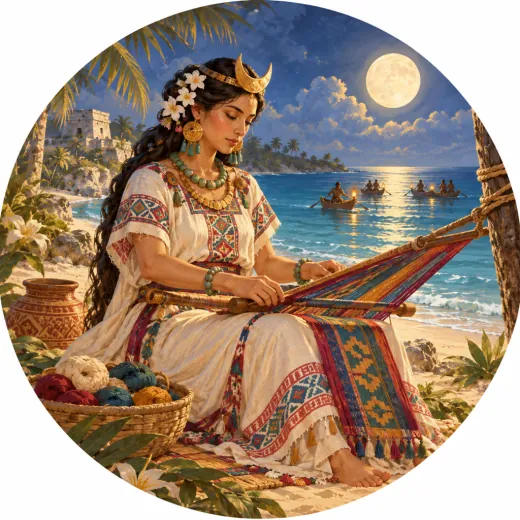
Ixchel
Ix Chel, in Yucatec Maya
not scary at all
Ixchel was a Maya goddess whom scholars link to the moon, to weaving, to medicine and to the birth of children. According to tradition she taught women to weave on the loom, and that she protected mothers and midwives. Her most important shrine was on the island of Cozumel: a 16th-century Spanish friar tells that Maya pilgrims crossed the sea by canoe to go and pray to her. Scholars still debate which images in the Maya books really show her, because Maya goddesses had many names and aspects.
Did you know? Only three painted Maya books have survived, plus a fragment of a fourth, the Grolier Codex, long debated; one of the most beautiful is in Dresden, in Germany.
The story
One evening long ago, in a village on the coast of Yucatán, a girl was weaving.
The loom was simple: a strap round her waist, a rod tied to a post, and the threads stretched between the two. Her hands went up and down, slowly, and under her fingers the cotton turned into a strip of white cloth with a pattern of little diamonds. The girl was expecting a baby. Only a few moons were left. Every now and then she stopped weaving, rested her hands on her belly and stayed still, listening.
Her mother was watching her from the doorway of the hut.
“We must go to Cozumel,” she said.
The girl looked up. Cozumel was the island off the coast, a low shadow on the sea, half a day away by canoe. Everybody knew what it was: the goddess's place.
“Now? With my belly like this?”
“Because of your belly. She knows what to do.”
Nobody in that village would have dreamt of having a baby without asking the lady of the island to look their way. Her name was Ixchel. She was the goddess of women who are expecting, of those who help babies be born, of those who heal. People said that someone, in very ancient times, had learnt from her the secret of the loom: holding the threads together and making them into one thing.
They set off at dawn.
The sea was the colour of milk, with a low light coming from the east. The canoe was hollowed out of a single trunk, long and narrow, with four paddlers. In the bottom lay a gourd of water, a basket of tortillas, a little bag of fragrant resin, and a bundle of white cloth: the gift. The girl had woven it herself, the evening before.
The stretch of sea between the land and the island is not easy. Under the smooth surface runs a current pushing north, strong and silent. The paddlers knew it. They paddled without talking, with steady strokes, keeping the bow turned a little to one side. At one point a dark, glossy back rose out of the water beside the canoe, blew, and went under again. The paddler at the bow smiled: in the village they took that as a good sign.
Halfway across, the girl grew frightened.
The shore had disappeared. The island could not be seen yet. There was only water, sky and the labour of the paddles. Her belly tightened for a moment. Her mother took her hand, without a word, and held it until her skin grew warm.
Then, ahead of them, the dark line of the trees appeared. Then a pale beach. Then other canoes, pulled up on the sand: a great many, from every village. Behind the beach a wide path, cleared of grass, led into the island.
There were people everywhere. Women with babies in their arms, men with baskets of fruit and honey, old women walking slowly, leaning on sticks. There was a constant murmur, like a beehive. The air smelt of burning resin and of the sea.
The friar who, many years later, wrote all this down, Diego de Landa, said that the Maya went to Cozumel the way Christians go to Jerusalem or Rome. To him it was a strange thing: a whole people crossing the sea to pray.
The shrine was a small stone building, cool and shady inside. The girl left her sandals on the threshold. She went in. Inside there was silence, and a reddish light, and a thin thread of resin smoke rising straight up to the roof.
There was no speech to make. She laid the gift on the stone, in front of the image. Then she stayed on her knees, her forehead lowered, and for the first time in many weeks she stopped being afraid.
Her mother did not need to explain. There were many women in the temple. Some prayed aloud, some wept quietly, some laughed with relief. An old woman sitting in a corner was humming a wordless lullaby that seemed to come from very far away, from the time when she too had arrived with a belly full of fear. Some already had babies in their arms and had come to give thanks. Another, young and scared, was expecting her first child, just like her. They looked at each other and smiled.
They went home the next day. The sea was calmer.
The baby was born ten days later, under a waning moon, early one morning. The midwife was the grandmother. When the crying filled the hut, nobody was surprised: everyone in that village had already made the journey.
This story is invented. But what holds it up comes from the sources: the island exists, it is still called Cozumel, and it has pale beaches and a blue sea. Ixchel's shrine really was there, and pilgrims really did go to it, and a friar wrote it down.
And it is strange that it was him. Because that same Landa, in 1562, in a small town called Maní, had many of the Maya painted books burnt, the ones where their stories were written in their own signs. He tells it in his book, and says the Maya grieved terribly. Of those books, in the whole world, only three have survived, plus a fragment, the Grolier Codex, which scholars have long argued over. One is the Dresden Codex, folded like an accordion, its bark pages covered in numbers, signs, gods and animals painted in black and red lines. Nobody knows for certain which of those figures are Ixchel. Maya goddesses had many names and many faces, and names, when it comes to goddesses, sometimes change like clothes.
Then there is the moon, which today's scholars have given her as a gift, and which is not in Landa. And there is the loom, which is still found today in many Maya homes, with the strap round the waist and the threads stretched tight, and the diamond patterns.
Weaving is a way of waiting. It takes patience, it takes calm hands.
Perhaps that is why a goddess of births ended up being a goddess of threads too.
Relatives around the world
Listen / Read next
- Music to read by: Cinematic JourneyEpic film-style music, no lyrics, by Ciro Simone IrmiciSpotifyYouTube Music
Sources
- Diego de Landa, Account of the Things of Yucatán (1566)
- Dresden Codex (11th–12th century)
