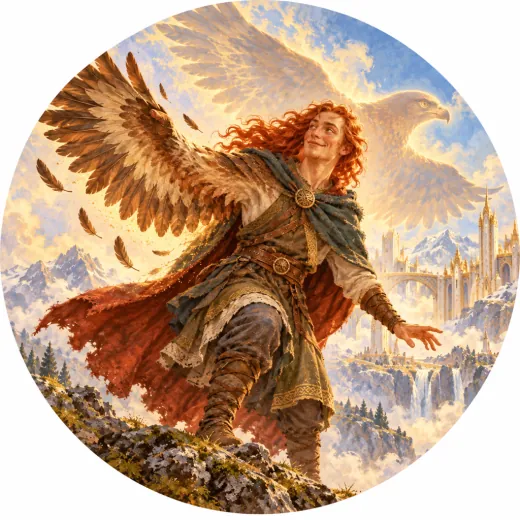
Loki
Loki, in Old Norse
a little scary
Loki is the most unpredictable character in the Norse myths. The son of giants, he lives among the gods, and sometimes he helps them with his cunning, sometimes he gets them into trouble. He can change shape: he becomes a salmon, a fly, a mare, a falcon. He got the gods many of their treasures, including Thor's hammer, but he also caused the death of Baldr, the most beloved of the gods. For this the gods chained him in a cave, where he will stay until the end of the world.
Did you know? He is the father of three monstrous children: the wolf Fenrir, the serpent Jörmungandr and Hel, the lady of the dead.
The story
They say Loki was the son of giants. And yet he lived among the gods, in Asgard, and sat at their table.
Nobody had ever quite understood why they had let him in. He was handsome, and he knew how to talk. He was clever, and he always found a way out. But above all he was useful: more than once his bright ideas had got the gods out of trouble. And more than once his pranks had got them into it.
He could change his shape. He could be a salmon, a fly, a mare, a falcon. Each time he changed completely, down to the fur and the feathers and the look in his eyes. It was his gift, and his curse.
Once, while she was asleep, he secretly cut off the hair of Sif, Thor's wife. When Thor found out, he grabbed Loki by the neck and made him put it right. Loki went to the dwarves, who worked gold like no one else, and had them make hair of real gold, hair that grew on its own. Then, while he was at it, he bet his own head with two other dwarves, the brothers Brokkr and Sindri: “You can't make finer treasures than these.” The dwarves made them. The most precious of all was a hammer. To win, Loki turned himself into a fly and stung Brokkr while he worked, but the hammer came out well all the same, only with a handle a little too short. Loki lost the bet. The dwarf wanted his head, and Loki answered: “The head is yours, but the neck is not.” So he got away with having his lips sewn shut for a while, and the gods found it very funny. The hammer went to Thor.
Then, one day, Loki did something nobody ever forgave.
It all began with a dream.
Baldr, Odin's son, was the most loved of all the gods. He was good, handsome and kind, so much so that when he walked into a hall, the hall seemed to light up. One night he dreamed that he would die. He told the gods, and the gods were afraid.
His mother Frigg decided to leave nothing to chance. She travelled the world and made every single thing swear that it would never harm her son. Fire swore. Water swore. Iron, stones, trees, sicknesses, beasts, poisons. They all promised.
From that day on, the gods made a game of throwing things at Baldr during their gatherings. Arrows, stones, swords: everything bounced off. Baldr laughed.
Loki watched them from a distance. He did not laugh.
One afternoon he turned himself into an old woman, knocked at Frigg's door and asked, all innocence: “Are you sure every single thing has sworn?”
Frigg smiled. “Everything, except a little shrub to the west of Valhalla. The mistletoe. It seemed too young to ask for an oath.”
Loki thanked her. He left. And he went looking for the mistletoe.
That evening, during the game, all the gods gathered round Baldr. They threw, and everything bounced off, and everyone laughed. Only Höðr, Baldr's blind brother, stood to one side, with no weapon, unable to join in.
Loki went up to him. “Why aren't you throwing too?”
“I have nothing to throw,” said Höðr. “And I can't see where he is.”
“I'll give you something. And I'll guide your hand.”
He put a thin branch of mistletoe into his hand. Höðr threw it, where Loki pointed.
The branch did not bounce.
There was a groan. Then a silence unlike any other silence. Baldr had fallen, and he did not get up.
The gods could not speak. They could not even move. No one could take revenge, because the meeting place was holy and the peace there could not be broken. They looked at one another, and they were all thinking the same thing.
They all wept. Then they sent Hermóðr, the messenger, riding to the kingdom of the dead. Hel, the lady of that kingdom, listened to his plea and said: “If every thing in the world weeps for Baldr, he may return.”
The gods sent messengers to every corner of the world. And every thing wept: people, beasts, stones, trees. Every thing except a giantess in a cave, who said: “Let Hel keep what she has.” It was Loki, in disguise. Baldr did not come back.
When the gods understood who had done it, Loki ran. First, though, there was one more feast, in the hall of Ægir, where the gods had gathered to drink. Loki walked in uninvited and began to speak to every god and goddess, one after another, reminding each of them of the thing they were most ashamed of. No one could make him stop. In the end Thor arrived with his hammer in his fist, and Loki, for once, left without a word.
Then he truly fled.
He escaped into the mountains and built himself a house with four doors, so that he could see in every direction. By day he turned into a salmon and hid in a waterfall. He wove a net for fishing, and when he saw Odin coming from far away, he threw it into the fire. But the gods read the shape in the ashes and made one just like it. They searched for him along the river. Loki leapt over the net and hid among the stones; he leapt again, and Thor caught him.
They dragged him into a cave. They bound him across three stones, with chains that had been the guts of his son Narfi and that turned to iron in their hands. Above his head they placed a serpent, dripping its venom.
Sigyn, his wife, stayed by his side. She caught the drops in a bowl, but when the bowl was full she had to go and empty it, and in that moment the venom fell on Loki's face. Then he writhed, and the earth shook, and people called it an earthquake.
They say he will stay there until the end of the world. Loki had had three monstrous children with the giantess Angrboða: the wolf Fenrir, the serpent Jörmungandr, and Hel, the lady of the dead. The gods had sent all three away, each to a place far from Asgard.
On that day his chains will break. He will come out. And he will fight on the side of the giants and the wolves.
Until then, in a cave in the North, someone waits in the dark, with the venom dripping and a woman who will not leave. It had started with a prank, as always. Only this time, nobody felt like laughing.
Relatives around the world
Listen / Read next
- Music to read by: Cinematic JourneyEpic film-style music, no lyrics, by Ciro Simone IrmiciSpotifyYouTube Music
Sources
- Snorri Sturluson, Prose Edda, Gylfaginning
- Poetic Edda, Lokasenna
