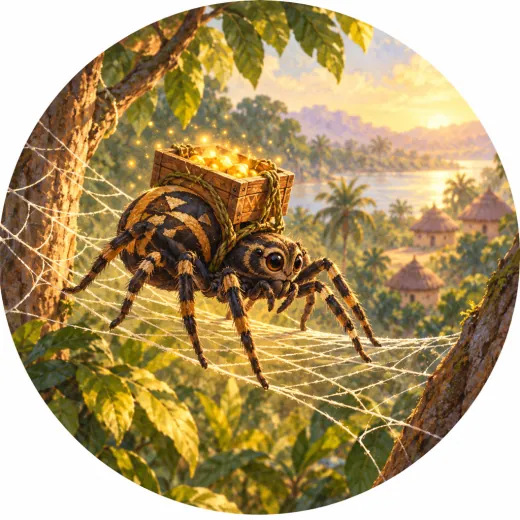
Anansi the Spider
Ananse, in the Akan language
not scary at all
Anansi is a very clever spider, the hero of hundreds of stories of the Akan people of Ghana. At first all the stories in the world belonged to the sky god, Nyame, who guarded them jealously. Anansi asked to buy them, and the god set an impossible price: catching a python, a leopard, a swarm of hornets and a small forest fairy. With a different trick for each one, the little spider managed it. Since that day stories belong to everyone, and they are called “Anansi stories”.
Did you know? Anansi's stories crossed the ocean: in Jamaica and the Caribbean they are still told, and there the spider became Aunt Nancy or Bre'r Anansi.
The story
Once, there were no stories in the world.
It was not that nothing ever happened: plenty happened. But nobody told any of it, because all the stories belonged to one person alone, the sky god, Nyame. He kept them in a big box, high up, so high that nobody could reach it. Whenever he felt like it, he took one out and enjoyed it all by himself.
One day Anansi the spider noticed.
Anansi was small, with eight thin legs and an opinion of himself far bigger than his body. He lived in a forest village with his wife Aso, and spent his time thinking up ways to avoid work.
“Aso,” he said, “I want those stories.”
“Which stories?”
“All of them. Nyame’s.”
Aso looked at him the way you look at a husband who has just announced he wants to buy the moon. “And how will you pay for them?”
“I’ll make him an offer.”
Anansi climbed up the longest thread he had and arrived in front of the god’s throne.
“Great Nyame,” he said, bowing, “I want to buy your stories. Name your price.”
Nyame looked down at him. For a while he said nothing. Then he spoke. “Many far bigger than you have tried. None has succeeded. I want four things. Onini the python. Osebo the leopard. The Mmoboro hornets. And Mmoatia the fairy. Bring them to me alive, and the stories will be yours.”
“Is that all?” said Anansi, without blinking.
He went back down. His legs were shaking, but he did not let it show.
Aso was waiting for him on the doorstep, arms folded. Anansi told her everything, and she was quiet for a good long while. Then she sighed, the way wives sigh when they know their husbands.
“The python is vain,” she said. “The leopard is always in a hurry. The hornets hate getting wet. And the fairy… the fairy has a soft spot for mashed yams. I’ll say no more. Making the mistakes is your job.”
“Aso, you’re a treasure.”
“I’m a wife. That’s different.”
First he cut a long palm branch and took it to the python’s den.
The python lay coiled in the sun, enormous, eyes half closed. Anansi began pacing up and down, talking to himself. “No, it can’t be,” he kept saying. “No, I’m sure he’s shorter. What a shame.”
The python raised his head. “Who’s shorter?”
“Oh, nothing. I was talking to my wife. She says this palm branch is longer than you. I say no, you’re longer. But she’s stubborn.”
“Longer than me?” The python was offended. “Put it here.”
Anansi laid the branch on the ground. The python stretched out beside it, perfectly straight, like a taut rope. “See? I’m longer.”
“Hmm. It’s hard to tell. If I tied your tail and your head to the branch, we’d be sure you weren’t moving.”
The python, full of pride, agreed. Anansi tied him up, round and round, with a rope he had brought along for the purpose, and when he had finished he picked up the branch with the python attached and dragged it all the way to the god’s feet.
Then he went to the leopard.
This time the spider dug a deep pit, covered it with leaves and waited. When Osebo came by, he fell in with a thud and a roar.
“Well, look at that!” said Anansi, peering over the edge. “You poor thing. Wait, I’ll help you.”
He bent a young tree right over, like a bow, and brought its tip within reach of the leopard’s tail. “Tie yourself on here, and I’ll pull you out.” The leopard, who could not wait to get out, let himself be tied. Anansi cut the rope that was holding the tree down: zip! The tree sprang up, the leopard flew into the air, and there he stayed, hanging upside down, snarling at the sky.
Anansi took him to the god, and Nyame began to look at him a little more carefully.
The hornets were the hardest job. Anansi filled a gourd with water and carried it close to their nest. He wet his head a little and started shouting: “It’s raining! It’s pouring! Take cover!”
The hornets were angry, but not stupid, and the sky was grey. Anansi poured some water over the nest, to make it seem like rain. “Why don’t you come into the gourd? It’s dry, it’s comfy!”
The swarm flew into the gourd, buzzing, all together, from the first hornet to the last. Anansi plugged the opening with a leaf and held it tight. Inside, the buzzing sounded like distant thunder.
That left the fairy.
Mmoatia lived in the forest and she was small, quick and bad-tempered. To catch her, Anansi did something no spider had ever done: he carved a wooden doll. He covered it in sticky gum, put a bowl of mashed yams beside it, and set it near the tree the fairy passed every day.
The fairy came. She saw the doll and the yams.
“May I eat some?” she asked the doll. The doll did not answer. “I asked if I may!” Nothing. Mmoatia lost her temper and slapped it. Her hand stuck fast. She slapped it with her other hand, and that one stuck too. The more she wriggled, the more she stuck. Anansi climbed down from the tree with a little snigger.
“Well done, you’ve already introduced yourself,” he said. And he took her to the god.
When the spider bowed before the throne, with the python, the leopard, the hornets and the fairy, for a moment the only sound in the sky was the buzzing of the gourd.
Nyame was not a god who was easily surprised. But this time he smiled, and called together all the chiefs of the sky.
“Come and see,” he said. “Little Kwaku Anansi has done what the strong could not. From today the stories are his, and for ever they will be called Spider stories.”
Anansi went home with the box under one arm. That same day he opened it on his doorstep, and all the stories flew out, one after another, in every direction.
Some ended up in huts, others in the fields. One went all the way to the sea and climbed aboard a ship. Even today, when someone begins to tell a story, there is a tiny leg twitching in a corner, among the threads of a web, and some people would swear it is laughing.
A living tradition, told with respect: how we tell myths.
Relatives around the world
Listen / Read next
- Music to read by: Cinematic JourneyEpic film-style music, no lyrics, by Ciro Simone IrmiciSpotifyYouTube Music
Sources
- R. S. Rattray, Akan-Ashanti Folk-Tales (1930)
