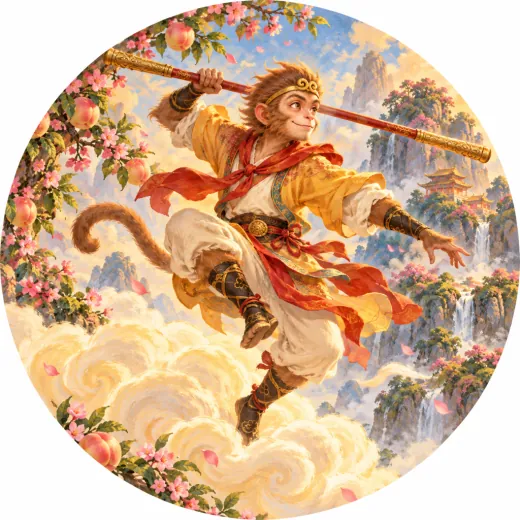
Sun Wukong, the Monkey King
孫悟空, in Chinese
not scary at all
Sun Wukong was born from a magic stone on a mountain and became the king of the monkeys. He learned seventy-two transformations, how to somersault thousands of kilometres through the clouds and how to fight with a staff that can become as small as a needle or as big as a pillar. He was so cheeky that he turned the heaven of the Jade Emperor upside down. As a punishment he was trapped under a mountain for five hundred years, until he was freed to go with a monk on a long journey all the way to India.
Did you know? Journey to the West, the sixteenth-century novel that tells his adventures, is one of the four great classic novels of Chinese literature.
The story
At the beginning of the world, on the Mountain of Flowers and Fruit, there was a stone.
It was an enormous stone, as old as the sky, and for centuries upon centuries it had soaked up the light of the sun and the light of the moon. One day it split open with a sound like thunder. Out came a stone egg. The wind blew on it and the egg cracked open, and inside was a monkey.
The monkey opened his eyes, and from those eyes shot two golden beams that reached all the way to the palace of the Jade Emperor, high up in heaven. The Emperor raised an eyebrow. “What on earth can that be?” he asked. Nobody could tell him. It was the first of a long series of questions that heaven could not answer, all because of that monkey.
He grew fast and ran even faster. One day, along a stream, the monkeys discovered a waterfall.
“Whoever is brave enough to go through it and find where the water ends,” they said, “we'll make our king.”
Nobody moved. Except one. The stone monkey took a run-up, shut his eyes and leapt straight into the waterfall.
On the other side there was no rock, but a cave. With stone tables, stone seats, even a stone stove. It was the home that nobody had ever found. The monkey came back out, shrieking with joy, and the monkeys carried him off in triumph. He became the Monkey King, and lived happily for a few hundred years.
Until one evening, at a feast.
Suddenly he stopped laughing, and tears ran down his face. “Why are you crying?” they asked. “Because one day I will die. And so will you. And this cave will be left empty.” An old ape stepped forward. “There are beings who never die: the Buddhas, the immortals, the sages. They go and learn a secret, and they never grow old.”
The Monkey King stood up. “Then I will learn it too.”
He built a raft, crossed the oceans, and after years he reached a master called Subhuti. Subhuti listened, looked at him and said, “I will give you a name. You will be Sun Wukong, ‘the monkey who has understood emptiness’.” Wukong was overjoyed, and he learnt quickly. He learnt seventy-two transformations, so that he could become a tree, a bird, a pebble, a fly. And he learnt the cloud somersault: a single leap, and a hundred and eight thousand li of road, more than fifty thousand kilometres.
But Wukong was Wukong. One day, to show the other pupils how clever he was, he turned himself into a towering pine tree, and everyone clapped. When Subhuti found out, he flew into a rage. “Get out!” he shouted. “And never tell anyone it was me who taught you!”
The monkey went home with the transformations in his pocket and his head full of ideas.
He needed a weapon. He went to the Dragon King of the Eastern Sea. “Give me something good,” he said. The Dragon King brought him swords, spears and halberds, and Wukong weighed each one in his hand and found them as light as drinking straws. At last the dragon, at his wits' end, showed him an iron pillar that was used to measure the depth of the sea. It weighed thirteen thousand five hundred jin, more than six tonnes. Wukong touched it and thought: maybe a bit smaller. The pillar shrank. “Smaller still!” In the end it was a needle, and he tucked it behind his ear.
Then he got a suit of golden armour out of him as well, since the Dragon King had some to spare.
By the time the dragons went to complain to the Jade Emperor, Wukong was already at the gate of the Underworld. There he crossed out his own name in the register of the dead, and the names of all the monkeys. From that moment on, he could no longer die.
Heaven tried being nice to him. They gave him a job: keeper of the heavenly stables. Wukong was delighted for a month, until he found out it was the lowest job of all. He stormed back to his mountain and had a banner made. On it was written: “Great Sage Equal to Heaven”.
Heaven, at a loss, gave him the title. But no real job, just a palace. And the Great Sage, who was bored, went for a stroll in the garden of the peaches of immortality. He tasted one. Then ten. Then a hundred: they were the ones meant for the banquet of the Queen Mother of the West. Then he went into the banqueting hall, which was still empty, drank all the wine and tasted every dish. And so as not to miss out on anything, he also stole Laozi's pills of immortality.
They sent armies against him. Wukong beat them all, until the god Erlang stood in his way with his dog. The two of them transformed ten times over, into birds, fish, temples. Wukong was captured. They put him in Laozi's furnace for forty-nine days to burn him up. When they lifted the lid, he leapt out, his eyes red and gold from the smoke, and stronger than before.
So heaven called on the last one left: the Buddha.
The Buddha listened and smiled. “Let us make a wager,” he said. “If you can jump out of my hand, you will be emperor of heaven. If not, you go back down to earth and stop being a bully.”
Wukong laughed. The Buddha's hand was as big as a lotus leaf. He did his somersault and flew at a speed nobody had ever seen. He reached the edge of the world, where there were five pink pillars. He wrote his name on one of them, as proof. Then, for a laugh, he played a little prank at the bottom of it. And he flew back.
“I've won!” he said. “I've been to the end of the world!”
“Look more closely,” said the Buddha, and raised a finger. At its base, in golden letters, was written the name of the Great Sage. And next to it, the little prank.
Those five pillars were the Buddha's fingers.
Before he could escape, the hand closed and turned into a mountain, with a seal on its peak. It was the Mountain of the Five Elements. Wukong stayed under it for five hundred years, with only his head sticking out, eating molten iron and drinking melted bronze, and watching the seasons go by.
Until one day a monk named Tripitaka passed by, on his way to India to fetch the holy scriptures. He removed the seal. The monkey burst out with a roar, bowed, and said, “Master, I'm coming with you.”
The monk put a golden band on his head, a gift from the goddess Guanyin, which tightened every time Wukong misbehaved, and the journey began. It lasted fourteen years, and the whole time the Monkey King never once stopped being himself.
Heaven watched him from above, shook its head, and smiled a little.
Relatives around the world
Listen / Read next
- Music to read by: Cinematic JourneyEpic film-style music, no lyrics, by Ciro Simone IrmiciSpotifyYouTube Music
Sources
- Wu Cheng'en (attributed), Journey to the West (16th century)
