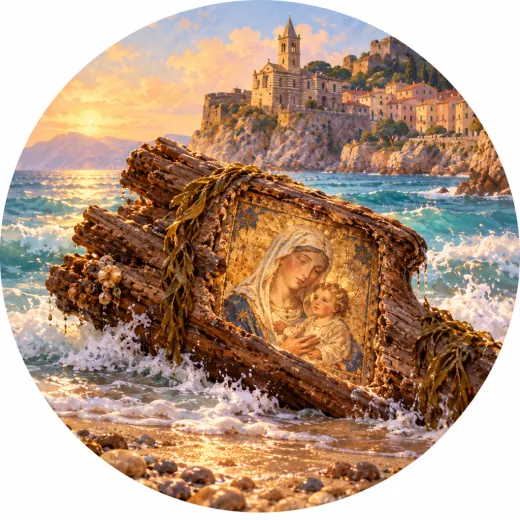
The Madonna Bianca of Portovenere
the painting that came from the sea
not scary at all
Tradition says that in 1204 a cedar log drifted from the sea to the shore of Portovenere, and inside it was a painting of the Madonna. Over the years the painting grew dark and was set aside. In 1399, during a plague, a man praying before it saw it turn bright and luminous again: today everyone calls it the Madonna Bianca (the White Madonna). It is said that after that day the sickness ended. The painting and the piece of log are still kept in the church of San Lorenzo.
Did you know? Every 17 August Portovenere lights up with thousands of small candles for the procession of the Madonna Bianca.
The story
Portovenere is one of those Ligurian villages that look like a drawing: tall coloured houses in a row along the sea, a black and white church perched above the waves, a tower on top of the cliff. And beneath the church, a grotto where, they say, Lord Byron came to write poems.
But Portovenere also has a story, told for more than eight hundred years, which begins with a tree trunk.
It was 1204. So says the tradition, the one the devout hand down from generation to generation. One day, from the open sea, a big tree trunk reached the beach (some say a beam). The sea brings many trunks, after a storm. Nobody would have taken notice. But the fishermen who saw it realised it was strange. It weighed more than it should. And inside there was something.
They opened it carefully. Inside the trunk they found relics, and among them a parchment, an ancient sheet drawn by hand. It was an image of the Madonna. The colours were pale, almost wiped away by water and time. But you could tell who it was.
Nobody knew where it came from. Nobody knew who had sent it. The sea had brought it, and that was all.
The village welcomed it. The parchment was placed in a place of honour, in the church of San Lorenzo, the church of the village. The faithful came to pray before the pale image. Then the years went by, and that painting stayed there, discreet, without great miracles.
Until 1399.
In that year, at Portovenere, a disaster struck. The area was occupied by the French, times of foreign soldiers and heavy taxes. And the plague fell on the village. The disease entered the houses, the alleys, the boats. The bells tolled for the dead every day. Families shut themselves indoors for fear of touching one another.
In the midst of the fear, there was a man of the village. His name was Lucciardo. He was a devout man, of those who never leave off prayer. One morning, while the scourge was at its hardest, he entered the church of San Lorenzo and knelt before the image of the Madonna.
He prayed for a long time. He asked that the plague might end. He asked for himself, for his own, for the whole village.
It was then that the thing happened.
While he prayed, before his eyes, the image changed. The faded colours, those nobody remembered any more, suddenly lit up. The mantle turned blue. The face glowed. The whole parchment seemed light, as if someone had lit a lamp behind it.
Lucciardo ran out of the church shouting. People rushed in. They saw. And the plague, they say, vanished immediately afterwards.
So says one version. Another places the miracle on the evening of 16 August 1399, in Lucciardo's house, before an image that had darkened over time and turned bright again.
Today they call her the Madonna Bianca, the White Madonna. Her painting is still kept in the church of San Lorenzo.
Every year, on 17 August, the village celebrates. It is the feast of the Madonna Bianca. Towards evening, Portovenere is transformed. The electric lights go out. Along the cliff, on the houses, on the point of San Pietro, in Byron's Grotto, more than two thousand torches and Roman candles are lit. The sea, black as ink, reflects the flames. It seems that the village is suspended in the air.
Then the procession begins. The icon of the Madonna comes out of the church and passes through the streets of the village, decorated with flowers. Behind, the crowd walks with candles in their hands, in silence. Someone sings softly.
Whoever is on the sea, on the boats, sees a small river of light flowing down towards the harbour, among the houses.
Tradition, of course, is tradition: nobody has written proof of a trunk, or of a time when the plague vanished in a day. And those who have studied the parchment have found old retouching on it. But there is something true in all this.
There are places where, when darkness comes, people decide to light a lamp.
Listen / Read next
- Music to read by: Cinematic JourneyEpic film-style music, no lyrics, by Ciro Simone IrmiciSpotifyYouTube Music
- The words of the dialect: GenoeseNonnese, the dictionary of Italian dialects
