Māui
Māui, in many Polynesian languages
not scary at all
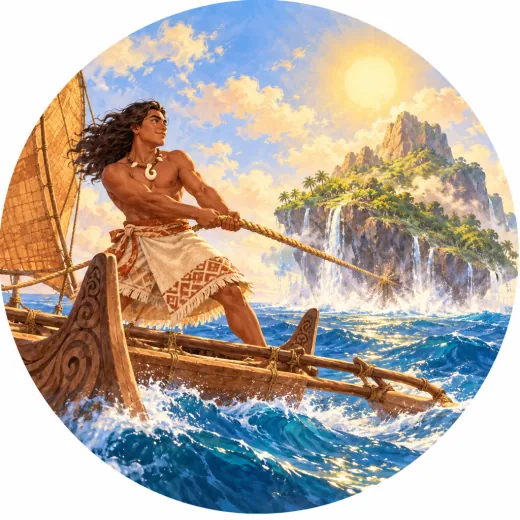
Māui is the great trickster hero of all Polynesia, from New Zealand to Hawaii. With a magic hook made from his grandmother's jawbone, he fished a gigantic fish up from the bottom of the sea: according to Māori tradition it is the North Island of New Zealand. The days were too short, so he caught the sun with a net of ropes and forced it to move more slowly across the sky. In many tales he also manages to bring fire to people. His stories change a little from island to island.
Did you know? In Māori tradition the North Island is called Te Ika-a-Māui, “the fish of Māui”, and the South Island is his canoe.
The story
Māui was born too early, and his mother thought he was dead.
Her name was Taranga, and that day she was on the beach. Weeping, she cut off a lock of her hair, wrapped the tiny baby in it and gave him to the sea. The waves took him. Jellyfish and seaweed covered him, the birds watched over him, and in the end an ancestor, Tama-nui-ki-te-rangi, found him on the shore and took him home. He raised him, taught him the names of the stars, and every name he learned made the boy laugh even more.
When Māui was old enough, he went looking for his family. One evening he arrived at a house where people were singing and dancing. He sat down behind everyone, quietly, among his brothers.
Taranga counted her sons. “I have four,” she said.
“Five,” said a voice at the back.
“Four. The others are dead.”
“I am the fifth, Mother. You gave me to the sea.”
There was a long silence, and then tears. So Māui, the youngest, had his family, and straight away the trouble began.
His older brothers went fishing every morning and never wanted him with them. “You’re too small,” they said. “You bring bad luck.”
Māui let them talk. Then, one night, he took his grandmother Murirangawhenua’s jawbone, a long curved bone as hard as stone, and made it into a hook.
The next morning, when the brothers’ canoe slid into the water, there was a boy lying under the floorboards, his legs pressed against the hull and a hook clutched in his hands. Nobody saw him. They paddled for a long time, until the coast was a blue line. That was when Māui came out.
His brothers stared at him, astonished. “Let’s go back!” shouted one. “I won’t allow it!”
“We’re here now,” said Māui. “And anyway, I need a place at the stern. Paddle, it’s getting late.”
They stayed and listened to him, because there was nothing else to do. Māui punched himself on the nose until it bled, and smeared the blood on the hook. Then he threw it far out, down among the fish. He sang a song softly, his lips barely parted, and from the depths of the sea something bit.
The canoe tipped. The water turned black. The line went as taut as a bowstring, and the brothers, straining every muscle, could not even stay upright.
“Paddle!” yelled Māui. “Paddle! Don’t let go!”
It was not a fish. It was something bigger than any fish. It rose slowly beneath the canoe, huge and flat, and when it came out of the sea it looked like a mountain with shells all over its back.
“Don’t touch it,” said Māui, jumping ashore. “I’m going to the priest, to offer the first part to the gods. You wait. When I come back, we’ll share it out.”
Off he went. The brothers stayed in front of the creature, which was breathing gently, still alive, still warm. Then one said, “Why should we wait? We caught it.” And another: “He’s right.” And another still: “Let’s cut it up.”
They took out their knives and began to cut.
The fish thrashed. It arched, it twisted, it slapped its tail on the water, and wherever the men had struck, its back crumpled and split. When Māui came back, the creature lay still, and it was no longer smooth. It had mountains, valleys, bays, hills, peninsulas. The brothers looked down at their hands in silence.
“There you go,” sighed Māui. “It could have been a nice flat plain. Instead it’ll be uphill all the way.”
Even today the Māori call that island Te Ika-a-Māui, the fish of Māui. The brothers’ canoe, they say, is the island further south.
But Māui had not finished.
Something else annoyed him: the sun. It raced across the sky so fast that the day was over before people had time to cook, and the cloth never dried. Māui gathered his brothers. Together they plaited thick ropes from flax fibre, until they had made a long, strong net. They walked east by night, and hid near the place where the sun rises.
The hours of the night passed slowly. The brothers were shaking, partly from the cold and partly at the thought of what they were about to do. Māui was not shaking. He held the jawbone in one hand and the end of the rope in the other, his eyes fixed on the dark edge of the world.
When the first light appeared, Māui threw the noose. The sun struggled, roared and filled the sky with fire, but the brothers pulled until their hands hurt. Māui struck it with his grandmother’s jawbone until it limped. Ever since, the sun has climbed slowly, and the days last longer.
Fire, too, in the stories, comes by way of Māui. One night, all over the village, the flames went out one after another, and people shivered in the cold, because nobody knew where to find more. Māui knew: fire belonged to Mahuika, a goddess who kept it in her fingernails and lived far away, under the earth.
He found her, and she greeted him with suspicion. “Are you my grandson?”
“I am.”
“Then I will give you a little fire.” She pulled out one of her nails, which burned like a small star, and handed it to Māui. The boy went outside, plunged it into a stream and came back empty-handed. “I dropped it,” he said. Mahuika gave him another. And another. Until she had only one nail left.
Then she understood the game, and anger lit up her eyes. She threw the last nail on the ground, and the ground caught fire. The flames chased Māui across the hills. He turned himself into a bird and flew through the smoke, calling for rain with what little voice he had. The rain came, heavy and cold, and almost all the fire went out. But one spark escaped, and hid inside the wood of the trees. That is why, they say, you can bring it out by rubbing two sticks together.
In Hawaii they say that Māui snared the sun on the summit of Haleakalā, and that it was his mother Hina who asked him to, so that her cloth could dry. The islands change, the names change. The hero is always the same: the smallest one, the one nobody wanted in the boat, who with a hook, a rope and a great deal of cheek pulled up a world.
A living tradition, told with respect: how we tell myths.
Relatives around the world
Listen / Read next
- Music to read by: Cinematic JourneyEpic film-style music, no lyrics, by Ciro Simone IrmiciSpotifyYouTube Music
Sources
- George Grey, Polynesian Mythology (1855)
- Te Ara, the Encyclopedia of New Zealand
