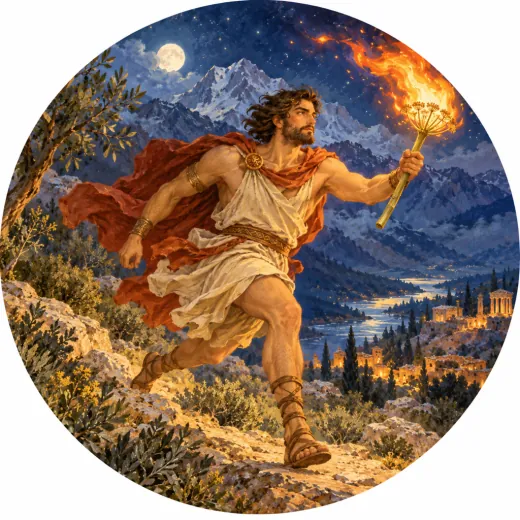
Prometheus
Promēthéus, “the one who thinks ahead”
a little scary
Prometheus was a Titan who cared about human beings. According to one myth he had even shaped them himself, out of clay. When Zeus took fire away from people, Prometheus secretly stole it from the gods, hid it inside a hollow reed and brought it back to earth. With fire, humans learned to cook, to keep warm and to work metals. Zeus punished him by chaining him to a mountain in the Caucasus, until the hero Heracles came to set him free.
Did you know? His name means “the one who thinks ahead”, and his brother Epimetheus, who married Pandora, was “the one who thinks afterwards”.
The story
In the beginning, human beings were cold.
Not the cold of a winter evening, when you put on another blanket. Real cold, the kind that gets into your bones and never leaves. They lived in caves, huddled against one another, with animal skins over their shoulders and their teeth chattering. They ate raw meat and bitter roots. Night was a black hole in which something, every now and then, growled.
In those days, only the gods had fire.
And among all the Titans, the ones from the old race that had lost the war against Zeus, there was one who looked at human beings with tenderness. His name was Prometheus. His name means “the one who thinks ahead”. His brother Epimetheus, on the other hand, was called “the one who thinks afterwards”, and he was the one who caused all the trouble.
Some stories say that Prometheus had made humans himself, out of clay and water, breathing into their bodies while they were still soft. Others say he had simply found them already alive. On one thing nobody has any doubt: he loved them, the way a craftsman loves the things he has made with his own hands.
One day, at Mecone, where gods and humans had gathered to decide how to share out the sacrifice of a great bull, Prometheus had an idea.
He cut the animal up and made two piles. In one he put the good meat, with the skin on top, hidden inside the stomach, which looked ugly and slimy. In the other he put the bare bones, covered in white, shiny fat, which looked rich. “Zeus,” he said, “you choose the gods’ share.”
Zeus looked. They say he saw straight away that there was a trick, but he chose the pile with the fat anyway, and found the bones. He was a king too proud to back down. From that day on, the gods had only the smoke and the bones of sacrifices, and humans kept the meat. But Zeus was furious, and the anger of a god is not forgotten.
And to take his revenge, he hid fire away.
All of a sudden, in every house and every cave, the flames went out. The smoke rose into the sky and never came back. Humans were left in the dark, in a winter longer than all other winters, rubbing their hands together.
Prometheus could hear them.
From high on the mountain, he could hear them coughing and shivering. One night, while everyone was asleep, he climbed up towards the home of the gods. He had only one thing with him: a hollow reed, a long stalk of giant fennel, the kind that grows in the meadows.
He crept up to the forge of Hephaestus, the god of metals. There, at the back, under the ash, an ember was glowing.
He took one spark from it. Just one, tiny and red. He put it inside the reed and hid it under his cloak. Then he slipped back down, without being seen, while his heart hammered like a smith’s hammer.
When he reached the earth, in a cave in the middle of the snow, he blew gently. A little flame, small and trembling, came alight. It climbed onto the dry wood, grew bigger, crackled.
The humans woke up, one after another. They came closer, curious, with their hands held out. And for the first time, they felt warmth.
With fire they learned to cook their food. To keep warm, to keep the wolves away, to light up the night. Later, to melt metals, to make swords and ploughs, pots and wheels. Civilisation was beginning.
Zeus noticed the next morning.
Far away, down below, he saw a thin column of smoke, then ten, then a hundred. His eyes flashed. The thunderbolts trembled between his fingers.
“Who did this?”
Nobody answered. But he knew.
Prometheus was brought before the throne. He did not bow his head. “Yes, it was me,” he said. “I couldn’t let them die of cold.”
The punishment was terrible. Zeus ordered him to be chained to a rock at the top of the Caucasus, where the wind cut like a knife. There, every day, an enormous eagle would swoop down from the sky, tear open his side and eat his liver. Every night, the liver would grow back. And every morning, it would all begin again.
No mortal could have survived it. But Prometheus was immortal, and his sentence would last forever.
Days went by. Years went by. Many, many centuries went by, the poets say, in the cold, under the sun and under the stars, with the chains scraping against the rock. Every so often, from on high, Zeus sent a messenger to ask him, “Will you beg for forgiveness?” And Prometheus, his face hollow and his eyes bright with pain, answered every time: “No.”
Meanwhile, because of the stolen fire, Zeus sent human beings another punishment too: a beautiful woman, Pandora, with a jar that must not be opened. But that is another story, and someone has already told it.
One day, an enormous hero arrived at the top of the Caucasus, with a lion skin over his shoulders and a club in his hand. It was Heracles, the son of Zeus himself. He was on his way to another adventure, and he stopped when he heard the eagle’s cry.
He raised his bow. A single arrow.
The eagle fell from the sky with a shriek and never rose again. Heracles broke the chains with his bare hands, and with the blessing of Zeus, who after so many centuries had perhaps stopped being angry, he set the Titan free.
Prometheus stood up, slowly, his legs trembling. He looked at the valley, the clouds, the sun. And he smiled.
Ever since then, whenever someone lights a candle, a fireplace or a stove, for a moment he is there in that flame too. The Titan who thought ahead. The one who, for the love of fragile, frozen creatures, agreed to suffer forever.
Relatives around the world
Listen / Read next
- Music to read by: Cinematic JourneyEpic film-style music, no lyrics, by Ciro Simone IrmiciSpotifyYouTube Music
Sources
- Hesiod, Theogony and Works and Days
- Aeschylus, Prometheus Bound
