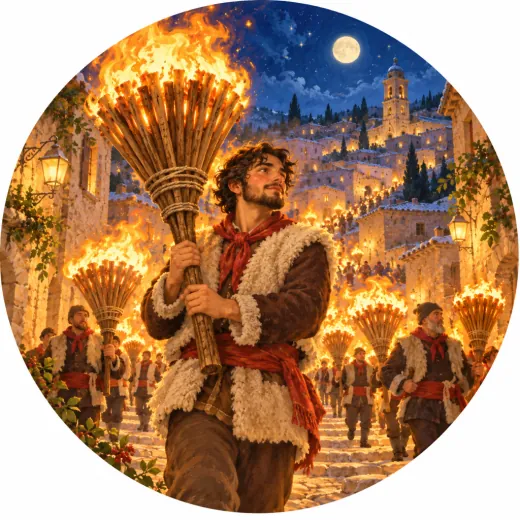
The 'Ndocciata of Agnone
the “'ndocce”, the torches
not scary at all
On Christmas Eve, in Agnone, a river of fire flows down the streets. It is made of many “'ndocce”, big fan-shaped torches of fir wood, each with many flames, carried on the shoulders of the people of the town's districts. Where this custom comes from nobody knows for sure. Many think of ancient fire rites for the longest night of the year; over time the torches became the light of Christmas, the light farmers used to walk down to church.
Did you know? A single 'ndoccia can have up to twenty flames burning at once.
The story
On the evening of the twenty-fourth of December, in Agnone, a village of fewer than five thousand inhabitants, darkness comes early. In the alleys, the windows light up one after another, and the air smells of cold, of wood and of bread.
But this is not an evening like the others. Something is waiting for its moment, well hidden under the sky that is turning black.
Then, from far away, a glow.
At first it looks like a fallen star at the end of the street. Then another. Then many. From the districts, small moving lights begin to advance, and that movement has a rhythm, like breathing. Some say you see it coming before you even hear it.
Then, in the street, there is the fire.
These are the 'ndocce. The torches of Agnone. Each one is a kind of tree of fire: a bundle of fir wood, up to six metres tall, opened like a fan, with one or more arms. Some have up to twenty flames burning together. They are made by hand, of fir and tow, by families who hand down this art from generation to generation: fathers teach it to their sons, as if it were a language.
The men of the village carry them on their shoulders, dressed in traditional clothes. Every step is an effort. The flames are high up, straight into the dark, and the heat reaches your face even from a distance. You hear the fire puffing, the wood crackling, the heavy tread of the bearers on the paving.
And it is not one person alone. There are many. They come from five districts, from five different parts of the village, and each has its own torches. They set out from the outskirts, go down, go up, draw near to the centre. From each district its river of fire flows towards the same point.
A child, on his father's shoulders, watches everything with his mouth open. The fire is reflected in his eyes. He thinks, perhaps, that the village has turned into one long flame that walks. He is right.
As they pass, people stop. Some applaud, others stay silent. Everyone feels the same thing: that this light, on this night, has weight.
Because where it comes from, nobody quite knows. That is the beauty of it, and the mystery too.
Many think it is a very ancient custom, from before even the Romans. It is said that the Samnites, the people who lived in these lands, began it, though no document proves it: the first written records of the festival date from the nineteenth century. For them, and for many peoples, the night of the winter solstice, the longest of the year, was a difficult night. The sun seemed to vanish. And so fire was lit: to give light, to protect, to tell the sun to return. Fire purified, brought rebirth.
Then time passed, religions changed, and the rite remained. With Christianity, fire took on a new meaning: the light of the birth of Jesus. And after the eighteenth century, the story goes, peasants began to carry torches towards the churches, on Christmas night. Those torches lit the dark road, but they were also a way of saying: we are coming.
That is why, even today, the 'ndocce are the light of Christmas in Agnone.
The procession advances, and the sound changes. It is no longer only the crackling. You hear voices, the pace growing faster, the drums of the heart. All around, people's faces are lit by the orange light, and each face seems younger, more alive.
At last, the square.
The five processions arrive there, from different streets, and merge. The 'ndocce draw close to one another, forming a single great forest of flames. And then, in the middle of the square, there is the bonfire. The torches are thrown into the fire, one after another, and the bonfire climbs high, very high. Some call it the Falò della Fratellanza, the Bonfire of Brotherhood. With it the village begins to celebrate.
People crowd round, warm their hands, embrace. Whoever is cold comes closer. Whoever was afraid of the dark does not feel it now.
This fire no longer belongs to Agnone alone. Every year the tradition is repeated in December too, around the feast of the Immaculate Conception, and sometimes the fire has left the village so that others could see it. One time, in Rome, in Saint Peter's Square, on the eighth of December 1996: offered to Pope John Paul II for the fiftieth anniversary of his priesthood. Another in Assisi, on the third and fourth of October 2011, on the forecourt of the basilica of Santa Maria degli Angeli. Another in Milan, on the twenty-sixth of September 2015: about five hundred torches carried by a hundred and thirty-five 'ndocciatori, which lit up the Darsena and the Navigli canals.
In 2011 the 'ndocciata received a recognition as "Heritage of Italy for tradition"; today the festival aspires to that of UNESCO, as intangible heritage of humanity. A similar version, slightly different, is also held at Civitanova del Sannio.
But the truth is that the only recognition that counts is the one they receive every twenty-fourth of December, when the lights come down from the hills and the village becomes, for one night, a river of fire.
And it seems a simple thing: a fire, a street, a community walking together.
And yet, when you think about it, it is almost everything that is needed.
Listen / Read next
- Music to read by: Cinematic JourneyEpic film-style music, no lyrics, by Ciro Simone IrmiciSpotifyYouTube Music
