The Devil of Tufara
“lu Diavule”
scary
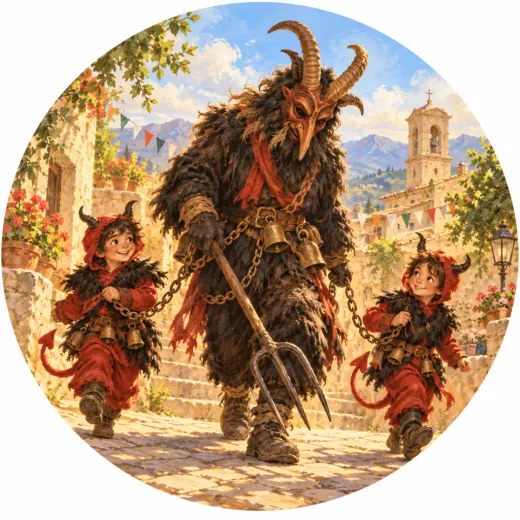
On the last day of Carnival, in Tufara, the devil runs through the streets of the village. He is a man dressed in black goatskins, with a frightening mask and a pitchfork in his hand. He is held in chains by some goblins, who drag him along and now and then let him loose among the people. With him walk figures dressed in white with floured faces, representing Death. It is the struggle between good and evil, and the passage from winter to spring: at the end it is the Carnival puppet that is tried and sentenced, and then thrown down from the cliff.
Did you know? According to those who tell its story, the costume of the Devil of Tufara was once made of seven goatskins.
The story
On the last day of Carnival, in Tufara, the village seems normal up to a point.
The doors of the houses are open, someone is making coffee, someone is laughing in the street, a child is running after a dog. But there is a strange air, as before rain. Whoever was born here recognises it. They know that somewhere, among the stone houses, something is on its way.
First you hear a sound. Chains. Far away, then closer, dragging on the paving.
Then you see the first of them. Their faces are covered in flour, and they are all dressed in white. Like ghosts, or like something worse. They walk in front of the others, a few metres ahead, and swing great scythes in circles, slowly, as if to cut the air. They are Death.
They say nothing, but they leap and shout, and the people move aside. White and floured, they seem to have come from a place where life is no more. The scythes pass close to the face, a hand's breadth from the shoulder. Someone laughs, but it is a nervous laugh.
Because behind Death, now, he arrives.
The Devil of Tufara.
He is black. All black, covered in skins that look still alive, and that give him a shaggy, wild look, half man and half beast. It is said that he wears seven of them, goatskins. The mask is black too and has the features of a goat: ears, muzzle, empty eyes. In his hand he holds a trident. When he moves, the tufts of fur sway as if the wind were under his skin.
He is in chains.
The chains grip his waist and some guardians hold them, pulling. They are the imps. They drag him along the streets, and he seems not to want to be there. He leaps, lunges forward, tugs at the chains until he almost frees himself. Then he falls to the ground. He rolls in the dust, gets up, runs. People step back against the walls.
The fear is not fake. For a second, when he passes beside you, you find yourself thinking that this time the chain will not hold.
The Devil does not try to hurt anyone. He tries to seduce. He stops in front of a person, stares at them from the black mask, as if to say: come with me. He wants to bring them among his followers, to initiate them into his mysteries. And the person, sometimes, smiles, sometimes runs away. Someone stays there, motionless, as if glued to the paving, until the chains pull him away.
And the Devil sets off again, with a leap, towards the next. You hear the steps on the tufa, the short breaths of the imps pulling, the shouts of Death clearing the way. From the windows, people lean out to watch. Nobody pulls back completely.
The smallest children hide behind the grown-ups' legs. The bigger boys pretend not to be afraid, and show it all the same.
They say, in Tufara, that this mask is very ancient. The pages of those who look after it tell that in the beginning it was not the devil of the Christians, but something far older: the passion and death of Dionysus, the god of vegetation, who died every year and every year was renewed. The goat was the animal in which, it was said, he liked to appear. That is why the Devil wears seven goatskins. When Christianity came, the sacred rite became a Carnival mask. Its ancient meaning, in part, has been lost.
And the scythes of Death? They say they recall the harvest. The seed dies in the earth, is purified, and in spring returns as crop.
Meanwhile the procession goes on. Death in front, the Devil dragged along, the chains, the shouts, the leaps. The whole village moves with them, as in a dance that has a precise place to go.
Because the Devil is not the real protagonist of the day. There is someone else who must answer for everything.
It is a puppet. A puppet of straw and cloth, that represents Carnival, with all its vices, its jokes, its chaos. The Devil, in this rite, is the scapegoat: the one on whom the village unloads what it does not want to carry with it.
The puppet is put on trial. A cheerful jury listens to it. The Mother and the Father are also present, and they defend it in a tragicomic way, like two desperate parents in a courtroom. Someone smiles. And yet the verdict is already written.
They condemn it.
The silence, now, is heavy. The puppet is carried to the tufa cliff, the one that is the symbol of Tufara, the very symbol of the village.
Then they hurl it down.
There is nothing horrible in that act: it is straw, it is cloth. And yet people look down, and for an instant nobody speaks. With that fall, the merriment, the jokes, the disorder of Carnival come to an end, and the feast ends too.
But it is not really the end. One figure is still there, among the people. It is the Mother-Fate, and in her hand she has a distaff and a spindle, the tools of one who spins time. She already has a new newborn of cloth ready, a new effigy, which will take the place of the one that fell. What dies returns: so the rite goes on.
The next day Lent begins.
And the Devil of Tufara, black and tired, takes off his mask and becomes once more a man of the village.
Relatives around the world
In the trails
Listen / Read next
- Music to read by: Cinematic JourneyEpic film-style music, no lyrics, by Ciro Simone IrmiciSpotifyYouTube Music
