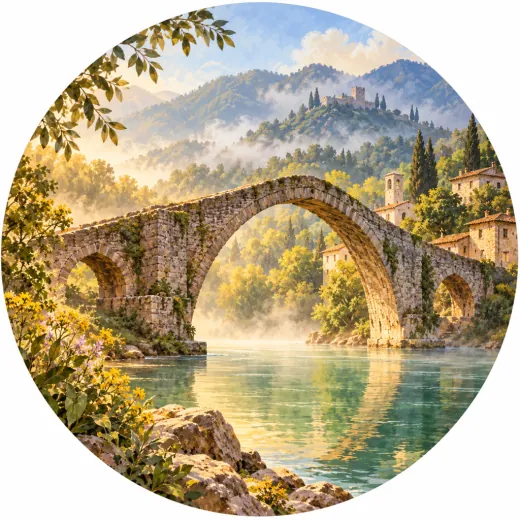
The Ponte del Diavolo of Borgo a Mozzano
the Devil's Bridge, also called Ponte della Maddalena
a little scary
Over the river Serchio stands a strange medieval bridge, with a very high, lopsided arch: the Ponte della Maddalena, better known as the Ponte del Diavolo (the Devil's Bridge). The legend says the master builder could not finish it and made a pact with the devil: the bridge would be ready in one night, in exchange for the first soul to cross it. Full of regret, the builder asked the parish priest for help, and in the morning they sent an animal across first. Tricked and furious, the devil threw himself into the river and vanished. The bridge, on the other hand, is still there.
Did you know? The bridge is more than 90 metres long and has a “donkey's back” shape, with a big central arch and three smaller arches, all different from one another.
The story
Whoever arrives at Borgo a Mozzano, in the Lucca area, and looks at the river Serchio, sees at once something that does not look right.
It is a bridge, more than ninety metres long. But it is not like other bridges. It has an enormous arch, more than eighteen metres high, which rises like a donkey's back, and then drops suddenly. The other arches, beside it, are small and crooked, as if made by another builder in another year.
The old people of the place say there is a reason. That the bridge was not built by one man alone.
A long time ago, in the days when people spoke of Matilda of Canossa and her lands, a master builder was given the task of making a bridge over the Serchio.
An impossible job. The river was wide, the water deep, the banks unstable. Every time the master builder set a stone, the current carried it away. Months passed. The workmen began to look at one another with distrust. The lord who had ordered the work asked when it would be finished, and the master builder did not know what to answer.
One evening, as the sun went down behind the mountains, he sat on the bank and stared at the river.
He was tired. He no longer knew whom to ask for help.
"A bad business," said a voice near him.
The master builder turned. A few steps away, standing among the reeds, was a man dressed in dark clothes. He had not been heard arriving. His face was ordinary. Perhaps too ordinary. He had the smile of someone who already knows how it will end.
"I can help you," said the stranger. "The bridge will be ready by tomorrow morning. All of it, from start to finish."
"By morning?"
"In one night. In return I want just one thing."
"What?"
"The first soul that crosses it."
The master builder said nothing. He knew who stood before him, and knew it at once, because he felt his blood run cold. But he thought of the lord, of the river, of the months wasted. He thought of himself, of what would happen if he failed.
"All right," he said.
It took a moment. The stranger smiled, and vanished in the fog of the river.
The master builder went home. He did not eat and he did not sleep. He paced back and forth all night, and heard from the river a noise never heard before. It was not the Serchio. It was stone on stone, a beating, a chiselling, the sound of a thousand hands working together without a voice.
Towards dawn remorse grew stronger than fear. He thought of whoever would cross the bridge first, unaware: perhaps a child, perhaps his wife. He could not do it. He could not.
He ran to the village priest. He had the eyes of someone who has not closed them all night.
"Father," he said. "I have done something terrible."
He told everything. The priest listened without interrupting. When he had finished, he stayed silent a moment, then stood up.
"A pact is a pact," he said. "But he spoke to you of the first soul. He did not say it must be a Christian."
The master builder looked at him.
"A beast is a beast," added the priest. "Does the devil want a soul? Let him take that."
They looked at each other. Then, little by little, both smiled.
At dawn the bridge was there. Perfect, immense, shining with dew, with the high arch riding the river like a hump of stone. The workmen stood open-mouthed. The lord asked no questions. On the other bank, among the reeds, someone was waiting in silence.
The devil.
He stood there, arms crossed, looking at the bridge and looking at the master builder. He no longer smiled, he waited.
"Well?" he said. "Who crosses first?"
The master builder did not answer. He made a sign.
From the village, driven by a boy with a wicker switch, came a pig. A fat, pink, calm pig, who knew nothing and trotted happily among the stones, sniffing the ground. He climbed onto the bridge. He crossed it all, from one side to the other, grunting with pleasure.
The devil watched him pass.
He understood at once. His face changed. His eyes became embers, his mouth twisted. A pig. A night's work, for a pig. They had mocked him, and in front of everyone.
He screamed. It was not a human cry. It made the poplars shake and sent the birds fleeing. Then, in an instant, he leaped from the bridge and threw himself into the Serchio, which closed over him with a long, dull splash.
The river went on flowing. Nothing more was seen.
Some, in other versions of the tale, say the animal was a dog. Others, that it was Saint Julian who tricked the devil with a piece of focaccia. The rest is the same: a pact, a trick, a devil who goes away empty-handed.
The bridge, though, has remained.
Over the centuries it has changed. It is said to have been restored by Castruccio Castracani, between the thirteenth and fourteenth century; that a writer, in the fourteenth century, Giovanni Sercambi, put it in a tale. Since the sixteenth century it has been called the Ponte della Maddalena. In 1836 a flood of the river damaged it badly. But it is still standing, beautiful and crooked, with its very high arch that seems to want to reach the sky.
And the local people still call it by the name everyone knows: the Ponte del Diavolo, the Devil's Bridge.
Relatives around the world
In the trails
Listen / Read next
- Music to read by: Cinematic JourneyEpic film-style music, no lyrics, by Ciro Simone IrmiciSpotifyYouTube Music
- The words of the dialect: FlorentineNonnese, the dictionary of Italian dialects
