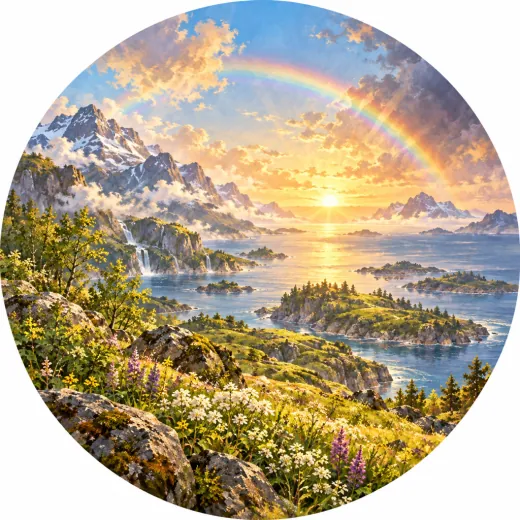
Ragnarök
Ragnarøkr, the fate of the gods
scary
The Norse myths also tell how the world will end. First will come a very long winter, then wolves will swallow the sun and the moon. Heimdall will blow his horn, and gods and giants will meet in the last great battle: Odin against the wolf Fenrir, Thor against the serpent Jörmungandr. Fire will burn everything and the earth will sink into the sea. But it is not the end of everything: afterwards the earth will rise from the waters again, green and new, and some gods will start over.
Did you know? A human couple, Líf and Lífþrasir, survive the end of the world by hiding in the wood of Hoddmímir.
The story
The seeress opened her eyes and looked at Odin.
The father of the gods had called her up from the depths of the earth, because he wanted to know. He had already left one of his eyes in Mimir's well in exchange for a sip of wisdom, but it was not enough for him. He wanted to know the end.
“Do you really want to hear it?” asked the seeress. “Then listen.”
She began at the beginning of the end. The first sign would be the cold. Not the cold of a single winter: three winters, one after another, with no summer in between. The Great Winter, it was called. Snow would fall from every side, the wind would cut like a blade, and the sun would warm no one any more. And in the dark, people would stop trusting one another: brothers would fight brothers, and nobody would spare anybody.
“Then the wolves will come,” said the seeress.
Since the beginning of time, two wolves had chased the sun and the moon across the sky. On that day they would catch them. One bite, and the light would go out, and the stars would drop from the sky like apples from a shaken tree. The earth would shake so hard that mountains would split and trees would crash down, and every chain, every bond, every knot would come undone.
“Even the wolf's,” said the seeress.
Fenrir would rise from the island in the middle of the lake, free. He would open his mouth: his upper jaw would touch the sky, his lower jaw the earth, and the sword that had once kept it wedged open would be of no use at all. Meanwhile the serpent Jörmungandr, writhing with rage, would rise from the bottom of the ocean, and the sea would follow him and pour over the fields. From the east a ship would come, Naglfar, built from the nails of the dead and loaded with giants.
Odin said nothing. Every word fell into the hall like a stone into a very deep well, and no sound came back up.
From the east, along with the giants, would come Loki too, free of his chains, with all the people of Hel. The tree Yggdrasil, which holds up the nine worlds, would groan from top to bottom. And three cockerels would crow in the dark: one among the gods, one among the giants, and a third, the colour of rust, in the halls of the dead.
The rainbow bridge, Bifröst, would break under the weight of the sons of fire, who came from the south. At their head would march Surt, with a sword brighter than the sun. And Heimdall, the watchman of the gods, would climb to the highest point and blow his horn.
“It will be heard in all nine worlds,” said the seeress. “You will hear it too.”
Odin would ride to Mimir's well to ask for one last piece of advice, and no one would ever know what answer he was given. The gods would arm themselves. Odin would put on his golden helmet and take up his spear, and he would lead his warriors to a plain called Vígríd, a hundred leagues wide in every direction. There they would all meet, for the last time.
For every god, an enemy.
Thor, the god of thunder, would face the serpent Jörmungandr, and strike it with his hammer until it died. Then he would take nine steps, and at the ninth he would fall, because the serpent's venom would have reached him. Tyr, the god with only one hand, would fight the hound Garm, and both of them would die. Freyr would try to stop Surt, but long ago he had given away his sword, and he would have no other to defend himself with. Heimdall and Loki would come face to face, and neither would leave the fight alive.
“And me?” said Odin.
The seeress looked at him for a long time.
“You, against the wolf,” she answered.
She said nothing more. There was no need: Fenrir's mouth, touching sky and earth, said it all. Odin would be the first to fall on the great plain, and his son Vidar would avenge his father. Vidar, the silent son, would set his foot on the wolf's jaw and defeat him. But that would bring nobody back.
Then Surt would fling fire across the earth.
The fire would sweep through the nine worlds, one after another. It would burn the houses, the forests, the cities of the giants and the cities of the gods. The smoke would rise up to the sky, and the sky would catch fire. And slowly the earth would sink into the black sea, and there would be nothing left to look at. No sound, no wind, no light: only dark water closing over everything, like water closing over a stone thrown into a pond.
Odin closed his one remaining eye. Inside his chest he felt an ancient heart beating, and for a moment it seemed to him that it, too, was counting the steps that were left.
“Have I finished?” asked the seeress. “No. The best part comes now.”
Because after a very, very long time the earth would rise again from the waters. Green. New. Waterfalls would tumble down the rocks, an eagle would fly above the fish, and the fields would grow grain without anyone sowing them. The sun would have a daughter, as bright as her mother, and she would ride across the sky in her mother's place.
Some of the gods would still be there. Vidar and Vali. Thor's two sons, Móði and Magni, who would inherit the hammer. Baldr, the good god, and his brother Höd would return from the kingdom of the dead and sit on the grass together, remembering. And two human beings, Líf and Lífþrasir, who had hidden in the wood of Hoddmímir during the fires and lived on the morning dew, would wake among the trees and see an earth with no one on it. From them all the people of the future would be born.
The seeress stopped speaking. The silence in the hall was so thick you could touch it.
“Now I must go back down,” she said.
And she sank into the earth.
Odin was left alone. He knew now where his story would end, and how, and by whose hand. He could have refused to believe it, or run away, or asked again. He did none of those things.
He stood up, took his spear and began to prepare his warriors.
Relatives around the world
Listen / Read next
- Music to read by: Cinematic JourneyEpic film-style music, no lyrics, by Ciro Simone IrmiciSpotifyYouTube Music
Sources
- Poetic Edda, Völuspá
- Snorri Sturluson, Prose Edda, Gylfaginning
