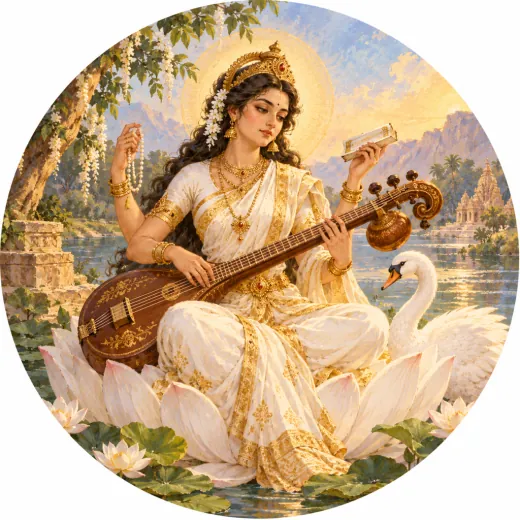
Saraswati
Sarasvatī, in Sanskrit
not scary at all
Saraswati is the goddess of knowledge, music, the arts and speech, revered by students, musicians and artists. She is shown dressed in white, seated on a white lotus or beside a swan, playing the veena, a large stringed instrument. In the oldest texts of India, the Vedas, Saraswati is also a sacred river, praised as the best of rivers. Her festival, Vasant Panchami, comes at the beginning of spring: in many families children write their very first letters on that day.
Did you know? Through Buddhism she travelled as far as Japan, where she is revered under the name Benzaiten, protector of music.
The story
On a morning at the end of winter, in a house in India, a little girl sits on the floor with a plate of uncooked rice in front of her.
She is dressed in yellow, the colour of the coming spring. Beside her is her grandmother, and in front of them, on a small altar, is the statue of a goddess with a veena in her lap. All around, scattered on the rugs, are the family's books: school books, old books, song books, a notebook not yet opened.
“Today we begin,” says her grandmother. “Use your finger. Do what I do.”
With her finger, the girl traces her first letter in the rice. It isn't hard. It's only a line and a curve. But her grandmother watches her the way you watch something being born.
It is the day of Vasant Panchami, Saraswati's festival. The day when, in many homes, children learn to write. The books are resting too: the evening before, they were placed at the goddess's feet, and nobody will open them until tomorrow.
“Grandma,” the girl asks, “why her?”
Her grandmother smiles. And she begins the story with the river.
Long ago, in the north of India, there was a river called the Sarasvati.
It came down from the mountains with all its water and flowed as far as the great sea, or perhaps a great lake. On its banks lived the tribes of the poet-priests. Every morning, before the sun was high, they sat beside the current and sang. They did not sing for fun. They sang to ask for rain, to ask for harvests, to praise the gods and the rivers that kept them alive.
The herds came down to drink, children ran about in the shallows, and the singers' voices rose together with the smoke of the first fires.
We still remember those songs, because they are the oldest in India: the hymns of the Rig Veda. And among those hymns are some dedicated to her.
“Best of mothers,” they sang. “Best of rivers. Best of goddesses.”
And again: “A pure stream flows from the mountains to the sea.”
To them the river was not simply water. It was something that gave bread, but also words: words for praying, for remembering, for passing on to their children what they knew. The water gave life, and the song made that life alive. In another hymn they prayed to her to purify them, and to inspire the right thoughts in those who speak.
The girl listens without moving.
“Then what happened?”
Then, says her grandmother, the river began to change.
The years went by. The rains were no longer the same. The tribes moved east in search of greener lands, and little by little the river grew small. One summer the water no longer reached the sea. Another summer it no longer even reached the plains.
The great poem of the Mahabharata remembers a man, Balarama, who one day decided to walk the whole length of the Sarasvati to visit its holy places. And it tells how, at a certain point, at a place called Vinasana, the current stopped. It was lost in the desert sand, as if the earth had drunk it.
“Did it die?” the girl asks.
“No,” her grandmother answers.
It is said that it still flows beneath the earth, where nobody can see it. That at Prayag, where the Ganges and the Yamuna meet, she is there too, invisible, making three rivers, and that this is why the place is so holy.
Some people say it is only a story. Scholars still argue about which river was really hers: perhaps today's Ghaggar-Hakra, which is dry in many places now, although many people now think this unlikely. Nobody is sure. But the grandmother does not worry about it.
“A river can vanish from the maps,” she says. “What it gave cannot.”
“What did it give?”
“Think of the words you use every day. Somebody said them first, and somebody taught them to somebody else, and then to someone else again, all the way to you. That is a stream too, and it has never stopped.”
And so, she says, the river became something else.
The sages who sang on its banks went on singing, even when the banks had moved. In later texts, the goddess Sarasvati became the Word, the voice that speaks the names of things. Without her, songs cannot be taught, books cannot be written, you cannot even say thank you. Then people began to portray her: a woman dressed in white, seated on a white lotus. Beside her, a swan, which is said to be able to separate milk from water, which means to tell the true from the false. In her arms, a veena, a large stringed instrument, which she plays calmly.
She wears no showy jewels. She carries no weapons. What she holds in one hand is a book, and in another a string of beads, used for counting prayers.
That is why students turn to her before an exam, musicians before a concert, artists before they begin a work. And that is why children, at Vasant Panchami, write their first letter. Not because it is the most important, but because it is the first of many.
In faraway countries she has been known by other names too. In Japan, arriving by way of Buddhism, she became Benzaiten, the protector of music.
The girl looks at the rice, where her first letter is. Then she looks at the statue, with its veena and its swan.
“Grandma, can she hear us?”
Her grandmother does not answer straight away. She thinks about it, the way you think about a serious question.
“They say that anyone who studies honestly, and anyone who sings from the heart, has already spoken with her,” she says at last. “Now do the second letter.”
The girl holds out her finger.
Outside the window, in an ordinary street, someone begins to play music.
A living tradition, told with respect: how we tell myths.
Relatives around the world
Listen / Read next
- Music to read by: Cinematic JourneyEpic film-style music, no lyrics, by Ciro Simone IrmiciSpotifyYouTube Music
Sources
- Rig Veda, hymns to Sarasvati
- David Kinsley, Hindu Goddesses, University of California Press (1986)
