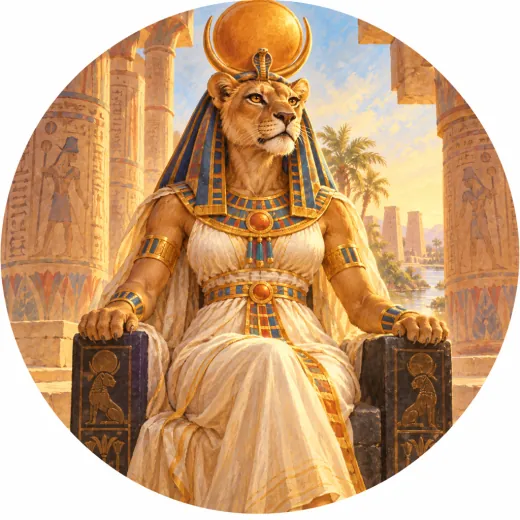
Sekhmet
Sḫmt, “the powerful one”
scary
Sekhmet was a goddess with the head of a lioness, mighty and fearsome. A myth tells that people had stopped respecting the old sun god, and he sent his fiery eye down to earth, in the form of a lioness, to punish them. But Sekhmet ran wild and nobody could stop her any more. So the gods dyed huge amounts of beer red and poured it over the fields: she saw her own lovely face in the red water, drank it and liked it: she fell asleep and calmed down. In Egyptian tradition Sekhmet could send diseases, but also heal them.
Did you know? Pharaoh Amenhotep III had hundreds of statues of Sekhmet carved; some of them are now in the Egyptian Museum in Turin.
The story
The sun grew old.
It happens even to gods, at least to those who live among humans. Ra, who had created humans and ruled them from the sky, now had bones of silver, flesh of gold and hair of lapis lazuli, and he walked slowly, like someone carrying the weight of every day he has ever lit.
Humans noticed.
At first it was only a whisper in the courtyards at evening. Then it was a bolder voice in the taverns. “He’s old,” they said. “He can’t see well any more. He can’t hear. Why should we obey a tired king?” Some began to put weapons aside, to choose their companions, and to look up at the sky without lowering their eyes.
Ra heard everything. The sun hears what is said beneath it, even in a low voice.
He called the gods to council. Nun came, father of the waters, who had existed before everything, and Shu, and Tefnut, and Geb, and Nut. They sat down in silence.
“Humans, who were born from my eyes,” said Ra, “have decided to strike at me. Tell me what I should do. I do not want to kill them before I have heard you.”
Nun spoke softly, in the voice of deep water. “Send your Eye. Let it fall upon them. No one can stand against your Eye.”
And so it was. The Eye of Ra came down from the sky, took the form of a goddess with the head of a lioness, and was called Hathor. But soon she had another name. The new one meant “the powerful one”: Sekhmet.
Humans understood that very day that they had made a mistake.
House doors were left open, ovens still lit, looms stopped halfway through the work. Mothers took their children by the hand and did not look back. Those who had talked loudly now said nothing.
They fled towards the desert. They ran to the hills, where the rocks are red, and hid behind stones and in ravines. It was no use. Sekhmet hunted them without hurrying and without tiring. First came the silence: birds that stopped singing, dogs that no longer barked. Then a breath, huge and steady, among the rocks. Then nothing more.
There is no need to tell what she found. It is enough to say that when the goddess came back in the evening, the desert had changed colour under her feet. For many nights she walked through red up to her knees, and every dawn she began again.
From on high, Ra watched. And at a certain point, his heart could bear no more.
“Enough,” he said. “Stop. I have seen enough. My heart is too weak to keep watching.”
Sekhmet raised her head. Her eyes were golden, and they seemed to see no one.
“By your life,” she said, “I have overpowered humans, and it pleased me.”
Then Ra understood that the Eye was no longer his. When he sent it out he had let it go, and there was no way to call it back. The lioness born from his gaze would not stop as long as there was anyone left to hunt.
He needed an idea. Just one, and fast.
Ra called for messengers, the swiftest, who run like the wind. “Go south to Elephantine,” he said, “and bring me as much red ochre as you can.”
The load arrived at Heliopolis. The priests ground it into a fine powder. At the same time the servant women were making beer from barley, a great deal of beer, in seven thousand jars. When it was ready, the red powder was stirred in, and the beer, which had been the colour of honey, turned the colour of blood.
Ra came to look, together with all the gods. He gazed at the jars one by one, and for the first time in days he almost smiled.
“How beautiful it is,” he said. “With this I will save humankind.”
That night, while the lioness rested, the beer was carried out to the fields. Jar after jar was poured out in the dark, until the fields were flooded three palms deep, in a flat red lake that glimmered faintly under the stars. Nobody spoke. The gods worked with their torches held low, so the light would not wake the lioness, and the only sound was the red water running between the furrows.
At dawn, she came.
She came from the desert with the first sun behind her, at a slow pace, her tail brushing the dust, her paws heavy. She stopped at the edge of the fields. In front of her lay still red water, and in it, very clear, there was a face.
It was her own. Sekhmet had never looked at it. It was a beautiful face.
She bent down. She sniffed. Then she began to drink.
She drank a little, then more. After a while she could no longer stand up straight. Her tail slowed. Her eyes half closed. She walked through the red water, swaying left and right, and from far away the people hiding among the stones heard her laughing softly, the way you laugh when you no longer know why.
When she came out of the fields she no longer recognised anyone. She passed a woman hiding behind a wall and did not see her. She lay down on a warm stone and slept. She slept a whole day and a whole night, while around her people crept out of hiding in small groups, not daring to come close, and watched from afar that slow breathing that raised and lowered her flank.
When she woke up, she was someone else.
Ra was waiting for her at the edge of the fields, his hands empty. “Come in peace,” he said, “come in peace, beautiful one.”
That, they say, is how the beautiful women came to be. And that is how a festival was born: every year, on the day of Hathor, sweet beer was prepared in the temples, in as many jars as there were priestesses of the goddess.
But those who knew her well never forgot her lioness face. In Memphis they still called her the Powerful One, and in the homes of people afraid of illness there were little statues of her, because whoever can send a sickness can also cure it.
And in the temples, when the red beer passed from hand to hand, nobody forgot where it came from.
Relatives around the world
Listen / Read next
- Music to read by: Cinematic JourneyEpic film-style music, no lyrics, by Ciro Simone IrmiciSpotifyYouTube Music
Sources
- Book of the Heavenly Cow, tombs in the Valley of the Kings (New Kingdom)
- Geraldine Pinch, Egyptian Mythology, Oxford University Press (2004)
