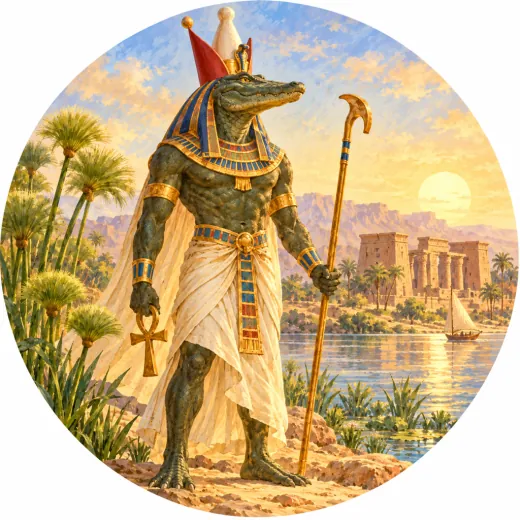
Sobek
Sbk, in Egyptian
a little scary
Sobek was the crocodile god, lord of the Nile and its waters. Crocodiles were frightening, and that is exactly why the Egyptians asked Sobek to protect them when they fished or crossed the river. He was also linked to the Nile flood, which made the fields fertile. In some towns sacred crocodiles were kept in the temple lakes: the Greek historian Herodotus says he saw some wearing gold earrings and bracelets. At Kom Ombo Sobek had a double temple, which he shared with the god Horus.
Did you know? Next to the temple of Kom Ombo there is a small museum with dozens of mummified crocodiles found in the area.
The story
In the river, in the evening, there are eyes.
Anyone who lives on the Nile learns it as a small child. You don’t see them unless you look for them: two dots just above the surface of the water, close together, motionless, like two pebbles. Then one pebble moves. And you realise they were never pebbles.
That summer the river was low and tired, and the flood would not come. Every year, at the right time, the Nile rose and spread over the fields, and when its waters drew back they left a soft black earth where wheat grew almost by itself. But that year the time had come and gone, the river was still the same, and in the villages people looked south, towards where the water came from, and said nothing.
The boy’s father was in bed with a fever. He fished with a papyrus boat and a net, and that day, for the first time in his life, he had not gone out.
“Take the fish,” he told his wife, “the good ones, and bring them to the temple. Ask the priest to pray for the flood. And for me.”
“Who will take them?”
The boy, who was twelve and already had strong arms, stood up. Nobody said no. His mother put bread and an onion in his bag and told him three times not to touch the water with his hands. He promised three times.
The temple stood on the opposite bank, on the high shore, at Kom Ombo, and you could see it from far away, white with stone, its columns heavy with carved flowers. It was a double temple, with two doors and two identical sanctuaries, because in that place two gods ruled together: Horus, the falcon god, and Sobek, the crocodile god.
The boy climbed into the boat with a basket of fish wrapped in wet leaves. He pushed off with the pole. The water was dark green and barely moving.
Halfway across, the sun touched the horizon, and the river turned into a sheet of copper.
That was when he noticed the silence. There was no one left on the banks: no birds, no voices. He stopped, the pole held in mid-air. Ahead of him, a few paces from the boat, were two dots above the water.
They did not move.
The boy held his breath. Everyone had told him you don’t play games with crocodiles, and that nothing is faster than one moving underwater. He thought of his mother. He thought of his father, who could not fish. He thought he ought to drop the basket and row away.
Instead he did something he had not planned. He took a fish from the basket, as long as his forearm, and threw it towards the two dots. “For Sobek,” he said. His voice shook. “Lord of the river. Let me pass.”
The water burst open.
It lasted an instant. A huge grey snout, full of sharp teeth, leapt out, snatched the fish and vanished. A wave lifted the boat and set it down again. Then the river was a mirror once more, and from its middle, slowly, two eyes moved away, heading south.
The boy stayed still for a long time. Then he started pushing with the pole again, and his hands were not shaking quite so much.
The temple priest, a hairless man with skin shining with oil, met him at the door. He took the fish, sniffed it, nodded, and listened gravely to the prayer. Then he led him across the courtyard to a large stone pool where, in the shallow water, a crocodile lay stretched out.
It was old and huge. In its ears it wore two gold rings, and on its front legs two bracelets that gleamed in the sunset. It was so still it looked carved. The priest took a fish from the basket and placed it in front of its snout. The beast opened its mouth with royal slowness.
“He is sacred,” said the priest. “We care for him like a guest. When he dies we will embalm him, as is done for important people, and bury him with respect.”
“He’s frightening,” said the boy.
“Of course he’s frightening. If he weren’t, we wouldn’t pray to him. The ancients said he is the son of Neith and that he has sharp teeth, and they were right on both counts.” The priest smiled. “But today you met a crocodile in the middle of the river, and you got here with both legs. What does that mean?”
The boy thought about it. “That he let me pass.”
“Exactly. Someone with that much strength who holds it back deserves to be thanked. That is Sobek. In the river he is the one who frightens and the one who protects. For fishermen, for those who cross, he is the one who says: go on. And when the Nile rises and soaks the fields, it is he again who opens the doors to the waters.”
Before bed, the priest showed him a room where mummified crocodiles lay in neat rows, wrapped in tight bandages: some as long as a man, others no bigger than a hand. The boy greeted them all, quietly, one by one.
He slept that night in the temple, in a corner of the courtyard, under a mat. He dreamed of two eyes on the water that grew large and green.
A sound woke him. It was a distant murmur, like many people talking softly. He got up and went to the low wall above the river.
The sun was rising. Down below, the water had changed: no longer dark and tired, but a bright, cloudy green, full of life. It was growing. It crept slowly up the banks, sliding in among the reeds, and every moment it seemed bigger.
It was the flood.
The priest was already on the wall beside him, saying nothing. Then the boy heard a shout from the shore, and then others: the villages had seen. Some people were laughing, some were singing. Far out on the surface, a flash of dark back appeared and was gone, heading towards the fields.
The boy went home that same day. His father, in bed, heard the voices from the street, and at last he got up, still weak, and went out to look at the river.
“Well?” he asked.
“He let me pass,” said the boy.
Relatives around the world
Listen / Read next
- Music to read by: Cinematic JourneyEpic film-style music, no lyrics, by Ciro Simone IrmiciSpotifyYouTube Music
Sources
- Herodotus, Histories, Book II (5th century BC)
- Geraldine Pinch, Egyptian Mythology, Oxford University Press (2004)
