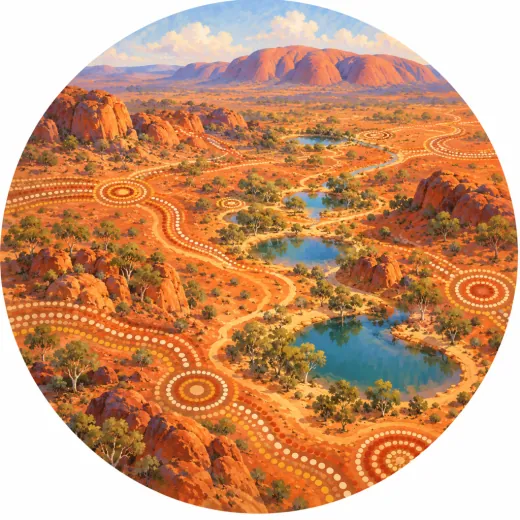
The Dreaming
in English “the Dreaming” or “Dreamtime”
not scary at all
For many Aboriginal peoples of Australia, the oldest living culture in the world, the Dreaming is the way of telling how the ancestral beings shaped the land, the animals, the plants and the laws of the community. It is not a time that ended in the past: it still goes on, and it is linked to particular places, songs, dances and paintings. The stories are not all the same: each people has its own, in its own language. Some are public, others are sacred and may be known only by certain people: here we tell only what is public.
Did you know? The English word “Dreamtime” is an imperfect translation: many communities prefer to use the terms in their own languages, such as “Tjukurpa” for the Anangu.
The story
Let's begin with something you need to know before anything else: this is not a story.
This is the way many peoples of Australia tell where the world comes from, and to understand it you have to accept one small strangeness: in this telling, time doesn't run straight like a road.
We are used to thinking that there is a past, a present and a future, each in its place, one behind the other. For the Aboriginal peoples of Australia, who have lived on this land for a length of time that makes your head spin, the most important things did not happen “once upon a time”. They are always happening. Many years ago a scholar tried to explain it with a word he made up: “everywhen”. It isn't a past that passes. It is a time that goes on, under our feet.
That is why “the Dreaming”, the name usually given to it in English, is an imperfect translation. Many communities prefer to use their own word. The Anangu, who live around the great red rock called Uluṟu, in the centre of the country, say Tjukurpa. It isn't easy to pronounce. It means the story and the law and the place all at once, and it means how to live.
Now I'll tell you what it was like at the beginning. With one honest warning: I'm telling it the way it can be told to everyone, because there are stories in this land that belong only to certain people, and that no book for young readers has the right to tell. I don't know them, and if I did, I wouldn't tell them.
In the beginning, they say, the land was already there, but it had no shape.
Imagine an enormous plain, red and flat, without a single hill, without a river, without a tree. An unbelievable silence. No birds. No footprints. The sky above, and below it the land, waiting.
Then, from beneath the earth, from inside the water, from the sky, the ancestral beings came out.
They were huge, and they were not only people: some had the shape of a snake, others of a kangaroo, a lizard, a bird, a woman, a man, and often they were all these things at once. They walked across the country, and as they walked they changed it. Where one lay down, a hill was born. Where another dug with a stick, a waterhole opened. Where one stopped to sing, a tree grew, and an animal passed by that had not been there before. Where two beings fought, the marks of the fight stayed in the rock.
The ancestral beings gave a name to everything, and to everything a place. They also gave people the rules: how food is shared, how the land is cared for, how guests are treated, how a place is respected. Those rules are the law, and for those who follow it, it isn't something you learn at school and then forget: it is like the land itself, with its curves and its springs.
At Uluṟu, the Anangu tell visitors walking around the base of the rock about a fight between two ancestral snakes. That story is theirs, and they ask that they be the ones to tell it, there in that place: that is why we don't repeat it here. They say only, to those passing by, that the marks and cracks in the red wall are not tricks of the stone, but traces of those days. So when an Anangu person looks at the rock, they don't see just a rock: they see a story they have known since childhood, one that was told to them as a child while walking around it.
This is the hardest part for anyone from outside. The rock doesn't remember the story. The rock is the story.
So listening with your ears isn't enough. To understand the Dreaming you have to learn to see with your legs too, by walking, with songs, with dances, with drawings in the sand and on stone and on skin. Everything that for us is “a story”, for them is done with the body and with the place. There are paintings made of circles, lines and rows of dots that to an outsider's eye look like beautiful patterns, and that, for those who can read them, tell of a journey, a waterhole, a place not to be forgotten. Those who paint and those who tell are not making things up: they are remembering, and they answer for what they say in front of those who know. And every people has its own places, its own stories, its own language. No two are the same, and none can be summed up in a page, not even this one.
Some are stories for children, told by the fire in the evening, to explain why the kangaroo has that tail or why the waterhole is where it is. Others are serious stories, stories of law, learned slowly over a lifetime. Others still are sacred stories, and you don't hear them unless you are the right person, at the right time, with someone who has the right to tell them. Those who are not invited to hear them respect that silence too. It is a kind of respect that we, used to being able to read everything, find hard to understand.
The Dreaming has never ended. The ancestral beings did not disappear: they became the land itself, the rocks, the waterholes, the stars. Walking in those places with respect, caring for them, singing them and telling them, is how the Dreaming goes on. And whoever cares for country is cared for by country in return.
And so, still today, in one of the oldest living cultures in the world, there are people who get up at dawn and greet a hill the way you greet a relative. That is not just a figure of speech.
If one day you happen to go to that land, remember the first rule, the simplest one. Don't try to take the story away with you. Stop. Listen to those who welcome you.
And walk softly. The Dreaming is under your feet.
A living tradition, told with respect: how we tell myths.
Relatives around the world
Listen / Read next
- Music to read by: Cinematic JourneyEpic film-style music, no lyrics, by Ciro Simone IrmiciSpotifyYouTube Music
