The Yowie
yowie or “yahoo”, in Australian English
a little scary
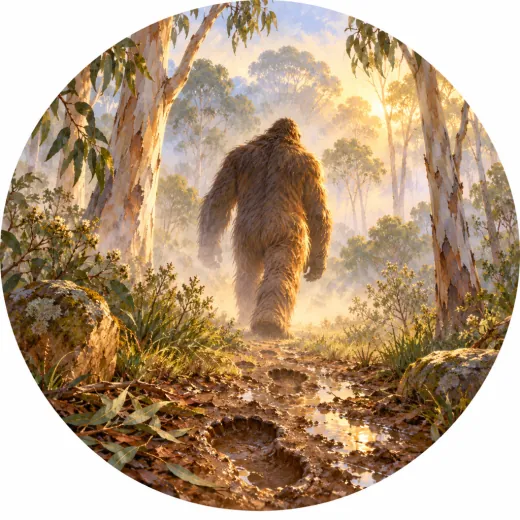
The yowie is a creature talked about in the forests and mountains of eastern Australia: a big hairy being that walks on two legs, like the yeti of the Himalayas or the American Bigfoot. Its story mixes different things. Some Aboriginal peoples tell of “hairy men” of the woods, with their own names in their languages; in the nineteenth century settlers wrote in the newspapers about a “yahoo” seen in the forest; the name “yowie” only became famous in the 1970s. No scientific evidence has ever shown that it exists.
Did you know? In 1977 a book about this story came out, written by Joyner.
The story
The first thing you noticed, in that forest, was the silence.
It was not that there were no sounds. There was the wind in the strips of bark hanging from the eucalyptus trees, the crackle of branches warming in the sun, the water of the creek, far away, down in the valley. But everything seemed to be keeping its voice down, as in a house where someone is asleep.
The three men who had set up camp on the ridge paid it no attention. They were timber-cutters. They had come with a cart, two oxen, a cook and a fourteen-year-old boy whose name nobody out there bothered to remember. The work was hard and the days were long. In the evening they ate bread and dried meat around the fire and went to sleep without talking.
On the fourth day a local man joined them, who knew the tracks and brought supplies from the nearest farm. He was a quiet man of few words. He sat down by the fire, took out his pipe and looked at the forest in silence for a long time.
“All well?” asked the cook.
“All well,” said the man. “As long as you don't follow certain tracks.”
“What tracks?”
He didn't answer. He smoked a while longer, then got up and spread out his blanket.
That night, the boy slept badly.
He woke before dawn. The fire was a heap of red embers. The men were asleep, and the oxen breathed slowly in their rope pen. And yet the boy had heard something, a distinct noise, a sound that had pulled him out of sleep like a hook.
A knock. A dull knock, wood on wood.
He lay perfectly still. After a while he heard it again, further off. Then nothing.
A smell reached his nostrils, carried on the air rising from the valley. It was a strong, musky smell, of wet animal and churned-up earth, with something sour in it. It was not the smell of the oxen. It was not the smell of the fire. The boy pulled his blanket tighter and did not dare move.
At first light he plucked up his courage. He walked out of the camp and around the oxen's pen. The animals were jumpy: they stamped, rolled their eyes, and the biggest one's back was dripping with sweat.
Near the pen, in the mud, there were footprints.
The boy crouched down. They were bare feet, with five toes. But they were far too big: his own foot, beside one, sat inside it like a boat in a ditch. The prints followed the edge of the pen in long strides, then went off among the trees. Some were deeper, as if whoever had made them had stopped to watch.
He ran to wake the others.
The men looked at the footprints for a long time. The eldest scratched his beard.
“A bear,” he said.
“There are no bears here,” said the cook.
“A man, then.”
“With feet like that?”
No one answered. The local man, who had come up quietly, took the pipe out of his mouth.
“I told you,” he said softly. “You don't follow them.”
But there is always someone who wants to see. The youngest of the timber-cutters, a curious fellow and a bit full of himself, decided to go and check on his own. He took a hatchet, went in among the trees and was gone for an hour.
When he came back, he was pale.
“What did you see?” asked the cook.
“Nothing,” he said. “I found where the tracks end. At the top of the ridge, under a big tree. The grass was flattened, as if someone had sat there looking down at the camp. For quite a while.” He rubbed the back of his neck. “And there were hairs caught on the bark. Black ones. As long as my hand.”
“A man's hair?”
“I don't know.”
That night nobody really slept. The fire was kept burning all night, fed in turns, and everyone kept their weapons close. Nothing happened. Or almost nothing. Around midnight, from very far away, came a sound that was not a scream and not a song: a low, long note that rose and then died away, like the breath of someone moaning. The oxen stopped chewing. The cook, who was on watch, got up, rifle in hand, and stayed on his feet, not breathing, for what felt like a very long time. The sound did not come again. In the dark, beyond the circle of firelight, the bushes stopped moving one by one.
Only towards dawn did the boy look up at the ridge and think he saw a darker shape against the paling sky: tall, thick, motionless, with shoulders too broad for a man and arms that hung down too low.
Then a bank of mist rose from the valley and covered it.
When it thinned, there was a broken tree trunk on the ridge. Or at least, that is what the cook said. The boy never knew if it was true.
The next day the timber-cutters loaded the cart and left, even though there were still plenty of trees to fell.
This story, just as it is told here, never happened. It is a story built from what people have been saying for a long time, in the forests of eastern Australia, about a big hairy creature that walks on two legs.
Some Aboriginal peoples spoke of hairy men of the woods, with their own names in their languages. In the nineteenth century, settlers wrote in the newspapers about a “yahoo”, a name that perhaps came from Gulliver's Travels. The name “yowie” had already been noted down in 1875, among the Gamilaraay, as the name of a spirit that wanders at night, but it only became famous in the 1970s, and in 1977 Graham Joyner gathered the tales and eyewitness accounts from the whole region into a book.
What came of it all? A great many stories, footprints and sightings. And no proof that a yowie exists. No bones, no clear photograph, no skin.
One thing remains to be said. In a big forest, at night, with the fire burning low, it doesn't take much. A falling branch, a smell, a shape in the mist. Sometimes fear is not an animal. It is a way people have of looking at the dark when they don't know what is in it.
But that forest, even today, is very big.
A living tradition, told with respect: how we tell myths.
Relatives around the world
Listen / Read next
- Music to read by: Cinematic JourneyEpic film-style music, no lyrics, by Ciro Simone IrmiciSpotifyYouTube Music
Sources
- Graham Joyner, The Hairy Man of South Eastern Australia (1977)
- National Library of Australia, Trove, nineteenth-century newspaper articles about the “yahoo”
