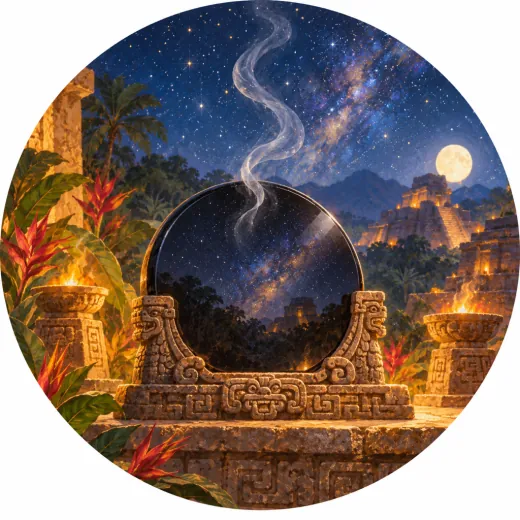
Tezcatlipoca
“smoking mirror”, in Nahuatl
scary
Tezcatlipoca was one of the most powerful deities of the Aztecs, the lord of night, fate and kings. His name means “smoking mirror”: he carried a mirror of obsidian, a black volcanic stone, in which he could see everything happening in the world. He was the great rival of Quetzalcóatl: the two clashed many times, and in the story of the fall of Tollan, the city of the Toltecs, Tezcatlipoca tricked him into leaving it. In one myth he loses a foot, eaten by an earth monster, and has a mirror in its place.
Did you know? Aztec obsidian mirrors were so shiny that some were taken to Europe: one belonged to the English magician John Dee and is now in the British Museum.
The story
The Aztecs used to say that Tezcatlipoca was missing a foot.
He had lost it in the days when the world was still a dark sea and the land did not yet exist, when a huge monster, the Lady of the Earth, swam beneath the surface with her jaws wide open. To lure her, Tezcatlipoca had dangled his own foot in the water, the way you dangle bait. The monster bit it off, and never gave it back. In its place, ever since, the god had worn a mirror of obsidian, black and gleaming, that gave off a smoky mist that nobody could see.
That is exactly what his name meant: “smoking mirror”. He was also called Titlacauan, which means “we are his slaves”. And they called him Moyocoyani, “he who invents himself”. People said he was invisible and impossible to catch, that he saw everything that happened, and that his gaze, from the nights of Tenochtitlan, reached into every room. They said you should never look into a black mirror for too long.
This is the story of the time the mirror looked at Tollan.
Tollan was the most beautiful city in the world. The houses of its people, the Toltecs, had walls of turquoise and of red feathers. The maize grew as thick as an arm, and the cotton in the fields came up already coloured, red and yellow and green, with no need for dye. Birds sang in every garden. Nobody was hungry. Nobody was afraid.
Tollan was ruled by a king and priest named Quetzalcoatl, the Feathered Serpent. He was wise and good, he loved fasting and prayer and peace, and his people loved him as you love a father. He had a great house with rooms for every season, and in that house, in the evenings, people gathered in silence.
But there was someone who could not bear the peace of that silence.
One evening, as Quetzalcoatl withdrew for the night, the dogs of Tollan stopped barking, all at once, as if on command. Then the sounds of the courtyards died away, and after the courtyards the voices in the alleys. A silence fell over the turquoise terraces that nobody could remember ever hearing before.
That was when an old man came to his door.
He was very, very old. He had white hair and a deeply wrinkled face, and he walked bent double, leaning on a stick. The servants stopped him on the threshold.
“Our lord is not receiving anyone,” they said. “He is ill. He doesn't want to see anybody.”
“I know,” said the old man. His voice was hoarse and low, like something crawling. “That is why I have come. I have a medicine for him.”
The servants looked at one another. There was not a sound in the whole house. The candles flickered. From the far end of the corridor, Quetzalcoatl's voice, weak, asked who it was. At that, the servants did not dare say no.
The old man went in. He crossed the corridor without a sound. In the king's room he took a cup from under his cloak and set it on the table.
“Drink, my lord,” he said. “It will give you back your strength.”
Quetzalcoatl looked at the cup. Inside it was a thick, whitish liquid that smelled of sweet things and of rotten things. He had never seen it before. It was pulque, a drink that he, the king of fasting, had never touched.
“Just one drop,” said the old man. “A taste is all you need.”
The king tasted it. Then he took a sip. Then another. The old man watched him in silence, with eyes that seemed made of black glass.
By the time the cup was empty, Quetzalcoatl's world had grown wider. He laughed. He said things he would never have said, and did things that, the next morning, he would not have the courage to speak of.
He woke at dawn. The room was empty. The old man was gone. On the table, the cup lay on its side.
Quetzalcoatl covered his face.
Out in the corridor, someone was waiting for him. But this time it was not an old man. It was a tall figure, wrapped in a black cloak, holding a mirror of obsidian in its hands.
“Look at yourself,” said the voice.
The king did not want to. But his eyes, all by themselves, dropped to the black surface. At first he saw nothing. Then, deep down, a face appeared. A swollen, heavy face, with drooping eyelids and marked skin. Red, bloodshot eyes. A face he did not recognise.
“If your people saw you like this,” said the voice, “they would all run away.”
Quetzalcoatl drew back. His heart was pounding. He understood that the face was his own, but he also understood, and this was worse, that someone had wanted him to see it. Too late, he understood whose mirror it was. He looked up to see who was speaking to him, but there was no one left in the corridor. There was only the grey light of morning and a distant echo of soft laughter.
That very morning Quetzalcoatl gathered his things. He would not explain anything to anyone. He called his most faithful men, left Tollan, and set off towards the east, towards the sea. The people watched him go from their turquoise windows, without understanding. The birds stopped singing. The cotton, they say, began to grow white.
When he reached the shore, the king stopped. Some say he built a raft of serpents and sailed away. Others say he set himself on fire, that from his ashes rose birds of a thousand colours, and that his heart went up into the sky and became the morning star, the one that shines just before dawn. They say he promised to return.
Nobody came back to Tollan. Without its king, the city was never the same again.
And Tezcatlipoca? Nobody saw him again, but people said he was still watching. In Tenochtitlan they worshipped him, and they feared him more than all the other gods, because he never did what anyone expected. He gave riches and took them away. He raised a man up and made him fall. And you never knew when.
They say that even today some obsidian mirrors are darker than others. That if you stare into one for a long time, in the half-light, at a certain moment you will see a shape appear behind your shoulder, and it will not be a reflection.
If that happens to you, don't turn round.
It is probably already too late.
Relatives around the world
Listen / Read next
- Music to read by: Cinematic JourneyEpic film-style music, no lyrics, by Ciro Simone IrmiciSpotifyYouTube Music
Sources
- Bernardino de Sahagún, Florentine Codex, Book III
- Histoyre du Mechique (16th century)
