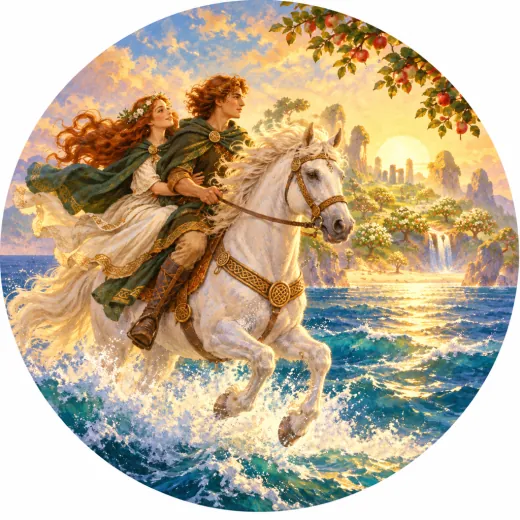
Tír na nÓg
“the land of the young”, in Irish
not scary at all
Tír na nÓg is a magic island beyond the sea, where nobody grows old and nobody falls ill. The best-known story tells that golden-haired Niamh arrived on a white horse and asked the young warrior Oisín, son of Finn McCool, to follow her. There they lived happily, and to Oisín it seemed like three years. But Oisín wanted to see Ireland again: Niamh lent him the horse and begged him never to touch the ground. In Ireland three hundred years had gone by. When he fell from the saddle while helping some men, he became extremely old in an instant.
Did you know? According to the legend, the aged Oisín still had time to tell the deeds of the Fianna to Saint Patrick.
The story
One morning, on the shores of the lake of Killarney, the Fianna were out hunting.
They were the warriors of Finn, the chief of the hunters of Ireland: big men, with cloaks over their shoulders and hounds at their feet. His son Oisín was the poet and warrior of the band. His hand was quick to the spear and his ear quick to a verse.
He was the first to see her.
She came from the sea, riding over the water, and the water did not even splash beneath the hooves. The horse was white, white as foam, with a mane that looked like silver. She wore a cloak the colour of the moon, embroidered with golden stars, and beneath her crown her hair fell to her waist, fair as ripe wheat.
She stopped in front of Finn.
“My name is Niamh,” she said. You say it “Neeve”. “I am the daughter of the king of a faraway island, the Land of the Ever Young. I have come for Oisín. I have heard of his verses and his courage, and I have crossed the sea to take him with me.”
Not one of the Fianna spoke.
“There, nobody grows old,” she went on. “There is no sickness and no death. There the music never ends, the fruit never rots, and whoever arrives stays just as they are. Will you come with me?”
Oisín looked at his father. He looked at his companions. He looked at that golden hair.
“I will come,” he said.
Finn wept that day, and all the Fianna wept. Oisín kissed his father, his friends, the paws of his hounds, and climbed into the saddle behind Niamh. The white horse turned its head towards the west.
The sea opened before them without effort. They travelled for days, wide awake and never tired. They saw strange things: a white hornless fawn, chased by a white hound with red ears; then a girl on a brown horse, with a golden apple in her hand, chased by a rider on a white horse. Oisín watched them vanish into the mist and did not understand. It did not seem important, but he remembered it for ever.
Then, all of a sudden, land.
An island greener than any green he had ever seen. A castle of crystal, and inside it a table already laid. Trees heavy with fruit. And a king, with his crown on his head, who welcomed them with a smile and married them.
Oisín lived there, and it seemed to him like three years.
Every day was a feast. He woke early, hunted without fear of falling, sang without tiring. Niamh stayed close to him, and few words passed between them: looks were enough. Songs seemed to be born on their own. Time, there, did not pass. It slid.
And yet.
One evening, as the sun sank over the sea, a strange sadness came over Oisín. It was not pain. It was like a distant whistle that only he could hear. He thought of his father. He thought of his companions. He thought of the lake of Killarney, and the cold of the morning, and the sound of the hunting horn.
“Niamh,” he said. “I would like to see Ireland again. Just for one day. I want to say goodbye to Finn and the others.”
She did not answer at once. She looked at him for a long time, and her face was the same as always, but for the first time he saw that she was tired.
“If you go,” she said, “you will never come back.”
“I will come back. I swear it.”
“Then take the horse.” She led him outside, and the white horse stamped its hooves, restless. “But listen to me carefully, Oisín, because everything depends on this. You must never get down. Not one step, not for one moment. If your feet touch the soil of Ireland, the horse will leave you, and you can never come back to me. Do you understand?”
“I understand.”
She took his hand and held it between hers, until he drew it away.
The sea carried him back like a dream. Oisín came ashore on a coast he knew, and at once something felt wrong. The fields were the same, but nobody was working them. The roads were there, but they were not his roads. He looked for Finn's fortress, and he found it: a heap of stones covered in nettles. Where the banqueting tables had stood, there were thistles now.
He met some men. Small, thin, with tired eyes. They looked nothing like the Fianna.
“Where are the Fianna?” he asked. “Where is Finn?”
They stared at him, and one answered: “Finn? The Fianna? People told stories about them in our grandfathers' time. That was three hundred years ago.”
Oisín sat in the saddle, not breathing. Three hundred years. His three years.
A little further on, some of those men were trying to shift an enormous stone blocking the road. Ten of them pushed, then twenty, and it would not budge. Oisín, who as a young man could move stones like that with one hand, felt tears come to his eyes. Not because of the stone. Because of them, so small and weak, the heirs of that great Ireland.
“Wait,” he said.
He leaned down from the saddle. He stretched out his arm, gripped the stone and pushed it with all his strength.
The stone moved. But the saddle girth snapped.
Oisín fell.
He fell slowly, or so it seemed to him, and before he even touched the grass he heard the white horse rearing, neighing, bolting. Then his feet touched the ground, and in that very instant the time that had waited for him for three hundred years fell on him all at once.
His hair turned white. His back bent. His hands, which had gripped the spear, became covered in wrinkles and spots. The men around him stepped back. Before their eyes a young man had turned into a very, very old one.
Oisín raised his head towards the horizon, where the white horse had vanished for ever.
“Niamh,” he whispered.
Nobody answered. The sea was far away, and the wind carried only the smell of grass.
They say he lived a little longer. That the old people found him and took him in, and that every evening he told a holy man named Patrick the deeds of Finn and the Fianna, so that they would not be lost. And that every time, at the end of the story, he looked towards the west.
The white horse never came back.
Relatives around the world
Listen / Read next
- Music to read by: Cinematic JourneyEpic film-style music, no lyrics, by Ciro Simone IrmiciSpotifyYouTube Music
Sources
- Micheál Coimín, Laoi Oisín i dTír na nÓg (about 1750)
- Lady Augusta Gregory, Gods and Fighting Men (1904)
