The Púca
púca, in Irish
a little scary
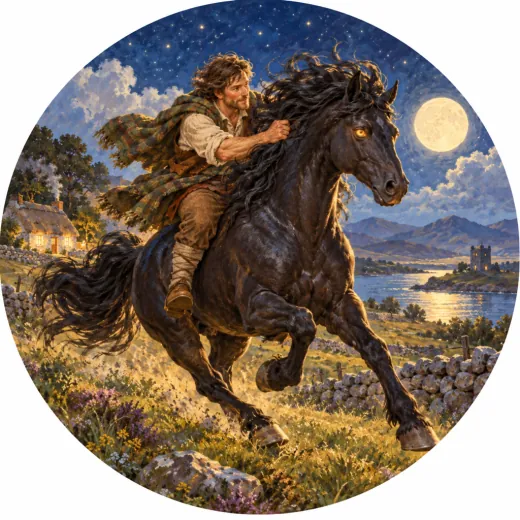
The púca is a shape-shifting spirit of Irish folklore: it can appear as a black horse with yellow eyes, a goat, a hare or an eagle. In the best-known stories it comes up to people walking at night, swings them onto its back and takes them on a mad ride over fields and ditches, before dropping them, frightened but unharmed, in the mud. It is not really wicked: it is mischievous and unpredictable, and sometimes it even helps farmers. Its favourite time is the beginning of November, when winter begins.
Did you know? In Ireland people said you should not pick blackberries after the first of November, because the púca had already got his hands on them.
The story
In Ireland they used to say that after the first day of November you must not eat blackberries any more.
It sounds like one of your granny's rules. But the old folk knew the reason: after the first of November the púca passes over the bushes, and whatever he touches is no good to anyone.
That's the púca for you. He isn't a monster and he isn't a ghost. He is a spirit of the countryside, mischievous and unpredictable, who changes shape the way other people change coats. He can be a goat with burning eyes. He can be a hare darting across your path. He can be an enormous eagle. But his favourite shape, the one he wears when he goes out looking for a laugh, is a black horse. Black as ink, with a long mane and two eyes as yellow as the November moon.
One November evening, a farmhand was walking home from a fair.
It was late. His feet were tired and his pocket was empty, because he had spent everything. The road was a pale line between the black fields, and there was not a single star in the sky. After a while he began to hear a noise behind him.
Clop. Clop. Clop.
He turned round. Nobody there. He walked on a little further. The noise came back: a slow, heavy, steady step, like a horse following him in no hurry at all.
He stopped again. Silence.
“Who's there?” he said, and his voice sounded tiny.
No answer. Only the wind, and a smell of wet earth. Then, from behind a hawthorn bush, out came the horse.
It was huge. So huge it filled half the road. Its coat was black and glossy, and its eyes, two still yellow eyes, were fixed on the boy with an almost human curiosity. It did not neigh and it did not fidget. It stopped two steps away from him, lowered its head and waited.
The farmhand knew all the stories. He knew that a black horse that turns up at night, alone, with no saddle and no master, is never just a horse. He knew he ought to run.
But his legs were tired, and the horse looked so gentle.
“Well,” he said, to keep his courage up, “if you take me as far as the bridge, I'll be much obliged.”
The horse snorted. The boy climbed onto its back, clinging to its mane.
For a few steps all went well.
Then the horse reared up, and off it went.
It was a ride the farmhand never forgot. The horse did not gallop: it flew. It leapt a hedge as high as a house. It leapt a ditch, and in the ditch the boy glimpsed the reflected moon sliding beneath him like a silver coin. It crossed a potato field without touching a single potato. It went up one hill, down the other side, and plunged into a bog, where the water lashed up at him like a whip.
“Stop!” the boy kept shouting. “Stop, please!”
Out of the horse's mouth came a laugh.
It was not a horse's laugh. It was a low, hoarse, happy laugh, the laugh of someone having more fun than anyone else. And a voice that belonged to nobody said, surprisingly cheerful:
“Hold on tight, lad! I don't often get company!”
The farmhand clung to the mane with both hands. The horse raced along a river, jumped a drystone wall, sailed over an old abandoned church and hurled itself towards a cliff, where the sea below was a black roar. The boy shut his eyes. He felt nothing beneath his legs for one very long moment.
And then the ground again, hard under the hooves.
They rode all night. The farmhand never found out where he had been. He thought he saw fields he did not know, houses with no lights, a road that ended in a lake. He thought he heard other laughter in the distance, and the voices of black horses. At some point he even stopped shouting. He just held on tight and prayed to make it to tomorrow.
At dawn, the horse slowed down.
The sky was turning grey in the east. The first bird sang. And on top of a hill the púca stopped, all at once, with all four hooves planted in the earth.
The boy flew forwards.
He sailed through the air, turned half a somersault and landed, splat, in a ditch full of mud. Cold, thick mud that got into his ears, down his neck, into his shoes.
When he raised his head, the horse was gone. On the edge of the ditch there was only a hare, watching him closely. Then the hare turned and hopped away through the grass, and for the rest of his life the farmhand swore he had heard it laugh.
He looked himself over. He was filthy from head to toe, his pocket still empty and his jacket torn. But he had his arms and his legs. He had his head. Nothing was missing.
He stood up, wiped his face on his sleeve and looked around. Down at the bottom of the valley, a couple of kilometres away, he saw the roof of his farm, with the smoke from the chimney rising straight up.
He walked home. He told everyone everything, and of course nobody believed him. But the next Sunday the old man of the village came by, the one who always knew what to say. He looked at the boy for a long time and said only:
“So he took a liking to you.”
“A liking?” said the farmhand. “He threw me in a ditch.”
“Exactly. The ones he doesn't like, the púca forgets. The ones he likes, he has fun with.”
From that evening on, the farm began to do something. When they gathered the last of the crops from the fields at the end of October, they left a share behind on purpose: a bunch of wheat, a few potatoes, a basket of apples. They said it was for the púca.
Nobody ever saw him take it. But every year, by the next day, it was gone.
Relatives around the world
Listen / Read next
- Music to read by: Cinematic JourneyEpic film-style music, no lyrics, by Ciro Simone IrmiciSpotifyYouTube Music
Sources
- Thomas Crofton Croker, Fairy Legends and Traditions of the South of Ireland (1825)
- William Butler Yeats, Fairy and Folk Tales of the Irish Peasantry (1888)
