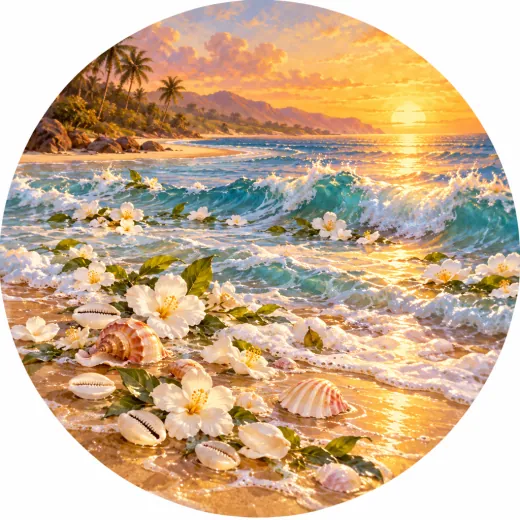
Yemoja
Yemọja, “mother whose children are fish”
not scary at all
Yemoja is a much-loved orisha, the great mother of the waters. In Nigeria she is linked to the Ogun River; in Brazil and Cuba, where the tradition arrived with people taken by force from Africa, she became the queen of the sea. She protects women, mothers and children, and anyone who must face a journey by sea. Her colours are blue and white, like water and the foam of the waves. It is said that many rivers and many other orishas were born from her body.
Did you know? Every 2 February, in Salvador da Bahia, Brazil, thousands of people dressed in white bring flowers and gifts to the sea for Iemanjá.
The story
The Ogun River rises far from the sea, among green hills and small villages, and flows south for hundreds of kilometres. Along the way it passes towns with red roofs and markets full of women. When at last it opens into the sea, it does so without hurrying, like someone arriving home.
The Yoruba say that the river is a person. Her name is Yemoja.
If you walk along the bank at dawn, you can feel her there: the water is warm and slow, and it carries leaves and petals with it, and the sound of a long breath.
Her name, the old people explain, means “mother whose children are fish”. Not because her children all live under water, but because she has so many children that they cannot be counted, and among them are the fish.
Yemoja is one of the oldest mothers. Long before people had learned to sail, she already lived in the water, and the orisha, the divine beings who watch over the world, ran to her when they were frightened or hungry or thirsty. She was great, strong and calm. With one hand she comforted, with the other she protected.
In one of the versions that have been collected, Yemoja married Aganju, and together they had a son, Orungan. That son grew up with his eyes held high, and his mother would watch him playing on the riverbank and think he was the most beautiful thing that had ever happened to her.
Then came a hard time, and at this point the story changes its tone. The old people do not like to tell the whole story, and there is no need to. It is enough to know that at a certain moment Yemoja found herself in great sorrow, and she began to run away. She ran and ran and ran, up the hill, far from the houses. Then her legs would carry her no further, and she fell to the ground.
She fell the way a very great tree falls. Her body stretched out on the ground, and the earth shook.
And then the most extraordinary thing happened.
Yemoja's body began to open. Not the way a wound opens, but the way a spring opens. From her breasts gushed two streams of clear water, which ran down towards the valley, joined together and became a river. The river widened its path, filled the hollows and formed a great lagoon. Then more waters came out of her, and more again, and they all began to flow onward, each along its own way.
Last of all, from Yemoja's womb, came her final and greatest surprise.
Out came the orisha.
The first was a warrior with a face of bronze, as strong as a mountain: Ogun, the lord of iron. Then a towering figure with arms full of fire, who carried thunder in his stride: Shango. Then Oya, the lady of the wind, who ran faster than the wind itself. Then Oshun, with golden hands and a smile of honey. Then others, and others still, until the whole forest was full of the new divine beings.
Each of them had a part of her: one her strength, one her gentleness, one her patience, one her fierceness. But all of them, even the most fearsome, became small in their mother's presence.
And she? She had not disappeared. She had become water, and wherever there is water, she is there. Her breath is the wind on the river. Her voice is the surf. Her embrace is the sea, which welcomes everyone.
That is why Yemoja is the protector of women and children, of mothers who are waiting and of those who must go to sea. People with a great sorrow speak to her in the evening, at the water's edge, in a low voice. And that is why, when the Yoruba come near a river, they never joke. They greet her, wet their hands and leave a flower. Along the Ogun River, they say, there are places where people still go today to offer her a little food and to ask her advice. Because they know that we come from the water, and that sooner or later, into the water we return.
Many centuries later, there was a journey that no one would ever have wanted to make.
Great ships, packed with people taken from their homes by force, crossed the ocean. They were men, women and young people, carried off to the Americas to be sold. They had nothing left: not even the right to keep their own names. But there was one thing that could not be taken from them: their memory.
On deck, on moonless nights, when the waves beat against the hull like a slow heart, someone would whisper Yemoja's name. A woman taught it, quietly, to a little girl who was not yet seven, so that it would not be lost. “Mother,” she would say. “Bring a piece of Africa with us.”
The ocean was immense, and for them it was also a source of anguish and fear. But in that darkness, so the stories say, the mother of the waters followed them. From a river she became a sea, so as not to leave them alone. She reached Brazil, where they called her Iemanjá. She reached Cuba, where they called her Yemayá. She dressed in blue and white, the colours of water and of foam.
And so today, on 2 February, in Salvador de Bahia, while the sun is still low, the beach fills with people dressed in white.
They come on foot, in groups, with baskets and buckets and armfuls of flowers. A grandmother has brought her granddaughter, who is holding a white rose with both hands, afraid she might drop it. A fisherman has loaded a huge basket full of gifts onto his boat: perfumes, combs, mirrors, ribbons. They sing. A group of women in white skirts circles the basket, clapping their hands. Some people laugh, some cry, no one is in a hurry.
Then the boats push off from the shore and head out to sea, all together, like a little procession. When they are far enough out, they place the gifts on the water and let them go.
The flowers float for a moment, white and red, then a wave takes them and carries them away.
The little girl watches them for as long as she can. “Where are they going?” she asks.
“To her,” answers her grandmother. “She was waiting for them.”
And the sea in front of them moves gently, as if it were breathing.
A living tradition, told with respect: how we tell myths.
Relatives around the world
Listen / Read next
- Music to read by: Cinematic JourneyEpic film-style music, no lyrics, by Ciro Simone IrmiciSpotifyYouTube Music
Sources
- Pierre Verger, Orixás (1981)
- Solimar Otero and Toyin Falola (eds), Yemoja: Gender, Sexuality, and Creativity in the Latina/o and Afro-Atlantic Diasporas (2013)
