Oshun
Ọṣun, in Yoruba
not scary at all
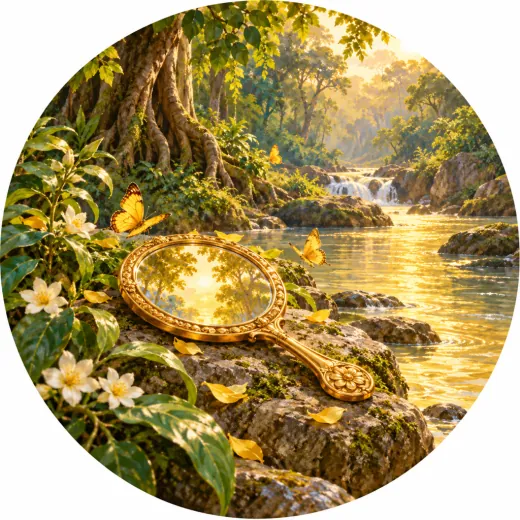
Oshun is the orisha of rivers and fresh water, of sweetness, love and fertility. Her colour is golden yellow; in Nigeria she is remembered with a brass fan and bracelets, and in the Americas with a mirror. One account says that when the other orishas tried to set the world in order without her, nothing worked: the rain did not fall and the earth dried up. Only when they asked for her help did things start to grow again. It shows that without her sweetness, strength alone is not enough.
Did you know? The Osun-Osogbo Sacred Grove in Nigeria, with its sculptures and shrines along the river, has been a UNESCO World Heritage Site since 2005.
The story
Anyone walking along a river in Nigeria who catches a sweet scent in the air, of honey and flowers, knows they are not alone. Someone, not far away, is watching with a smile.
It is Oshun, they say, the lady of fresh water.
You can spot her from far away. She dresses in yellow, the colour of gold and honey. She wears brass bracelets that jingle at every step, like little waves. In her hand she holds a fan that glitters (in the Americas they say she gazes into a mirror, and that in the mirror she is looking at you too), and her laugh passes through the trees like a breeze. When she dances, the river dances with her.
But once, long ago, nobody listened to her. And it is a story worth telling, because since then a great many things have changed.
In the beginning, when the world had only just been made, seventeen orisha came down from the sky to the earth. They were the first, the most powerful. Olodumare had ordered them to put everything in order: to give a place to the rivers, the forests, the animals and the people.
Sixteen of them were men. Only one was a woman: Oshun.
On the day they met to decide how to go about it, they sat down in a circle, side by side, and began to argue. They talked and talked and talked. Each of them had an idea and wanted to push it through. Some wanted to raise mountains, some to dig valleys, some to light fires.
Oshun listened. At one point she raised her hand.
“May I say something?”
Silence. The sixteen looked at one another. Then one of them huffed.
“This is a serious matter, Oshun. Keep out of it. We are talking about strength, about work. You go and see to something else.”
“But I…”
“Not now.”
Oshun closed her mouth. She did not get angry. She stood up, straightened her bracelets and walked away without a word. She set off along the riverbed and disappeared among the trees.
The orisha, satisfied, went back to their work.
Days went by. Weeks went by. And little by little they noticed that something was wrong.
The sky was clear, but it would not make up its mind to rain. The fields were ready, but the maize did not grow. The river, which had once flowed merrily, grew narrow and slow, until it was nothing but a ribbon of mud. The women of the village, who had longed so much for children, had none. The plants withered. The world, made with such care, looked like a beautiful empty jar.
“I don't understand,” said one of the orisha. “We did everything right.”
“We did everything right, and nothing works,” said another.
“Perhaps we got a spell wrong.”
They tried other spells. They tried other rites. Each time, for a moment, something seemed to show a sign of life, and then it faded away.
In the end, worn out, they went back up to the sky, to Olodumare.
“We beg you to help us,” they said. “The world is not alive. We have done everything you asked.”
Olodumare listened patiently. Then he asked:
“Where is Oshun?”
The sixteen lowered their eyes.
“She… she wasn't with us.”
“Then you have not done everything,” said Olodumare. “What you have built without her cannot live. Go back to the earth and ask her forgiveness.”
They hurried down. They looked for her along the dry river, through the bare forests, in the silent villages. At last they found her, sitting in a corner of the forest with her face in her hands. Her dress was still yellow, but it no longer shone.
“Oshun,” they said, and this time they said it softly. “We were wrong. We did not listen to you. We are asking you to help us.”
She looked at them for a long time.
“I tried to tell you,” she said. “But you would not hear it.”
“We know.”
Oshun stood up. She looked around at that grey world, which should have been green, and sighed. She was a little angry, but she was also a mother, and mothers do not let the world dry up out of spite.
“I cannot do anything on my own,” she said. “The rain is in the sky. I must go to Olodumare.”
But the sky was high, and the road was impossible to travel on foot. So Oshun did something that no one had ever seen her do: she changed. Her arms became wings, her voice a hoarse croak, her yellow dress turned into dark feathers. She was a great bird, a vulture, which no one would ever have thought of calling beautiful. But it flew higher than any other.
She climbed, and climbed, and climbed again. The sun burned her and the air grew thin. Along the way her feathers fell out, and flying became toil and pain. But she did not stop.
At last she came before Olodumare.
She did not bring shouted demands. She did not bring threats. She stood still and spoke with the gentle voice that had always been her strength. She told him about the dry earth and the women in tears, about the fields, and about the children never born. Olodumare listened to her until the very last word.
Then he raised his hand.
And the rain fell.
It fell on the cracked earth, which drank like a thirsty mouth. It fell on the river, which rose again and began to sing once more. It fell on the maize, which lifted its leaves. It fell on the women, who laughed and danced in the rain. All at once, the world was full of green.
The sixteen orisha stood to one side and watched.
“She was right,” murmured one.
“She was always right,” said another.
From that day on, none of the orisha ever again dared to say that strength is enough on its own. And Oshun became the lady of fresh water, of love and of children, the mother of honey, the one who knows how to make things grow where fire and iron cannot.
Even today, in the city of Osogbo in Nigeria, there is a grove that bears her name. It is a dense forest with a calm river running through it, full of small shrines and sculptures that tell her story. UNESCO declared it a World Heritage Site in 2005. Every year in August, thousands of people come from far away, dressed in white and yellow, to thank her. Women who long for a child bring her honey and pour it into the water.
Anyone who stops on the bank in silence, they say, can hear a faint jingling among the trees. It is the sound of her bracelets.
Oshun has passed this way, and she is in no hurry.
A living tradition, told with respect: how we tell myths.
Relatives around the world
Listen / Read next
- Music to read by: Cinematic JourneyEpic film-style music, no lyrics, by Ciro Simone IrmiciSpotifyYouTube Music
Sources
- UNESCO World Heritage Centre, Osun-Osogbo Sacred Grove
- Diedre L. Badejo, Ọ̀ṣun Ṣẹ̀ẹ̀gẹ̀sí (1996)
