Trolls, elves and dwarves
troll, álfar and dvergar, in Old Norse
a little scary
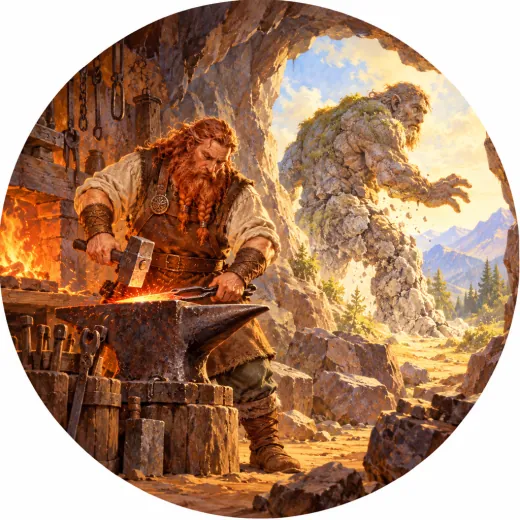
Norse myths are not only about gods and giants. The light elves live in Álfheim and are fairer than the sun. The dwarves, born underground like little maggots in the body of the giant Ymir, are the finest smiths of all: they forged Thor's hammer, Odin's spear and the magic fetter that binds the wolf Fenrir. Trolls, in the folk tales that grew up later in Norway and Iceland, are big, dim creatures that live in the mountains and forests. Many stories say that sunlight turns them to stone.
Did you know? In the poem “Alvíssmál” Thor keeps a dwarf talking until dawn, and the poem ends as the sun enters the hall.
The story
It had been snowing outside for three days, and the wind flung the snow against the windows like handfuls of sand.
In the farmhouse there was only one room with a fire lit. Around it sat an old woman knitting, a sleeping dog and two children, a boy and a girl, who had no wish to play any more.
“Granny, tell us a story.”
“Which one?”
“One with trolls.”
Granny stopped knitting. She looked at the fire, then at the window, where there was nothing to be seen.
“All right,” she said. “But a troll can’t stand up on his own. I’ll tell you about all the folk behind the world, the ones you can’t see. I’ll start with the ones that shine.”
The children huddled under the blanket.
“Up there,” said Granny, “in a place called Alfheim, live the light elves. They are fairer than the sun. If you looked at them, it would hurt your eyes, like looking at snow at midday. But there are other elves too, who live underground, and they are as black as pitch. The old people said they were different to look at, and even more different inside.”
“Wicked?” asked the girl.
“Different,” said Granny. “That’s not the same thing.”
A log split in the hearth.
“Then there are the dwarves. They weren’t born like us. When the world was still waiting to be made, there was an enormous giant called Ymir, and out of his body came maggots, small and white. The gods looked at them and decided to give them minds to think with and the shape of men. That is how the dwarves were born. They live in the rock, under the mountains, where the sun never goes, and they work.”
“At what?”
“Everything. They made Thor’s hammer and Odin’s spear, and the fetter that no wolf has ever broken. It’s called Gleipnir. Do you know how they made it?”
The children shook their heads.
“With six things. The sound of a cat’s footsteps. A woman’s beard. The roots of a mountain. The sinews of a bear. The breath of a fish. The spit of a bird.”
“But cats don’t make any noise!” said the boy.
“Exactly. And women don’t have beards, and fish don’t have breath, and mountains don’t have roots you can see. That’s because the dwarves took them all to make the fetter. That’s where they went.”
The boy thought about it and decided it was a reasonable explanation.
“And there’s a story about a dwarf,” the old woman went on, “called Alvíss, which means All-Wise, who one day turned up at Thor’s home. Thor wasn’t there. The dwarf found his daughter and said she had been promised to him as his wife.”
“But he was small and ugly!”
“And as pale as a dead man. When Thor came back, he looked at him and said: you’re white around the nose, what have you been doing, sleeping with a corpse? The dwarf answered that he came from under the earth and knew more than anyone. So Thor said: good, if you know so much, answer me. What is the earth called? And the sky? And the moon? And the wind? And beer?”
“But those are just ordinary names!”
“Ah, but every world has a different one. The gods say one thing, the giants another, then humans, elves, dwarves. And the dwarf knew them all. All night long he answered, one question after another. Thor kept asking, with an innocent face, and all the while the night was passing.”
“And then?”
“And then Thor said: I have never found so much wisdom in a single breast. But you have been tricked, dwarf. You see? It is day in the hall now.”
For a moment, nobody in the room said anything.
“And the dwarf?” asked the girl.
“The poem doesn’t say. They say the sun in the face does terrible things to his kind. That it turns them to stone. The same thing happens to trolls.”
The girl pulled the blanket up to her chin.
“Trolls,” said Granny, lowering her voice, “are another folk altogether. Big, heavy, not very bright. They live in the mountains and under bridges. They tell of one who waited under a wooden bridge, with eyes as big as plates and a nose as long as a broom handle. Three billy goats came along, all from the same family, from the smallest to the biggest, all on their way to the meadow on the other side of the river. The first one crossed the bridge: trip, trap, trip, trap.”
At that very moment, outside, something banged against the door.
Trip.
The girl screamed. The boy jumped to his feet. The dog raised its head. Then the wind blew again and the door banged once more, and they realised it was only the latch, which someone had not closed properly.
Granny laughed. “You’re as white as the dwarf.”
“And then?” asked the boy, sitting down by the fire again, but closer to Granny than before.
“The troll wanted to eat them. But the first goat said: wait for the next one, he’s fatter. The second one said the same. When the third came, the biggest, he said nothing. He charged across the bridge, tossed his horns and threw the troll into the river. Then he went off to eat the grass, and from that day on all three of them grew fat.”
The girl laughed. The boy sighed with relief.
Then, little by little, as the story came to an end, the children fell asleep.
The next morning the snow had stopped. The sky was a hard blue, and the sun burst through the window like a blow. The children went outside. High up on one side of the valley was a long grey rock they had seen a thousand times, which in the evening looked like a face with a nose. In daylight it was only a rock.
“Granny,” said the boy, “it’s day in the hall now.”
The old woman, behind them, did not answer. She smiled, and stood looking at the mountain.
Relatives around the world
Listen / Read next
- Music to read by: Cinematic JourneyEpic film-style music, no lyrics, by Ciro Simone IrmiciSpotifyYouTube Music
Sources
- Snorri Sturluson, Prose Edda, Gylfaginning and Skáldskaparmál
- Poetic Edda, Alvíssmál
- Peter Christen Asbjørnsen and Jørgen Moe, Norwegian Folktales (1841–1844)
