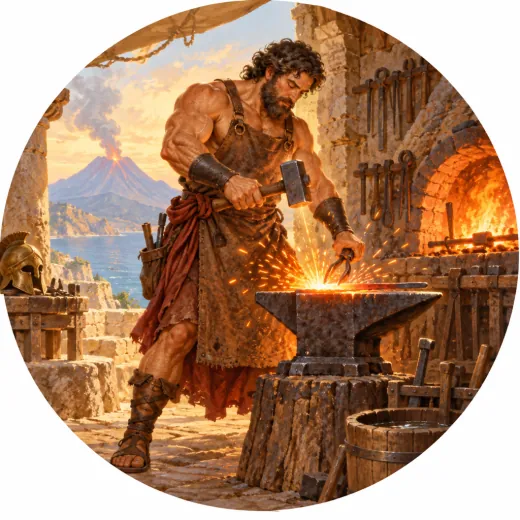
Hephaestus
Hḗphaistos, in Ancient Greek
not scary at all
Hephaestus is the god of fire and the blacksmith of the gods. According to Hesiod he was born to Hera alone, out of anger. He was lame, and one myth says he was thrown down from Olympus and fell for a whole day before landing on the island of Lemnos. But with his hands he was a genius: in his forge he made the armour of Achilles, as the Iliad tells, golden thrones and even mechanical servants that moved by themselves.
Did you know? In Homer, the forge of Hephaestus is not under a volcano but on Olympus.
The story
On Olympus, at the end of a corridor where no god usually goes looking for anyone, there is a house of bronze with a fire that never goes out.
You hear it before you see it. A blow, a breath, another blow. Twenty bellows puffing together and stopping at a sign from the one who commands them. The sound of a hammer on an anvil, as steady as a heartbeat.
It is the forge of Hephaestus, the god of fire. And at a certain hour of the day, when no one is watching him, it is the most cheerful place on Olympus.
Not because he is a happy god. Hephaestus is lame. When he walks, he rocks from side to side, and at dinner the gods make fun of him. Once, to settle a quarrel between Zeus and Hera, Hephaestus took on the job of cupbearer. He limped from table to table with the jug of nectar, and the gods burst into laughter that went on and on. He laughed too, to be polite. But there was nothing to laugh about.
Because Hephaestus knew how it had all begun.
Hesiod says that Hera brought him into the world on her own, without Zeus, out of anger. As for why he was lame, Homer gives two versions. In the first book of the Iliad, Hephaestus takes his mother's side against his father, and Zeus grabs him by the foot and hurls him from the threshold of Olympus. He falls for a whole day, and as the sun sets he lands on Lemnos, where some men, the Sintians, pick him up, still alive. In the eighteenth book, on the other hand, it is Hera who is ashamed of a crippled son, and she is the one who throws him away. But in the sea, two kind goddesses are waiting for him.
This is the story Hephaestus tells one evening, to a visitor.
She was the goddess Thetis, the mother of Achilles. She knocked at the bronze door with tears on her face. Her son had lost his dearest friend, Patroclus, killed at Troy, and he wanted to go back into battle to avenge him. But Achilles' armour was on the body of an enemy. Thetis could not stop him. All she could do was give him a gift.
Hephaestus was at work. Around the walls of the room stood twenty tripods with golden wheels on their feet: he was building them to move by themselves, rolling into the hall of the gods and back again without anyone pushing them. When he heard the knock, he put down his hammer. He stood up with difficulty and called his handmaidens.
They are two girls made of gold, made by him, who look alive. They have voices, they have minds, they have strength in their hands. They held him close on either side and supported him along the corridor while he moved forward on his thin legs, and the handmaidens shone like two flames. Behind them came his wife, Charis, whose name means Grace, who had seen the goddess arrive from the window and ran to take her hand.
“Thetis of the lovely veils, dear and honoured, why are you here?” said Hephaestus. “You never come. Sit down.”
She told him everything, and he listened.
“Don't cry,” he said at last. “I wish I could hide your son from death as surely as I can give him fine armour. When people see it, every man will stand and stare.”
Then he added quietly: “You helped me once. You and Eurynome, when I was falling. You took me in at sea, and for nine years I worked in a cave under the waves: buckles, brooches, necklaces, and all around me the endless roar of the Ocean. No one knew where I was. I owe you far more than a shield.”
And he went back to the forge.
He fired up twenty bellows, all at once. He threw bronze, tin, gold and silver onto the fire. He took up his hammer and his tongs. And he began to work.
The bellows blew wherever he wanted, hard or gently, depending on the job. The forge filled with sparks, with smoke, and with that smell of hot metal that smiths think of as perfume. Hephaestus worked without a word, the tip of his tongue between his teeth, the way craftsmen do when something is turning out better than they hoped.
First he made a great shield, with five layers of metal and a triple rim. Then, on the bronze, he made a world.
He showed the earth, the sky and the sea. The tireless sun, the full moon, all the stars: the Pleiades, the Hyades, mighty Orion, and the Bear that circles round and never dips into the Ocean. He showed two cities. In one there were weddings, and processions with torches, and women standing at their doors, and music, and a quarrel over the price of a man who had been killed, brought before the elders, who sat in a circle on smooth stones. The other was besieged by two armies, and its people waited on the walls. A ploughed field, with farmers turning their oxen and a man handing out a cup of wine at the end of every furrow. A king's estate, with reapers, and a meal being prepared in the shade of an oak. A vineyard heavy with dark grapes, and a boy playing the lyre while the others gathered the harvest, singing. A herd with its herdsmen, and two lions attacking a bull. A dancing floor, like the one Daedalus had made at Knossos, where boys and girls hold hands and whirl around, with a singer in the middle and two acrobats turning somersaults.
All around the rim, the river Ocean, which encircles everything.
When he had finished, Hephaestus made the helmet, the breastplate and the greaves as well. And he laid them at Thetis' feet, for her to take to Achilles.
She swooped down from Olympus like a hawk, carrying the shining armour.
That was how the Greeks imagined their god of fire. Lame, laughed at, thrown down by those who should have protected him, and yet able to do something none of the other gods could: take a piece of metal and fit the whole world inside it, with its feasts, its wars and its harvests.
They say that when Achilles looked at the shield for the first time, his eyes blazed. It was so beautiful that none of the warriors around him dared to look straight at it.
Relatives around the world
Listen / Read next
- Music to read by: Cinematic JourneyEpic film-style music, no lyrics, by Ciro Simone IrmiciSpotifyYouTube Music
Sources
- Homer, Iliad, Books I and XVIII
- Hesiod, Theogony
