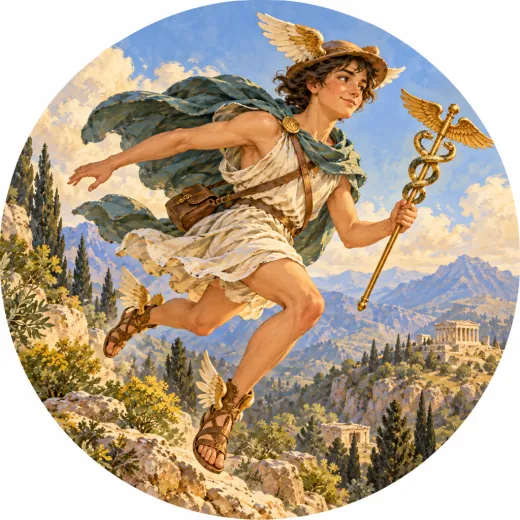
Hermes
Hermês, in Ancient Greek
not scary at all
Hermes is the messenger of the gods, lightning fast thanks to his golden, immortal sandals, which carry him over sea and land. He is a cattle thief, a spy of the night and a keeper of doors, because he is the cleverest of all. On the very day he was born, an ancient hymn says, he slipped out of his cradle, stole his half-brother Apollo's cows and invented the lyre using a tortoise shell. To make peace, he gave the lyre to Apollo. Hermes is also the only messenger who goes all the way to Hades.
Did you know? In the ancient hymn, Apollo gives him a golden sceptre, the sceptre “of wealth”.
The story
On the morning he was born, Hermes was already bored with his cradle.
He was born at dawn, in a cave on Mount Cyllene, in Arcadia. His mother was Maia, a nymph with beautiful braids who lived hidden away in the shadows. His father was Zeus, who visited her at night while the other gods were asleep. By noon the baby could already play music. By evening he had already stolen something.
Here is how it happened.
As soon as he could stand, he walked out of the cave and found a tortoise on the doorstep, nibbling the grass. He smiled. “What a lucky meeting,” he said. “Hello, you dancer who carries your house on your back! Come inside. You'll be better off.”
He took it into the cave, scooped it out, cut two reeds, stretched an ox-hide over the shell, added two arms and a crossbar and seven strings of sheep gut. He ran his finger across them. The sound rang out clear, and the baby sang along: he sang about Zeus and Maia, about the cave where they had met, and about himself and his own name. It was the first lyre in the world.
He hid it in his cradle. He had only just invented music and already he was hungry, hungry for meat. So he thought of his brother Apollo's cows.
The sun was setting when he reached Pieria, where Apollo's herds were grazing. He picked out fifty cows and drove them off. To muddle the tracks he made them walk backwards, so their hoofprints seemed to point the other way, and on his own feet he tied strange sandals made of tamarisk and myrtle twigs. Anyone who saw those prints in the mud could not have said what creature had made them.
At Onchestus he met an old man hoeing his vineyard. “Old man,” said the baby, “when these vines are heavy with grapes, you'll have plenty of wine. But you saw, and you didn't see. You heard, and you didn't hear. Keep your mouth shut if you don't want trouble.”
The old man stared at him without understanding. Then he went back to his vines.
Towards evening Hermes led the cows into a stable near the river Alpheus, and did something nobody had ever done before: he rubbed a stick of laurel against another piece of wood, and out came fire. It was the very first. Over that fire he roasted two cows, and divided the meat into twelve portions, as if for the twelve gods.
He was starving, but he did not eat. A god does not eat the meat of a sacrifice, however much he longs to, and it was steaming in the evening air with a smell that made him ache. He hid everything in the stable, put out the fire, covered the embers with dust and threw his sandals into the river. Then he left.
By dawn he was back on Cyllene. He slipped into the cave through the keyhole, light as an autumn breeze, crept into his cradle and wrapped himself in his swaddling clothes, with the lyre tucked under his arm. He looked like any other newborn.
But Maia was no fool.
“Where have you been, you little rascal?” she whispered. “Apollo will come and tie you up in chains that can't be broken.”
“Mother, why do you treat me like a baby?” he replied. “I want honours, not a cave. If my father won't give them to me, I'll become the prince of thieves. And if Apollo comes here, I'll do worse to him: I'll get into Delphi and carry off his tripods, his robes and his gold.”
Apollo arrived that very day. He had questioned the old man in the vineyard, who had sighed, “I saw a child driving some cows backwards. But I'm not saying anything else.” That was enough for him. He stamped into the cave, and Hermes made himself as small as he could, like a newborn sleeping peacefully.
“Baby in the cradle,” said Apollo, “tell me where my cows are, right now, or I'll throw you into Tartarus, and neither your mother nor your father will get you out.”
“Son of Leto, what harsh words!” Hermes opened his eyes wide, all innocence. “You came here looking for cows? I haven't seen them or heard of them. I was born yesterday. My feet are soft and the ground is hard. All I know how to do is sleep, drink milk and have warm baths. I swear on my father's head: I stole nothing, and I saw no one else steal anything.”
His eyes sparkled, and he whistled as if the whole thing amused him. Apollo laughed quietly.
“You little trickster,” he said. “I bet one day you'll be breaking into rich people's houses.” And he picked him up to take him to Zeus.
In Apollo's arms, Hermes sneezed, and straight after that he let out something even louder. Apollo, annoyed, dropped him.
Up on Olympus, Zeus listened to them both. The baby swore he knew nothing, Apollo shouted, and the father of the gods could not stop laughing. In the end he said, “Go and look for the cows, and let Hermes show where he has put them.”
Hermes obeyed. When they reached the river Alpheus, Apollo saw the hides of the two cows spread out on a rock and his jaw dropped: how could a baby have skinned two cows? Hermes did not answer. He took out the lyre and began to play.
Apollo listened. The music went into his chest and never left. “Where did you learn this?” he asked. “This is something that brings joy. I'll tell you what: you'll be famous among the immortals if you give it to me.”
Hermes gave it to him, and in return Apollo gave him a herdsman's golden whip and put him in charge of the herds. He also gave him a golden staff, the staff of wealth. They swore to be friends: Hermes promised never again to touch Apollo's things, and Apollo promised never to betray him.
From that day on Hermes was also the messenger who goes down to Hades, to the dead. But the Hymn says one more thing, and it is best not to forget it.
Hermes is not much help, it says. Instead, all night long, he never stops tricking the tribes of mortal men.
Relatives around the world
Listen / Read next
- Music to read by: Cinematic JourneyEpic film-style music, no lyrics, by Ciro Simone IrmiciSpotifyYouTube Music
Sources
- Homeric Hymn to Hermes
- Homer, Odyssey, Book V
