Tarantism and the Taranta
“taranta”, the spider, and the “tarantate”
a little scary
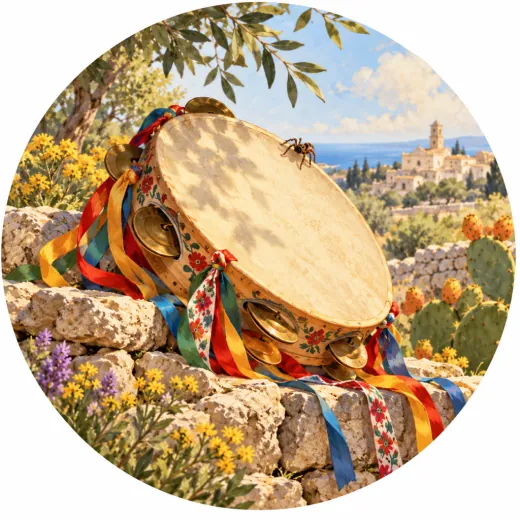
In the Salento, until a few decades ago, people believed that the bite of a spider, the taranta, made women in particular unwell between June and August: tiredness, sadness, restlessness. The cure was music. Players of tambourine, violin and accordion came, and the “tarantata” danced the pizzica, sometimes for days, until the illness went away. Then she went to Galatina, to the chapel of Saint Paul, to pray for healing. In 1959 the anthropologist Ernesto de Martino explained that the taranta was a symbolic animal: behind the bite lay real suffering.
Did you know? To cure the tarantate, the players tried one melody after another: the rhythm of the pizzica or the tarantella, but also slow tunes.
The story
It was the end of June, and the heat sat in the house like a guest who will not leave.
In the Salento, for many years, in those days someone fell ill. Almost always it was a woman. She had no fever, she had broken nothing. She simply stopped, that was all. She fell into a kind of bottomless weariness, and stayed staring at one point, without speaking, with no wish to do anything. The old people already knew the name of that illness. They said that the taranta had bitten her.
Nobody, however, could have said what spider it was. It was not a real spider, a single one, to be crushed with a shoe. It was a creature of whom stories were told: there were many kinds, and each had its own music. There was the one that made you laugh and do mad things. There was the one that wanted to sing. There was the furious one, that wanted to fight. And then there were the saddest, the silent ones, that did not say a word.
That illness came back. It could come back for years, every summer, between June and August, like a deadline.
There was only one cure, and it was not a medicine. They sent for the musicians.
They arrived at the house with the tambourine, with the violin, with the accordion, sometimes with the mouth organ. They were experienced people, who had learned the trade from the older ones. They came in silently. In the middle of the room they spread a white sheet on the floor, and the woman lay down on it, or stayed seated. The musicians gathered around her.
And something began that looked like a game, but was not.
They tried one music, then another. One more melody, and another still, slow or fast. Each time they watched the woman. For a long time she did not move. Then, suddenly, at a certain music, a foot shifted, a finger lifted, the body answered by itself. That was the right music, the music of that taranta. The musicians never stopped again.
Then came the colours. Someone showed the woman ribbons, strips of coloured cloth. She looked at them. One attracted her, one made her angry: the colour that bothered her was the colour of the spider. Sometimes she lunged at anyone wearing a dress that was too bright. In the house, around her, they put what she asked for: tubs of water, jars of fragrant herbs, a rope, a chair, a ladder, even a sword.
Then she rose.
The dance was the hardest part to watch. First she moved on the ground, and at that moment she was the taranta: she crawled, writhed, stopped. Then she stood up. Standing, the dance changed. The woman chased the spider that was not there, searched for it with her eyes, pursued it around the room. And finally she trampled it, with her feet, in time, always to the rhythm that never ended: the pizzica, the tarantella, the wave of the tambourine rising.
When she fell to the ground, the musicians waited. A few minutes, perhaps ten. Then they began again. The cycle repeated until late at night, for several days in a row. The people of the house took turns bringing her water. Nobody laughed. The heat did not drop even at night, and the music went on. Outside, the neighbours passed in the street with slower steps.
And inside her, what was happening? Nobody knows. Perhaps the woman, hidden from everyone, was saying something she could never otherwise have said. Perhaps it was the weariness of the whole year, the children, the work, an unspoken sorrow that had no words and now had a dance.
Then, at a certain point, the music stopped. And this time she did not fall. She remained standing, or sat down, and breathed softly, as after a long run. The illness, for this year, had gone.
But it was not over.
Because every tarantata, when she was better, had to go and give thanks. The place was at Galatina, in the province of Lecce, in a chapel dedicated to Saint Paul. Saint Paul, in the Bible's story, had been bitten by a snake in Malta and nothing happened to him. That is why the Salento chose him as the protector of those stung by venomous animals. On 29 June, the day of his feast, Mass was celebrated in the church. The healed tarantate came to give thanks. In the chapel they drank the water from the well, the sacred water.
Then the decades passed. Tarantism had been known throughout the South since the fourteenth century. In the Salento, in weaker forms, it survived until the 1990s.
In 1959 a scholar, Ernesto de Martino, came to look at it closely. He understood something that the old people, deep down, perhaps already knew: the taranta was not a spider. It was an animal of symbols, a way of giving a name to a pain, and of asking the village to help carry it. It was a way, for those who could not speak, of making themselves heard by everyone.
Today the pizzica is danced in the squares in summer, with lights and wine. It is a party. But beneath the party, if you stop and listen, the tambourine still has that beat. The beat of a woman lying on a white sheet, in a room that is too hot, waiting to hear the right music.
A living tradition, told with respect: how we tell myths.
Relatives around the world
Listen / Read next
- Music to read by: Cinematic JourneyEpic film-style music, no lyrics, by Ciro Simone IrmiciSpotifyYouTube Music
- The words of the dialect: ApulianNonnese, the dictionary of Italian dialects
Sources
- Ernesto de Martino, «La terra del rimorso. Contributo a una storia religiosa del Sud», Il Saggiatore (1961)
- Treccani, Enciclopedia on line, «Tarantismo»
