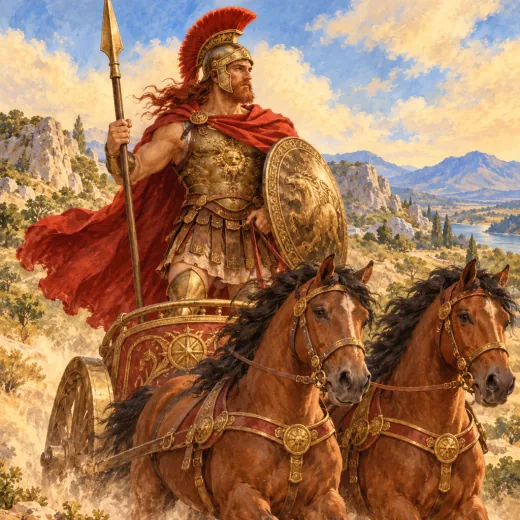
Ares
Árēs, in Ancient Greek
a little scary
Ares is the god of violent war and battle. He was the son of Zeus and Hera, but in Homer's poems he is not a well-loved god: in the Iliad even his father tells him he is the most hateful of all the gods of Olympus. He is brave but rash, and he often loses: during the Trojan War the hero Diomedes, guided by Athena, managed to wound him, and Ares went back to Olympus bellowing like nine or ten thousand warriors. He was followed by his sons Phobos, fear, and Deimos, terror.
Did you know? The two small moons of the planet Mars, discovered in 1877, are called Phobos and Deimos after his sons.
The story
They say Ares has a friend, and his name is not a pleasant one to hear: he is called Din.
Wherever Ares goes, the first thing you hear is a racket. Swords banging on shields, chariots overturning, the screams of men who no longer know who they are. Behind the racket, one step back, comes a cloud of dust. And in the middle of the dust, tall as a tower, with his bronze cloak and his gleaming helmet, is Ares, the god of war.
He was the son of Zeus and Hera. He had everything: strength, courage, a shining chariot. What he did not have, and everyone on Olympus knew it, was a scrap of patience. He liked the battle, not the reason for the battle. He fought on one side or the other, depending on his mood. And with him, wherever he went, were his sons: Phobos, Fear, and Deimos, Terror. They walked on either side of the chariot. Wherever they passed, even the toughest soldiers stopped for a moment to swallow.
On the plain of Troy, on the day this story takes place, the war had been going on for nine years.
That morning Ares was fighting for the Trojans. His armour was caked with dust and his heart full of dark joy. The Achaean lines were giving way under his blows, and the dust rose so thick that the soldiers could recognise each other only by their voices. On the other side of the field was Athena, goddess of wisdom, who was on the Achaeans' side and couldn't bear to see such chaos.
“Ares is ruining everything,” Hera said to Athena, watching the plain from the top of Olympus. “Let's go.”
They came down to earth in a chariot pulled by immortal horses. Hera took the form of a herald, Stentor, a man with a voice of bronze, as loud as fifty men's voices together. She shouted to the Achaeans: “Shame on you! Will you run from Troy like deer? Fight!” And her words, in the air, did more than a thousand drums.
Athena, meanwhile, went looking for Diomedes, a young and stubborn warrior. She found him beside his chariot, wounded, wiping his brow.
“Don't be afraid of Ares,” she told him. “I am with you. Strike him: he won't be so terrible up close.”
Then Athena did something not even a god should do. She put on the helmet of Hades, lord of the dead, which makes its wearer invisible. So, as Diomedes drove his chariot towards the god of war, none of them, neither the god nor his sons, saw the goddess riding beside him.
Ares saw Diomedes coming and laughed. He raised his bronze spear and hurled it with all the strength he had. A blow that would have split a mountain. But Athena, invisible, reached out her hand and turned the shaft aside, and it vanished into the air with a thin whistle.
Then it was Diomedes' turn. Spear in hand, guided by a hand no one could see, he struck. The shaft flew through the air and hit Ares below the belt, between the plates of his armour.
For a moment, nothing happened.
Then the god screamed.
It was a cry to make the earth shake, as loud as nine or ten thousand men shouting together, says Homer. At that sound, Achaeans and Trojans alike felt their legs go weak. Even the horses cowered. For the first time, the god of war was afraid of something he didn't understand: pain.
A black cloud came down over the field. When it opened, Ares was gone. He was rising towards Olympus wrapped in a storm of wind, and behind him, from the wound, ran a liquid that was not blood: ichor, the fluid that flows in the veins of the gods.
He reached his father's palace and dropped to his knees before Zeus's throne, his hand pressed to his side.
“Father,” he said, “look what they've done to me! A mortal! A little girl with a helmet nobody can see! Will you let them treat me like this? We gods are always fighting each other because of humans!”
Zeus looked down at him and showed no pity.
“Don't come whining to me,” he said. “Of all the gods on Olympus, you are the one I hate most. All you like is quarrels, brawls and war. You have your mother's temper, which never stops. If you'd been born of any other god, you'd have ended up far lower than all my enemies long ago.”
Ares bowed his head. Nobody spoke up for him.
But Zeus was still his father. After a moment's silence, he sent for Paeon, the physician of the gods. Paeon came with his herbs and spread an ointment on the wound, and they say the flesh closed in an instant, the way milk thickens when you add fig juice. Ares was washed, dressed again and seated at his father's side. Hera and Athena, meanwhile, had left the plain and were riding back up to Olympus in their chariot, their horses tired and their consciences clear. Below them, at Troy, the battle started up again as if nothing had happened. Later, one of the soldiers said he had heard a cry coming down from the sky, and had thought it was thunder.
The god of war was healed. But he was not the same. From that day on, whenever he heard the din of a battle, a thought crossed his mind, small and thin: there is an invisible hand that guides the spears.
Ares is not a well-loved god. The ancients feared him and respected him, and nobody thought of throwing him a festival. They imagined him in the wild lands of the north, in Thrace, among dark forests and snow. It was said that his sons, Phobos and Deimos, walked behind him even when the war was over.
And up in the sky, the small red planet the Romans named Mars, after their god of war, has two tiny moons. They still bear the names of Ares' sons: Fear and Terror.
They circle the planet without ever stopping, like two guards nobody has the courage to send away any more.
Relatives around the world
Listen / Read next
- Music to read by: Cinematic JourneyEpic film-style music, no lyrics, by Ciro Simone IrmiciSpotifyYouTube Music
Sources
- Homer, Iliad, Book V
- Hesiod, Theogony
