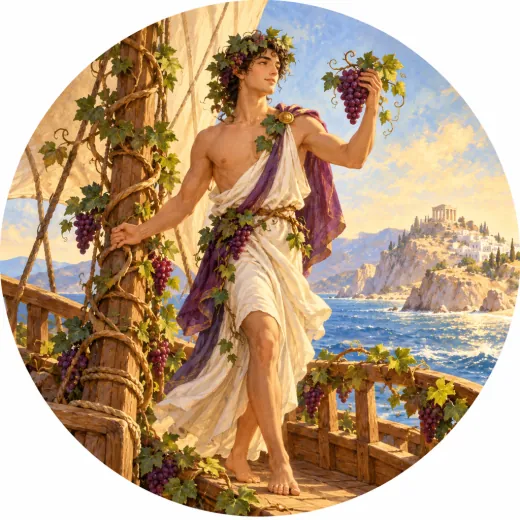
Dionysus
Diónysos, in Ancient Greek
not scary at all
Dionysus is the god of the vine, of wine, of celebration and of theatre. He was the son of Zeus and a mortal princess, Semele, and his birth was truly strange: Zeus kept him sewn into his own thigh until he was ready to come into the world. He travelled far, to the edges of Asia, teaching people how to grow vines. An ancient hymn tells that some pirates kidnapped him, thinking he was a rich boy: grapevines sprouted all over the ship, and the terrified pirates dived into the sea and became dolphins.
Did you know? Greek theatre was born during the festivals held in his honour: in Athens, tragedies were performed in the Theatre of Dionysus, below the Acropolis.
The story
They say Dionysus was born twice. And the second birth was much stranger than the first.
It began in Thebes, in a royal house, where there lived a princess called Semele. She was so beautiful that even Zeus, king of the gods, noticed her. He came down to her in secret, in disguise, and visited her so many times that in the end Semele was certain: she was expecting a child, and the father was the lord of the sky.
But someone had worked it out before she did. It was Hera, Zeus's wife, who never forgave.
One day an old woman knocked at Semele's door, bent and sweet-voiced. It was Beroe, her old nurse, the one who had brought her up as a little girl. Or so it seemed. In truth, behind that wrinkled face was Hera herself.
“Are you sure it's really Zeus?” she said softly. “So many men claim to be a god, to get what they want. If it really is him, ask him for proof. Tell him to show himself to you the way he shows himself to his wife, in all his splendour.”
The doubt, like a seed, took root. That evening, when Zeus came back, Semele said to him: “Swear you'll give me whatever I ask.”
Zeus, who loved her, swore by the water of the Styx, the river no god can ever go back on. “Anything,” he said. “Ask.”
“I want to see you as you really are.”
Zeus turned pale. He tried to back out, but the oath had been given and could not be taken back. He rose to the sky with a heavy heart, put on his robe of lightning and returned to Thebes with the thunder.
A mortal body cannot bear the sight of a god. The palace filled with light. Then with fire. Then, in an instant, with silence.
But Zeus, inside that light, had not forgotten his son. He snatched him from the flames before it was too late: the baby was still too small to be born. And so Zeus did something no god had ever done. He opened his own thigh, placed the baby inside and stitched it up again. For months he carried him, like something precious, until the day the child was ready. Then the thigh opened, and Dionysus was born for the second time, healthy and bawling, in his father's arms.
He was a dangerous baby to keep, because Hera had not given up. So Zeus gave him to Semele's sister, Ino, and then to the nymphs of a faraway mountain, who hid him in caves and raised him on milk and honey. Nobody knew where he was.
He grew up among the vines. He discovered what happens when you crush grapes and leave the juice to rest. He discovered music, dancing, laughter. Then he set off.
He travelled the world. He went from the coasts of Asia to its furthest edges, followed by a noisy procession of dancing women, satyrs with goats' legs, flutes and drums. Wherever he went, he taught people to plant vines and make wine, and people learned to laugh. But not everyone welcomed him. The king of Thebes, Pentheus, his cousin, rejected him: but that is another story, and not a pleasant one.
This one is about the pirates.
One day, on a beach, there was a boy. He had dark hair down to his shoulders, a purple cloak, and the look of someone who has drunk too much and slept too little. He was walking unsteadily on the sand, and he seemed so young and so rich that a ship of passing sailors saw him and thought: here's a bargain.
They were seafarers of the kind who don't ask questions. They tricked him on board, and he, without resisting, asked for just one thing. “Take me to Naxos. My home is there.”
“Of course,” they said. But among themselves they were shaking their heads. The helmsman was called Acoetes, and he was the only one who realised something was odd. There was nothing ordinary about that boy. When he spoke, the sea grew calm.
“He isn't a man,” he told the others. “There's a god inside that body. We can't harm him. Let's take him where he wants to go.”
The others shut him up. They turned the ship the opposite way, towards lands where they could sell a boy as a slave.
The ship didn't move.
It stood still on the sea, as if held up by a hand. The oars thrashed, the sails filled, the wind whistled, but the ship didn't go forward by so much as a hand's breadth. Then, on deck, came a gurgling sound. Wine welled up from the planks, sweet and fragrant, and spread over the sailors' feet.
Vines began to climb up the sails, heavy with bunches of grapes. Ivy wound itself around the mast, the oars, the ropes, and filled with dark berries. The sound of flutes came from nowhere. The sailors looked at each other, short of breath: on the ship, among them, stood a boy who was no longer a boy. Standing tall, a crown of leaves on his head, smiling, was the god.
At his feet lay wild beasts that hadn't been there before: a tiger, a lynx, a panther with a gleaming coat. The sailors screamed. Terror drove them all together to the side of the ship, and one after another, without thinking, they threw themselves into the sea.
But in the water, something happened. Their arms grew short and became flippers. Their backs curved. Their skin turned smooth and dark. When they came back up to the surface, they were no longer men: they were dolphins. And still today, they say, when a pod of dolphins leaps beside a ship, playing and laughing, anyone with an ear for it seems to hear in those leaps a joy that doesn't belong only to the sea.
Only the helmsman was left untouched. Acoetes, who had shown pity, stayed on deck, trembling, gazing at the god.
“Don't be afraid,” Dionysus told him. “Now we'll set course for Naxos.”
The ship moved off on its own, light, with the wine shining on the deck and the breeze among the leaves.
That, they say, is what Dionysus is like. God of the vine and of wine, of festivals and dancing, of theatre. A god who was born twice, who crosses the world with music behind him, and who sometimes, like his vines, grows where nobody expects him.
Relatives around the world
Listen / Read next
- Music to read by: Cinematic JourneyEpic film-style music, no lyrics, by Ciro Simone IrmiciSpotifyYouTube Music
Sources
- Homeric Hymn to Dionysus (VII)
- Euripides, The Bacchae (405 BC)
- Ovid, Metamorphoses, Book III
