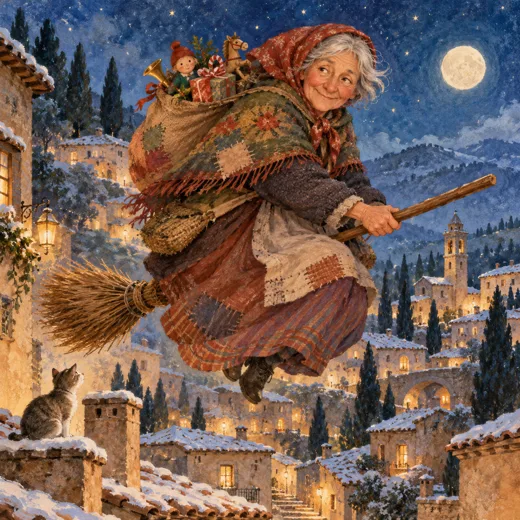
La Befana
from “Epifania”, the feast of 6 January
not scary at all
An old woman on a broomstick who, on the night between 5 and 6 January, brings sweets to good children and coal to naughty ones. A legend says the Three Wise Men asked her the way to Bethlehem and invited her to follow them; she refused, then regretted it, and since then she has been looking for the Child from house to house, leaving a present for everyone. Scholars also find older roots, in the farming rites of late winter. La Befana belongs to all of Italy, but Urbania, in the Marche, has declared itself her town.
Did you know? In Urbania la Befana has a house in the old town and even a post office, where letters from children all over Italy arrive.
The story
There is a little old woman in Italy who flies at night on a broom and whom children wait for with their stockings hung at the chimney. Everybody knows her. But almost nobody knows why she flies, and why every year, on the night before the sixth of January, she begins all over again.
The story, say the grandparents, goes like this.
A long time ago, on a cold, clear winter night, there was a little old woman who lived in a small house at the end of a path. She was a woman who always had something to do. As soon as she got up, she swept the floor. Then she swept the step. Then she swept the yard, and when she had finished she began again, because dust, as everyone knows, never ends. On the fire there was always a pot bubbling, in a corner there was always a basket of clothes to mend. Nobody could say she was lazy. Quite the opposite, she was so busy that she never lifted her head.
That evening, as she gave the last strokes of the broom to the doorstep, she heard an unusual sound. It was not the wind. It was a jingling of bells, a clatter of hooves, a rustle of long cloaks. She looked up, and saw three men on horseback coming along the path, dressed so finely that they seemed to have stepped out of a fairy tale. They had velvet cloaks, crowns that shone in the moonlight, and they carried in their arms chests covered with precious cloths.
They were the Magi, the Three Wise Kings.
They stopped at her door and got down from their horses with a courtesy that made her blush.
"Good woman," said the oldest, in a voice as warm as a blanket, "we have been travelling for many days. A star guides us, but tonight it has hidden behind the clouds, and we have lost our way. Could you tell us how to get to Bethlehem?"
The old woman stood still with the broom in her hand. She did not quite know what to answer. Then, a little embarrassed, she pointed along the path.
"That way," she said. "Follow the road to the end, then turn left, and from there you can see it."
The Magi thanked her with a bow. But the youngest, the one who seemed the most curious, added:
"You should come with us. We are going to visit a child who has just been born, a king who will bring peace to the world. Bring a gift too. He would be happy to meet you."
The old woman looked at their chests, their cloaks, the sky full of stars. For a moment, a single moment, she felt something in her chest that made her want to go. Then she looked at her house, the yard to sweep, the soup on the fire, the basket of clothes.
"Thank you," she said, shaking her head. "But I have too much to do. I have the house to clean, supper to make... Maybe later, if I finish in time."
The Magi did not insist. They said goodbye, climbed back on their horses and set off again. The jingling of the bells faded slowly away and then went out.
The old woman went back into the house and shut the door. She put the broom back in its place, stirred the soup, took up her mending again. But there was something strange: that silence now weighed on her. The needle trembled between her fingers. She looked at the pot and still saw the kind eyes of those three men. She thought of that phrase: "a child who has just been born".
Time passed. An evening, a morning, a whole day. And inside her, little by little, that weight grew bigger.
Towards evening, the old woman jumped to her feet. She put down the mending. She took a sack, and put inside everything she had in the house that could be a gift: some sweets she had made for herself, a pair of woollen socks, a few wooden toys she had kept for years, without knowing why. Then she took her broom, and went out into the night.
She looked for the Magi along the path. Then along the streets of the neighbouring village. Then in the fields, and on the hills. She asked everyone she met. But the Magi had already resumed their journey, and nobody could say where they had gone. The star, by now, had vanished.
Then the old woman understood that she had done something wrong. She had lost the chance to go and meet something great, only because she was too busy. And she could not go back.
But she did not want to stop.
She thought: "If I cannot bring my gift to that child, I will bring it to every child I meet. Who knows, perhaps one of them is he."
And from that night she began to go round, from house to house, from village to village, with the sack on her shoulders and the broom in her hands. She comes in by the chimneys, because the doors are shut. She passes without a sound, without waking anyone. And where she finds a stocking hung at the chimney, she leaves something.
To good children, she leaves sweets, nuts, candies, tangerines. To children who have been naughty, she leaves a piece of coal: not out of spite, but as a reminder, a little scolding that says "you can do better". And in the morning, everyone finds that someone has been by.
Then she flies away, fast, before day breaks. She flies because she has a long way to go, and because, after all, a little old woman so busy could only use her broom to go faster.
They say that on the night between the fifth and sixth of January, which is the night of the Epiphany, she is still on her way. That she goes round every corner of Italy, and that sometimes, for a moment, she stops to look at the lit windows, with a smile a little tired but full of tenderness.
Scholars add one more thing. They think that the story of the Befana is older than that of the Magi. That already the peasants, long before, when winter was ending and the fields slept under the snow, told of an old woman who went about at night between the end of the year and the beginning of the new one, and that those rites of the end of winter later mixed with the tale of the star and the Magi. Nobody can say for certain how it went. But it is nice to think that the two old women met along the road, and became one.
For this reason, still today, throughout Italy, the Befana has a special place. But there is one town that considers her truly its own: Urbania, in the Marche. There, every year, in the first days of January, the town fills with children, sweets, enormous stockings and old women with brooms. There the Befana even has a house, in the heart of the old town, and a post office all her own, where letters from children arrive from every part of Italy.
Because after all, the Befana is not a witch, nor a frightening grandmother. She is a little old woman who learned too late what really matters, and who since then, every year, tries to make up for it with a sack of sweets and a bit of broom.
And so, on the night of the fifth of January, do not forget to leave the stocking hanging at the chimney.
Because, if you hear her coming, there is no need to be afraid. Just wait, in silence, with a light heart.
It might be her night, after all.
Relatives around the world
In the trails
Listen / Read next
- Music to read by: Cinematic JourneyEpic film-style music, no lyrics, by Ciro Simone IrmiciSpotifyYouTube Music
