Baba Yaga
Baba Jaga, the old witch
scary
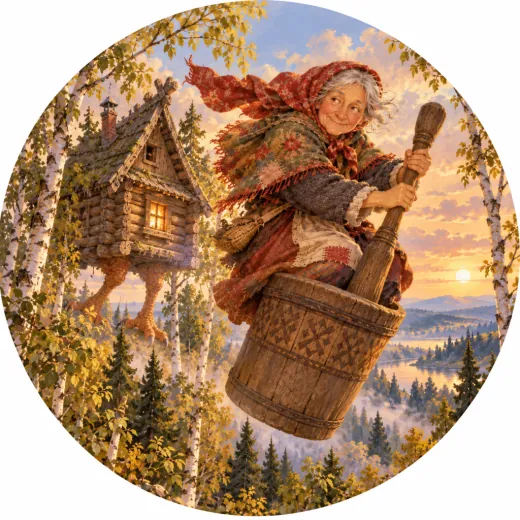
Baba Yaga is the most famous witch of Russian fairy tales. She lives deep in the forest in a hut that stands on two huge chicken legs, surrounded by a fence of bones topped with glowing skulls. She does not fly on a broomstick but inside a mortar, rowing with the pestle and sweeping away her tracks with a broom. She can be terrible, but not always: to those who are brave, kind and able to answer her questions, she sometimes gives help and magic gifts.
Did you know? In the fairy tale “Vasilisa the Beautiful” a magic little doll helps the heroine pass all of Baba Yaga's tests.
The story
When her mother was dying, Vasilisa was eight years old.
Her mother called her to the bed and gave her a little cloth doll, no bigger than a hand. “Keep her with you always,” she said. “Show her to no one. When you need help, give her a crumb of bread to eat and ask her what to do. She will help you.” Then she closed her eyes and never opened them again.
Vasilisa's father married again. His new wife had two daughters, and all three of them hated Vasilisa because she was kind and beautiful. They piled work on her from morning till night, hoping she would wear herself out, or fall ill, or simply disappear. But every night Vasilisa gave the doll a crumb of bread and told her about her day, and in the morning the work was done: the fields hoed, the well full, the stove lit.
One autumn, her father had to go away on a long journey. The stepmother and stepsisters moved to a house at the far edge of the forest, in a place where, people said, Baba Yaga lived.
One evening, after dark, the stepmother blew out the only candle in the house.
“How careless of us,” she said. “The fire has gone out. Vasilisa, go to Baba Yaga and fetch us a burning ember.”
The stepsisters smiled without making a sound. They knew who lived deep in that forest. They knew that nobody ever came back.
Vasilisa put the doll in her pocket and set off.
The forest was black. The pines were so tall that the moon could not get in. All she could hear was the crackle of branches and, now and then, a long breath among the trees that might have been the wind. “What shall I do?” Vasilisa whispered. From her pocket, the doll whispered back: “Don't be afraid. Follow the path.”
She walked all night. At dawn a white horseman on a white horse rode past her and vanished among the trees: the day came with him. When the sun rose, a red one went by on a red horse, galloping like a flame. In the evening the forest opened up, and Vasilisa saw the clearing.
It had a fence all the way round. But the fence was not made of wood. It was made of bones. Long bones, curved bones, woven together like willow branches, and on top of every post sat a skull, its eye sockets gaping. The gate had legs instead of hinges, arms instead of bolts, and a mouth full of sharp teeth instead of a lock.
In the middle of the clearing stood a hut. It did not sit on the ground. It stood on two chicken legs, huge ones, with claws, and every so often it shifted, slowly, from side to side, as if it were breathing.
Just then a third horseman rode by, black on a black horse, and disappeared beyond the gate. Night fell. And suddenly the skulls' eyes lit up.
One by one, they glowed with a reddish light that lit up everything. Vasilisa stood perfectly still. She could hear her heart pounding in her ears.
Then came a rustling in the forest. The sound of things snapping. A whistle.
Above the trees appeared an iron mortar, as big as a barrel, flying through the air. Standing inside it was an old woman, very tall and very thin, with a long hooked nose, iron teeth and legs as skinny as sticks. She rowed through the air with a pestle, and behind her she swept away her tracks with a broom.
It was Baba Yaga.
She landed in front of the gate. She sniffed the air. “Phoo, phoo, phoo!” she said. “I smell a Russian! Who's there?”
Vasilisa stepped forward with her eyes lowered and bowed. “It's me, Granny. My stepmother sent me to ask you for a little fire.”
“I know, I know,” said the old woman, and her voice was a creak. “Very well. You will stay and work for me, and then I'll give you what you came for. But if you don't do what I tell you, and do it well, I'll eat you.”
They went in. The hut swayed. Baba Yaga sat down at the table and ordered Vasilisa to serve her everything in the stove: meat, broth, soup. She ate almost all of it and left Vasilisa a crust of bread. Then, before going to bed, she said:
“Tomorrow, when I go out, you must sweep the yard, clean the house, cook the supper and wash the clothes. Then sort the grains of wheat from the earth, and the poppy seeds from the dust. One by one. When I come back, it must all be done. Otherwise…” And she snapped her iron teeth.
Left alone, Vasilisa gave the doll the crust of bread. “Cry, cry,” whispered the doll. “Then go to sleep. The night is wiser than the day.”
In the morning, Baba Yaga went out in her mortar. The yard was swept, the supper was ready, the washing hung out, the wheat sorted from the earth, the poppy seeds in their basket. When the old woman came back, she looked everything over and found nothing to complain about. She roared: “Who helped you?”
“My mother's blessing, Granny.”
The old woman's eyes went wide. “Out of here!” she roared. “I want no blessed ones in my house!”
She snatched a skull from the fence, stuck it on a stick and held it out to her. Its eyes were still burning.
“Take your fire. That's what you wanted.”
Vasilisa took it, bowed, and ran. The skull shone ahead of her like a lantern, lighting up the path. By dawn she was home.
The stepmother and stepsisters had been waiting for her with no candles and no fire ever since she left. When they saw the skull, their mouths fell open. The skull's eyes stared at them. Wherever they moved, wherever they hid, those eyes followed them, and burned.
By morning, all that was left in the house was a little heap of ash.
Vasilisa buried the skull in the garden and never touched it again.
The forest, meanwhile, stayed where it was. And even today, they say, on certain windy nights, when the pines creak and the moon cannot get in, you can hear a creaking far away: the sound of a mortar flying over the trees, and a thin voice sniffing the air. “Phoo, phoo, phoo. I smell a Russian.”
Anyone who hears it usually shuts the door. And does not go out looking for fire.
Relatives around the world
In the trails
Listen / Read next
- Music to read by: Cinematic JourneyEpic film-style music, no lyrics, by Ciro Simone IrmiciSpotifyYouTube Music
Sources
- Aleksandr Afanas'ev, Russian Fairy Tales (1855–1863)
