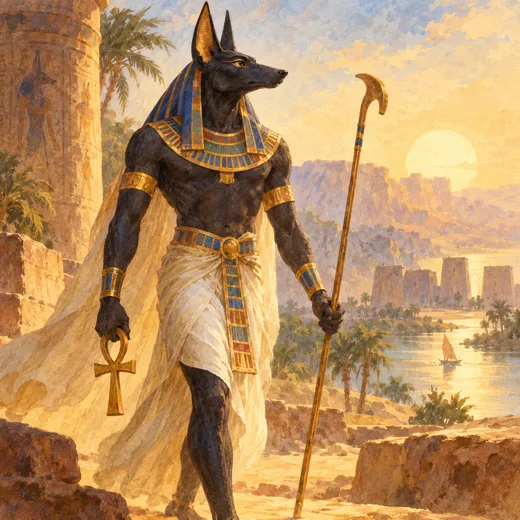
Anubis
Anpu, in Ancient Egyptian
a little scary
Anubis is the jackal-headed god who protected tombs and guided the dead into the afterlife. In the “weighing of the heart” he placed the dead person's heart on a scale, against the feather of Maat, the goddess of justice: if the heart was light, the person could continue the journey. He was also the god who knew how to prepare mummies. It was said that he was the first to wrap the body of Osiris; according to Plutarch he was the son of Osiris and Nephthys, and he helped Isis search for him.
Did you know? The Egyptians pictured him as a jackal because these animals prowled around the cemeteries at the edge of the desert.
The story
At the edge of the Nile valley, where the fields end and the desert begins, jackals walk at night.
They move among the tombs without a sound: thin shapes with pricked-up ears and glinting eyes. The Egyptians saw them every evening, and did not chase them away. They believed the jackals had a reason to be there.
One of them, people said, was not an animal. His name was Anubis, and his black head, with its pointed ears, was painted on the walls of every tomb. He was the god who went with the dead. And it is his story that begins now, with a man called Ani.
Ani was a scribe in Thebes. He had spent his life writing up accounts, counting sacks of grain, keeping other people's numbers in order. He was neither rich nor powerful. He had a wife, Tutu, and people greeted him in the street. One day he died, as everyone does, and his family did what was done for the dead.
For many days the priests worked around his body in silence, with oils and spices that smelled of resin. His body was washed, tended and wrapped in long linen bandages. It was said that Anubis had been the first to do this, with the body of Osiris, and that ever since then every dead person had been wrapped the same way, so that they could set out on the journey whole. Beside him they placed a papyrus with the spells he would need to say. It was the Book of the Dead, and Ani had wanted one for himself.
Then the tomb was closed, and Ani's road began.
It was not a road like any other. It was dark, with no walls and no horizon. You walked for a long time, through gates you had to know how to name, and through places where nameless creatures lived. Behind him, with every step, the last light of the tomb grew smaller, until there was only darkness. Ani knew the spells and repeated them under his breath, like a child going over a lesson. His heart was pounding.
Suddenly, a hall opened up in front of him.
It was vast and cold. It was called the Hall of the Two Truths. Along the walls sat forty-two judges, motionless, each with his own name and his own task. Nobody spoke. The judges had names that sounded like noises and faces that could not be read. Ani walked into the middle, with Tutu beside him, and stopped.
“I have not stolen,” he said. His voice shook, and the sound was lost in the towering ceiling. “I have not lied. I have made no one cry.”
Forty-two times he repeated those words, once for each judge. It felt as if he would never finish. At the far end of the hall stood a pair of scales.
Next to the scales, standing upright, was a jackal.
He was tall and black, with amber eyes, and he did not move. He had the head of a jackal and the body of a man, and he stood so still that he seemed painted on the wall. Ani had never seen him before, and yet he knew him. When he was close enough, the jackal held out a human hand and took him by the wrist, gently, the way you take hold of a frightened child.
“Come,” said Anubis.
He led him to the pans of the scales. On one of them, in the flickering light, Ani saw a white feather, as light as a breath: it was the feather of Maat, the goddess of order and justice. On the other pan there was nothing.
“Give me your heart,” said Anubis.
It was Ani's heart: the place where, for the Egyptians, memory and thoughts lived, along with all the good and all the bad a person had done in life. Anubis, who knew every heart of every dead person, took it with steady hands and laid it on the empty pan.
The pan swayed.
Ani had stopped breathing, and in the hall there was not even the rustle of a robe. He thought of everything he had done. A lie, when he was a boy. A coin he once kept when he shouldn't have, so as not to admit he had found it. A harsh word said to Tutu and never quite taken back. His heart felt terribly heavy. The spells got muddled in his head. “My heart,” he thought, “do not speak against me.”
To one side, crouching in a corner of shadow, was something else. A creature with the head of a crocodile, the body of a lion and the legs of a hippopotamus, which never took its eyes off the scales. Its name was Ammit. It waited for the hearts that weighed too much. It was not a judge: it was only an appetite, and it waited in silence, the way someone waits who is in no hurry, because sooner or later there will be something to eat.
Beside the scales, the god Thoth, with the head of an ibis, held his pen above the papyrus, ready to write.
The pan with the heart rose. It sank. It rose again, more slowly. Then it stopped.
The heart and the feather were level.
No one said anything. Thoth wrote a single line. Ammit lowered its head, and for a moment it looked almost disappointed. Anubis took the heart from the pan, gave it back to Ani and nodded, just barely, as if to say that all was well.
Ani felt his legs give way beneath him.
Then a young god with the head of a falcon, Horus, came towards him and took him by the hand. He led him past the scales, past the judges, to a throne where a king with green skin sat, wrapped in bandages: Osiris. Behind him stood two women.
Anubis did not follow. His task was done.
He went back towards the shadows, where the hall opened onto the darkness, and from there along the sandy road into the desert. And even today, they say, when a jackal passes silently among the tombs at night, head low and ears pricked, nobody chases it away.
It might be bringing someone home.
Relatives around the world
In real history
Listen / Read next
- Music to read by: Cinematic JourneyEpic film-style music, no lyrics, by Ciro Simone IrmiciSpotifyYouTube Music
Sources
- Book of the Dead, Papyrus of Ani (about 1250 BC)
