Ceres
Ceres, in Latin
not scary at all
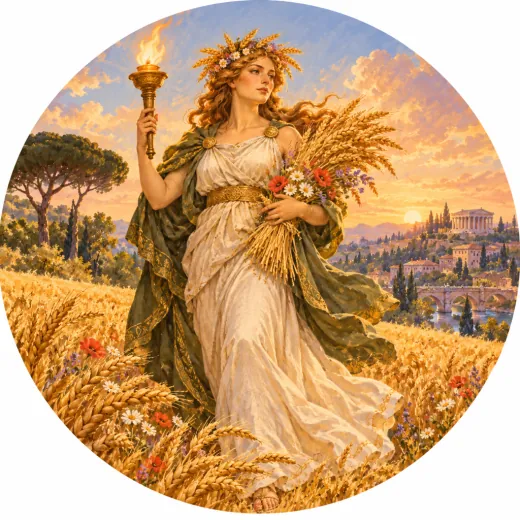
Ceres was the Roman goddess of grain, of farmed fields and of growing plants. The Romans gave her the stories of the Greek Demeter: she too had lost her daughter, Proserpina, carried off by the king of the dead, and she too had searched for her over land and sea with lighted torches. Her temple on the Aventine, built at the start of the 5th century BC, was the sanctuary of the plebs, the common people of Rome. In April, during the Cerealia, games and races were held in her honour.
Did you know? Her name gives us the word “cereal”, and also the dwarf planet Ceres, discovered in 1801 in Palermo by the astronomer Giuseppe Piazzi.
The story
On the Aventine Hill in Rome there was a temple where ordinary people went: farmers, craftsmen, people with no famous ancestors. It was the temple of Ceres, goddess of the grain. And when children asked why she mattered so much, the old folk always began with a meadow.
It was a meadow full of flowers, and among the flowers was Proserpina, Ceres's daughter. She was picking roses, violets and irises with her friends. Then she saw a narcissus. It was a strange flower with a hundred heads, and its scent was so strong that the sky and the earth and the sea seemed to laugh with delight. Proserpina reached out her hand.
The ground split open.
Out of it came a chariot drawn by black horses, and in the chariot stood the king of the dead, Pluto. He seized her and carried her down, while she screamed for her father, Jupiter, who was far away and did not hear. The earth closed again, and in the meadow only the flowers were left.
But someone had heard. Hecate, goddess of caves, from her cavern. The Sun, who sees everything from up there. And her mother. Proserpina's voice echoed off the mountain peaks and the bottom of the sea, and it reached Ceres like a blade. The goddess tore the veil from her head and flew over lands and seas like a bird.
For nine days she searched for her daughter with two blazing torches in her hands. She did not eat, she did not drink, she did not wash. At the tenth dawn she met Hecate, who had heard but not seen, and together they went to the Sun.
“Tell me the truth,” said Ceres. “You see everything.”
The Sun made no excuses. “Jupiter gave her away, her own father, to Pluto, his brother. He is not a bad husband for your daughter. He is a king.”
The grief went into Ceres's heart wilder than before. She left Olympus, she left the gods, she disguised herself as an old woman and walked among humans, and nobody recognised her.
She came to Eleusis, a town near the sea, and sat down under an olive tree beside the well. It was late afternoon. Four girls came with bronze jugs to fetch water, the daughters of King Celeus, and seeing the old woman alone they asked who she was.
“Pirates kidnapped me,” said Ceres, who did not want to tell the truth, “and I escaped. I’m looking for a house where I can work.”
The girls took her to their mother, Metaneira, who held a little baby, Demophon, in her arms, and who offered her a seat and a cup of red wine. Ceres refused the wine. She asked for water and barley mixed with mint, and drank it in silence, without smiling.
Then a servant called Iambe began to tell her jokes, so many and so funny that at a certain point the goddess, for the first time in nine days, laughed. It was a short laugh, but Iambe remembered it all her life.
For a while Ceres was little Demophon's nurse, and the child grew like a god. He did not eat and did not drink milk, because every day the goddess rubbed him with ambrosia, the food of the immortals. At night, in secret, she put him in the fire, the way you push a log into the embers, to burn away whatever was mortal in him. She wanted him never to grow old.
One night Metaneira caught her. She saw her baby in the middle of the flames and let out a scream, and Ceres, furious, took him out of the fire and set him on the ground.
“Foolish humans,” she said. “You cannot tell good from bad when it comes to you. This child would have been immortal. Now he will die like everyone else.”
Then old age fell from her like a cloak. She appeared tall and beautiful, in a light that filled the house with the scent of ripe grain. She ordered them to build her a temple with an altar, and she shut herself inside it.
So began the most terrible year anyone could remember.
Ceres sat in her temple, and no seed grew. Oxen pulled ploughs across the fields and nothing happened. People scattered seed in the furrows, and the seed stayed seed. The earth dried up, there was no bread. The old men of the villages looked at the sky and said nothing, and mothers shared the last handful of flour among too many mouths. Without humans there would be nobody left to offer the gods a sacrifice, and the gods, for the first time, noticed.
Jupiter sent messengers, one after another. Ceres did not get up.
“I will not go up to Olympus,” she answered. “I will not let a single blade of grass sprout. Not until I see my daughter with my own eyes.”
Then Jupiter understood, and sent Mercury underground to speak to Pluto.
When the king of the dead heard, he smiled faintly, with his eyebrows. “Very well,” he said. “Let her go back to her mother.” Then, as Proserpina climbed into the chariot, he handed her a pomegranate seed, sweet as honey. She ate it without thinking.
Ceres saw her from the doorway of the temple and ran to meet her like a woman out of her mind. They held each other without speaking, and for a moment even the wind stopped to listen to that silence.
“Did you eat anything down there?” her mother asked afterwards. “If you didn’t, you will live with me for ever.”
Proserpina lowered her eyes. “A pomegranate seed,” she said. “They gave it to me in secret.”
Jupiter decided that for a third of the year Proserpina would stay in the dark beside her husband, and for the other two thirds she would come back to her mother and the gods. Ceres agreed. She raised her hand, and in a few hours the plain was covered with leaves and flowers.
She also taught her rites to the kings of Eleusis, so that no one would forget.
In Rome, every April, at her festival, the ordinary people of the Aventine held games and races in her honour. Then, out in the fields, the seed went back down into the earth, to vanish under the clods. And it waited.
Relatives around the world
Listen / Read next
- Music to read by: Cinematic JourneyEpic film-style music, no lyrics, by Ciro Simone IrmiciSpotifyYouTube Music
Sources
- Ovid, Fasti, Book IV
- Dionysius of Halicarnassus, Roman Antiquities, Book VI
