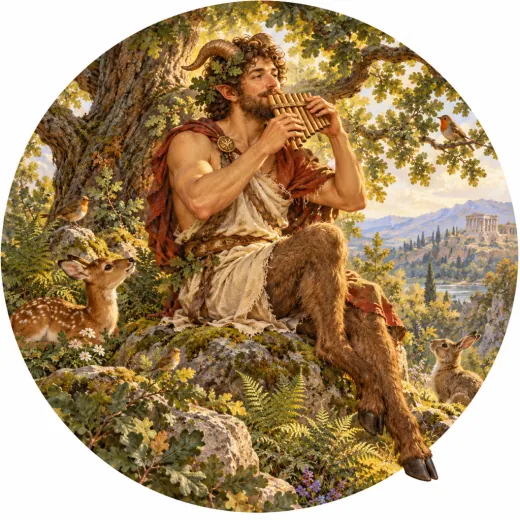
Faunus
Faunus, in Latin
not scary at all
Faunus was a very ancient god of the Latins, protector of woods, fields, flocks and shepherds. According to Virgil he had also been a king of Lazio, the father of King Latinus who welcomed Aeneas. Faunus spoke to people through dreams and the mysterious voices of the woods: anyone who wanted an answer went to sleep on sheepskins in a sacred forest, and waited. In time the Romans likened him to the Greek god Pan, as Ovid does in the Fasti.
Did you know? On 15 February Rome celebrated the Lupercalia, a festival linked to Faunus, in which young priests ran about with strips of goatskin.
The story
In Lazio, long before Rome was Rome, there was a wood where nobody went to gather firewood and nobody went to hunt. You went there only with a question no human could answer.
The wood lay not far from Laurentum, the city of King Latinus. Among the dark trees a spring bubbled up that stank of sulphur: the water came out of the ground with a heavy smoke, and all around it there was a strange silence, as if even the birds had decided to speak more softly. The spring was called Albunea. People said the name under their breath.
That spring, King Latinus could no longer sleep.
He was old. He had ruled in peace for many years, and he had a wife, Amata, and a daughter, Lavinia. He had no other children: his only son had been taken from him as a little boy. So after him, the crown would go to the man who married Lavinia.
There were suitors by the dozen. The handsomest, the richest and the most self-assured was Turnus, a young prince of the Rutulians, from an ancient family. The queen wanted him as her son-in-law at any cost. She said so at breakfast, at dinner, in the courtyard, in front of the fire.
But the king hesitated, and not out of whim. In his palace stood a sacred laurel, very tall. One day a swarm of bees had flown in and hung thick from its highest branches, dark as a bunch of grapes. The seer had looked at it for a long time. Then he had said: “A stranger will come. He will come with his people, from far away, and he will be master of this citadel.”
That was not good news for a king whose wife had already chosen a suitor. Latinus understood he could not sort this out alone. So he did what people did in those days, when human words were not enough: he went to ask his father.
Because his father was Faunus.
Nobody could say how long Faunus had been there. He was a very ancient god, older than the cities, lord of the woods and the flocks, and the Latins respected him more than they feared him. He did not hurl thunderbolts or stir up the sea. He did one thing only, but he did it better than anyone: he spoke. He spoke inside dreams, and inside the voices you hear only in the woods, if you have the patience to wait.
The king set out at sunset with a procession of priests, and reached the spring at nightfall. A hundred white-fleeced sheep were brought before the altar. When the priests had finished, Latinus did something that looked very strange to the onlookers. He took the fleeces of those sheep, spread them on the ground in the thickest part of the wood, and lay down on them.
“Stay here with me, but don’t speak,” he told an old servant. “And if you see me move, don’t wake me.”
Then he closed his eyes.
At first nothing happened. You could hear the water simmering softly in the spring, and the king felt the still-warm wool against his face. Then it seemed to him that the darkness was filling up. Thin, pale figures he had never seen went by, coming and going like leaves on water. He heard voices: the voices of gods, he thought, and beneath them other voices, further away, rising from deep below, from places where the living do not go.
Then, among them all, he recognised one.
It was a calm, ancient voice, with the sound of wind in the branches inside it. It was his father’s voice.
“Latinus, my son. Do not look for a husband from Lazio for your girl. Do not promise the wedding they have arranged for you at home. Strangers will come, and they will be your sons-in-law. Their blood will carry our name to the stars, and their descendants will see everything at their feet, as far as the sun can see, from one sea to the other.”
The king woke with a start, his heart pounding. The servant gave him water. The spring was smoking just as before. The birds were still not singing.
“Did you hear anything?” Latinus asked.
“Me? Nothing, my king. Only the sheep.”
Latinus smiled. That was as it should be: the voice had been for him alone.
He went home, and this time he did not keep the secret. He was a king, not someone who hides things at the back of a drawer. The news spread all over Lazio, and people began to go to the spring of Albunea with their sheep, to lie down on the fleeces and wait.
A few days later, at the mouth of the Tiber, ships appeared.
They were long ships, weary ships, that had crossed an entire sea. Out of them climbed men crusted with salt and tiredness, led by a man called Aeneas, who came from a city that had been destroyed: Troy. They sat down on the grass under the trees and took out their food: flat wheat cakes, which they used instead of plates, with wild fruit piled on top. When they had finished the fruit, they ate the cakes too.
“Look!” said the youngest, laughing. “We’ve even eaten our tables!”
The others laughed, and then they stopped laughing. It was the sign they had awaited for years, the one meant to tell them where to stop: they had arrived.
The old king received them with honour. He looked at Aeneas, he looked at his daughter, and he thought back to a voice in the middle of a wood.
The wood of Albunea stayed where it was, and Faunus was never forgotten. When Rome became great, the Romans held a festival for him every year, on the fifteenth of February, at the foot of the Palatine Hill, in a cave called the Lupercal. Young priests sacrificed a goat and then ran through the streets of the city with strips of skin in their hands, and people came out of their houses to be touched by them and carry home a little luck.
At night, though, Faunus still had something of his own. The shepherds of Lazio, they say, when they find a sheep that has wandered off, sometimes stop and listen. The wood has a way of being silent that seems full of words. And some swear they have almost understood them.
Relatives around the world
Listen / Read next
- Music to read by: Cinematic JourneyEpic film-style music, no lyrics, by Ciro Simone IrmiciSpotifyYouTube Music
Sources
- Virgil, Aeneid, Book VII
- Ovid, Fasti, Book II
