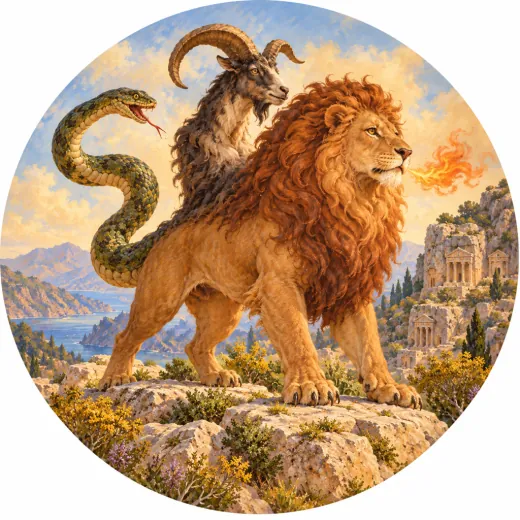
The Chimera
Chímaira, “she-goat”
scary
The Chimera was one of the strangest monsters of Greek myth: a lion at the front, a goat in the middle and a snake at the back. It breathed fire and laid waste to the fields of Lycia. The king of that land gave the task of defeating it to the young hero Bellerophon, hoping he would never come back. But Bellerophon managed to tame the winged horse Pegasus and, attacking from above, where the flames could not reach, he beat the monster.
Did you know? The “Chimera of Arezzo”, a large Etruscan bronze statue found in 1553, is now in the National Archaeological Museum of Florence.
The story
In Lycia, where the mountains drop sheer into the sea and fields are few and precious, there were shepherds who had stopped sleeping.
Not because of fear. Or rather: not only because of fear. It was because at night the sky, over towards the mountains, turned red.
It wasn't dawn. It was a low glow that pulsed, rising and falling like the breathing of a giant animal. Then came the smell: a stench of sulphur and burnt fur that drifted down into the valley on the wind. And then the noise, a deep roar, followed by a hoarse bleat, followed by a long hiss.
Three voices, from a single throat.
The old people of the village called it the Chimera.
They said she was the daughter of Typhon and Echidna, two monsters so ancient that even the gods were afraid of them. They said that a man, one Amisodarus, had raised her when she was small, and that she had been the ruin of many. She was not a beast. She was of divine birth, not human: in front she had the body of a lion, in the middle that of a goat, and behind, a serpent that served as her tail. And from her mouth, whenever she wished, she breathed fire.
Those who had seen her up close didn't talk about it. Those who talked about her had never seen her. But every morning, at the edges of the valley, there were blackened fields, bare trees, and livestock scattered across the meadow with their eyes wide open.
The king of Lycia was called Iobates. He was a cautious man who had no love for lost battles. The Chimera made his life hard: his subjects complained, the harvests vanished, and no warrior dared go near the mountains.
It was in those days that a stranger arrived.
He walked with the weary step of someone who has travelled a long way, and he wore the cloak of a young nobleman. His name was Bellerophon. He had been sent by Proetus, king of Argos and Iobates' son-in-law, with a sealed message.
Iobates welcomed him to the palace with great honours. For nine days he feasted him, and every day he had an ox slaughtered in his honour. He didn't know the young man's story: he knew only that he was a guest, and that guests are sacred.
What Iobates didn't know, and Bellerophon didn't know either, was what the message said.
In Argos, Proetus's wife, who was Iobates' own daughter, had accused Bellerophon of something he had never done. Proetus had believed her. But he didn't want to kill a guest, so he had chosen another way. He had folded a tablet, written deadly signs on it, and placed it in the young man's hands with just one sentence: “Take this to my father-in-law.”
For days, Bellerophon had walked with his own death sentence under his arm.
On the tenth day, Iobates asked: “What have you brought me?”
The young man handed him the tablet. The king opened it. He read.
For a moment his face didn't move. Then he raised his eyes to the stranger. He, too, did not want to kill a guest. But he did want to carry out the order.
“I have a task for you,” he said in a calm voice. “There is a monster in the mountains. No one has the courage to face it. If you are a true hero, you will go.”
Bellerophon didn't know he was being sent to his death. He knew only that a beast was destroying the land of the man who had welcomed him, and that a debt of hospitality must be paid.
“I'll go,” he said.
Before setting off, though, he did something wise: he asked the gods for advice. One night he slept in a temple, and Athena appeared to him in a dream. She left him a gift: a golden bridle, for a horse. When he woke, the bridle was in his hand.
There was a white horse with wings that drank at the spring of Peirene, in Corinth. His name was Pegasus. No one had ever managed to get near him. Bellerophon went looking for him at the hour when the sky is still grey, and found him with his muzzle in the water. He came closer, slowly. The horse pricked up his ears. His eyes went wide. Bellerophon, without a single sudden movement, showed him the golden bridle.
Pegasus let himself be caught.
Together they rose until they cut through the clouds, and they crossed the sea towards Lycia. From up high, the valley looked small. And at the far end of the valley, in the heart of the mountains, something glowed red.
Bellerophon gripped the mane and turned the horse towards the glow.
The Chimera was stretched out on the rock. All around, the ground was black. The lion was asleep with its muzzle resting on its paws; the goat's eyes were open; the serpent moved slowly, tasting the air. Then the lion's head lifted its muzzle. It felt the shadow above it. Its roar boomed against the mountain walls.
From its mouth burst a column of fire, straight up.
But Pegasus was higher than the fire could reach. Bellerophon felt the heat on his skin, felt the scorching wind. Then, from up high, where the flames died away in the air, he took his bow and began to shoot arrows, one after another, unhurried, never missing.
The Chimera screamed with all three voices. She thrashed on the rocks. She spat fire again, twice, three times. Then the ground stopped shaking.
When silence returned, a real silence, for the first time in a long while, the shepherds heard the wind in the leaves.
The monster was gone. In the evening, the sky stayed dark, the way it should.
Bellerophon went back to Iobates with his deed done. The king looked at him for a long time. Then he gave him more tasks, and then more still, and Bellerophon completed every one. In the end Iobates understood that this young man must be the son of a god, and no longer a man to be condemned. He gave him his daughter in marriage, and half of his kingdom.
The ancients say the Chimera lived on in stories, and that now and then, on some clear night, over the mountains of Lycia, the sky turns red. They say it is just a reflection.
But when the shepherds see it, they put out their fires and keep very quiet.
Relatives around the world
Listen / Read next
- Music to read by: Cinematic JourneyEpic film-style music, no lyrics, by Ciro Simone IrmiciSpotifyYouTube Music
Sources
- Homer, Iliad, Book VI
- Hesiod, Theogony
