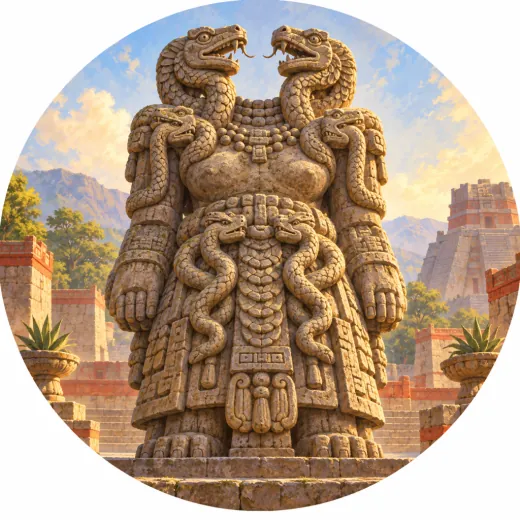
Coatlicue
“serpent skirt”, in Nahuatl
scary
Coatlicue was the “serpent skirt” of the Aztecs, a mother goddess whom scholars link to the earth. While she was sweeping the temple on Mount Coatepec, she picked up a ball of feathers that had fallen from the sky and tucked it into her bosom, under her dress: and so she came to expect a son, the god Huitzilopochtli. Her figure was frightening, because the earth gives life but also takes in the dead. Her most famous statue, more than two and a half metres tall, has two serpent heads in place of a face and a skirt of woven serpents.
Did you know? That statue was found in 1790 in the main square of Mexico City and was buried again; today it is in the National Museum of Anthropology.
The story
On the mountain of Coatepec, near Tula, there lived a woman who did penance. Her name was Coatlicue, “she of the serpent skirt”.
Every morning, before the sun warmed the stones, she climbed to the temple on the mountaintop with a broom in her hand, and she swept. She swept the floor, the steps, the dust the wind had brought. It was humble work, repeated for many years, and she thought of nothing except doing it well.
She had many children. A daughter, Coyolxauhqui, and four hundred sons, the Centzon Huitznahua, who were always together like a flock of birds.
One morning, as she swept, a little ball of fine feathers floated down from the sky. It turned in the air for a while, light, as if choosing where to land. Coatlicue picked it up. The feathers were so beautiful and soft that she did not want to leave them in the dust. She tucked them under her dress, against her chest, and went back to work.
When she had finished, she went to take them out again. They were gone.
That was the moment she understood. She was expecting a child.
The news ran over the mountain faster than the wind. The four hundred heard it first, and they did not take it well. Coyolxauhqui was the angriest of all. “Our mother has covered us in shame,” she told her brothers. “Who is the father? Nobody knows. We must kill our mother.”
Coatlicue heard them talking, and a fear seized her that closed her throat.
All night she did not sleep. From the valley came whispers round the fires, the scrape of stone on spear points, the steps of someone walking back and forth. She stayed sitting in front of the temple, the broom leaning against the wall and her hands on her belly, and she listened to the dark the way you listen to an animal circling the house. She could have run away. She did not. She did not yet know why, but something inside her seemed surer than she was.
That was when someone answered her. A small voice, but a steady one, coming from inside her.
“Don't be afraid, mother. I know what I must do.”
It was the child she was carrying. His name was Huitzilopochtli, and he had not yet been born.
Meanwhile the four hundred were getting ready for war. They tied up their hair like warriors, dressed themselves in weapons and feathers, and lined up behind their sister. The noise of their shields could be heard from far away. They climbed the mountain all together, and with every step the mountain seemed to shrink.
But one of them, Cuahuitlicac, did not agree with the others. He ran ahead along a path his brothers did not know and reached the top before them. He looked for Huitzilopochtli, who was still speaking from his mother's womb, and said in a low voice, “They're coming.”
“Where are they?” asked the voice.
“At the bottom of the path.”
“Watch carefully, and tell me when they come closer.”
Cuahuitlicac went down to look, then came back up. And each time his words were fewer. “They're at the bend.” “They're halfway up.” “They're here.”
The night had no time to turn into morning. The four hundred reached the top of the mountain with Coyolxauhqui in front, all of them silent, all of them with weapons in their fists. Coatlicue stood still in front of the temple. She did not scream, she did not cover her face. She watched her children climb, one after another, and she could not hate them: they were her children.
And in that instant Huitzilopochtli was born.
He did not come into the world as a baby. He came as a warrior. He already had his shield and his darts, his face painted, one leg covered in feathers. On his shoulder he carried a serpent of fire, a xiuhcoatl, glowing like a blue ember.
Coyolxauhqui was the first to fall. There was no time to cry out. She fell from the top, rolled down the slope, and at the bottom she lay still on the stones. The mountain received her.
Her brothers ran. Huitzilopochtli chased them, and chased them to the end, four times round the mountain, the way a hunter chases a frightened herd. They shouted, they begged, they pleaded with him to stop. He did not stop. The few who survived fled south, and nobody saw them again.
When the silence returned, there was nothing on the mountain but the wind.
Coatlicue was still in front of the temple. She was no longer afraid, but she was not smiling. She was the mother of a god, and the mother of four hundred children who were no more. They say nobody wept on the mountain of Coatepec in those days. And yet, in the morning light, the woman bent down, picked up the broom where it had fallen, and began to sweep again, as she did every day, from the first step.
Perhaps because the earth is like that. It gives life, and it gives the end, and it keeps on sweeping.
Many centuries later, in 1790, in Mexico City, workmen digging in the middle of the main square hit something hard. It was a stone statue, taller than a man, wider than a door. A woman with no face. In place of her head, two great serpent heads looking at each other. A skirt of woven serpents. Clawed hands and feet. A necklace of hands and hearts carved in stone, with a skull in the middle of her chest.
Whoever saw it could not forget it. The statue was dug out, studied, and then buried again. Later it came back to light.
Today it stands in the National Museum of Anthropology, in a quiet room, and the young people who come on school trips stop in front of it longer than in front of the others. Some lower their voices without knowing why.
Scholars say the statue is Coatlicue. Some also say that the ancient people of Tenochtitlan looked at it with respect and with fear, because in it they saw the mother and the tomb together. But Sahagún's account does not explain it. It leaves it like this: a woman, a broom, a little ball of feathers fallen from the sky.
Everything else came later.
Relatives around the world
Listen / Read next
- Music to read by: Cinematic JourneyEpic film-style music, no lyrics, by Ciro Simone IrmiciSpotifyYouTube Music
Sources
- Bernardino de Sahagún, Florentine Codex, Book III (about 1577)
- Museo Nacional de Antropología, Mexico City, Coatlicue
