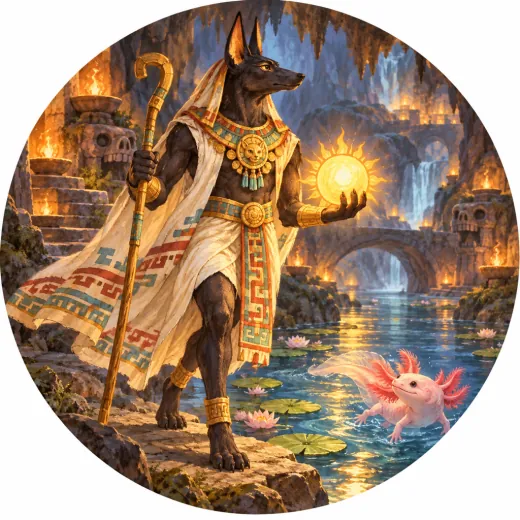
Xólotl
Xōlotl, in Nahuatl
a little scary
Xólotl was the dog-headed god, twin brother or companion of Quetzalcóatl. According to other traditions he was the god of lightning, of twins and of everything strange and double, he went with the sun when it sank underground in the evening, and he guided the souls of the dead into Mictlán, helping them cross a river. One story tells that, to avoid being sacrificed, Xólotl ran away changing shape: he became a double maize plant, then an agave, and finally he dived into the water and became a little animal, the axolotl.
Did you know? The axolotl, the smiling Mexican salamander, bears his name; and so does the xoloitzcuintle, an ancient hairless Mexican dog.
The story
Once, a very long time ago, a god was afraid.
It happened at Teotihuacan, and the world was still dark. There was no sun, no moon, no day. The gods had gathered round a great fire to decide which of them would become the sun.
Two had stepped forward. One was rich and splendid, dressed in feathers and jewels. The other was poor and sick, his skin covered in sores, and hardly anyone looked at him. The rich one went up to the flames and stopped: it was too hot. He tried again, and stopped again. Four times he tried, and four times he drew back.
Then the poor one closed his eyes and jumped.
After him, ashamed, the other jumped too, and the fire took them both. For a moment the world was so silent you could hear the wood crackling. Then, on the horizon, something began to turn red.
The sun was born. It rose slowly, huge, the colour of copper, and stayed still.
Completely still. Like a great coin stuck to the sky. The gods stared at it, one after another, and nobody could find a word. The sun was there, but it did not walk. If it did not walk, there would be no days, no nights, no seasons. Everything would wait for ever.
It was one of them who said it aloud. “This won't do. The sun is born but it doesn't move. To make it move, we must give it our lives.”
A long silence, in the dark. Then one of the gods nodded. Then another. One by one they all agreed, because there was no other way.
All except one.
Xólotl was the dog-headed god. He was the twin of Quetzalcóatl, or his companion, and in him everything was double: every thing that existed seemed to have a shadow beside it. When his turn came, his mouth opened, but the word he was meant to say did not come out.
“No,” he said. And then louder: “I don't want to die.”
The others looked at him. Nobody scolded him. Some lowered their eyes, some turned their heads towards the fire. Among all those gods there was not one with a better answer than his: they were afraid too, and they had said yes all the same. But the sun could not move, and the wind, Ehécatl, was already waiting.
Xólotl began to cry. He cried so hard that his eyes swelled into two slits, red, shining, full of tears. Then he turned, and ran.
He ran out of the circle of the fire, into the night. The stones cut his feet. Behind him he could hear only the breathing of the wind.
Ahead of him he saw a field of maize, tall and thick, swaying in the dark. He threw himself among the plants and changed shape. He became a maize plant, but not just any plant: one with two identical stalks, grown from the same root. A double plant. Because in him, everything was double.
He stayed still among the leaves, holding his breath. He could feel his heart beating so hard that he seemed to be the loudest thing in the world. Outside the field, someone was walking slowly, and the leaves rustled.
“There he is,” said a voice. “The maize with two stalks.”
There was nothing more to be done. Xólotl shot out and ran.
Further on he saw a field of maguey, the plant with broad, fleshy leaves. He hid there and became a double maguey, two plants growing from one. This time he did not even breathe. The spines pricked his skin. He heard footsteps coming closer, stopping, moving on.
For a moment he thought he was safe.
“There he is,” said the voice again. “The maguey that comes in two.”
Xólotl ran again. He had no breath left, no strength left. His legs were lead, his throat was burning. Ahead of him, in the night, something black and smooth glinted: water.
He dived in.
And in the water he changed one last time. He became a little pale-skinned creature, with thin tufts on both sides of his head like feathers, and he went to hide on the bottom, where the water is darkest. That animal has a name that comes from him: axolotl.
For a while nothing happened. The water closed over him and grew smooth as a mirror again.
Then they saw him.
The Codex does not dwell on this. It says they found him, they caught him, and that Xólotl too gave his share. It says so in a few words, and we will do the same, because there is nothing good to add.
When it was all done, the wind Ehécatl blew. He blew with all his strength, and the sun, which had stayed still for so long, moved. It was a slow movement, barely a step. Then another. The light spread over the mountains, over the maize fields, over the lake. It was the first day.
It is a hard story to tell, because Xólotl does nothing heroic. He beats nobody, he saves nobody. He is afraid, and he runs, and he hides in the wrong places. He is the god who, more than the others, is like us.
Perhaps that is why, they say, his name has lasted.
Today, if you go south of Mexico City, to the canals of Xochimilco, among the brightly painted boats, you can meet an animal that looks like no other. It is a pink or grey salamander, with three tufts of gills on each side that look like velvet horns, and a mouth that always seems to be smiling. It is the axolotl. It spends its whole life in the water, as if it had decided never to come out again.
And in Mexico there is also an ancient dog, hairless, with smooth warm skin, called the xoloitzcuintle: Xólotl's dog.
The sun still rises every morning. The dog-headed god is nowhere to be seen. But on certain evenings, when the water is still, it still has the colour of a night when someone ran away.
Relatives around the world
Listen / Read next
- Music to read by: Cinematic JourneyEpic film-style music, no lyrics, by Ciro Simone IrmiciSpotifyYouTube Music
Sources
- Bernardino de Sahagún, Florentine Codex, Book VII (about 1577)
- Leyenda de los Soles (1558)
