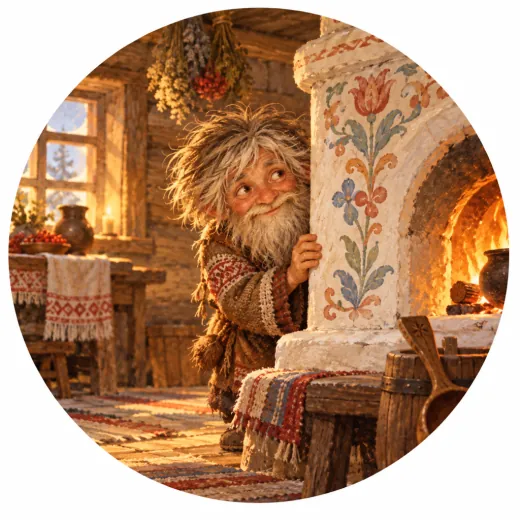
The Domovoi
domovoj, “the one of the house”, in Russian
not scary at all
In every old Russian home lived a domovoi, a bearded, hairy little old man who lived behind the big stove or under the threshold. He protected the family and the animals: if he was happy, all went well in the house; if he was offended, he slammed doors, hid things and made noises at night. To keep him in a good mood, people left him a little bread, salt or milk. When a family moved house, they invited him to come along by carrying a few embers from the old stove.
Did you know? It was said that if the domovoi touched you at night with a warm, hairy hand, it meant good luck; if the hand was cold, trouble was on its way.
The story
In a Russian house of long ago, when the evening grew dark and the fire burned low, there was always someone listening.
Behind the great brick stove, in the narrow gap between the wall and the stove's warm side, lived a little old man. He was small and covered all over in grey hair, with a long beard that reached his belt and two eyes that glowed in the dark like coals. The family called him the domovoi, but nobody ever said that name out loud. He was called “Grandfather”, and that was that.
The boy in this story knew him well, even though he had never seen him. He knew that when a door slammed with no wind, Grandfather was angry; that when the pot boiled all by itself, he was happy; and that every evening you had to leave a little bread with salt and a bowl of milk behind the stove. Granny said so every day, and the boy said so in turn to his brothers.
But that autumn, Father had built a new house, a bigger one, at the top of the village, and before the hard frosts came they were going to move in.
“Is Grandfather coming with us?” asked the boy.
“What grandfather?” said his father, with his mouth full. “There's no grandfather behind the stove. That's an old wives' tale.”
Granny raised her eyebrows and said nothing. But that evening, under the window, she spoke quietly to the boy.
“When you move house, you have to invite him. Otherwise he stays there all alone, and he gets angry with whoever lives there, and angry with us too. Because he belongs to the family, not to the house.”
“How do you invite him?”
“You take the embers from the old stove, the very last ones, and put them in a pot with a lid. You carry the pot to the new house, and you tell him so, with kind words: Grandfather, come with us. Then you light the new stove with those embers. That way the fire is the same fire, and he knows he's at home.”
The boy thought about it all night long.
Moving day came. It was a frosty morning, with the sun low and the snow creaking underfoot. The carts were loaded with sacks, benches, pots and mattresses. Father was giving orders in a loud voice, and nobody had any time.
The boy waited until the house was empty. He stayed behind in the big room, in front of the cold stove, with Granny at his shoulder holding a clay pot and a little shovel. Together they gathered the embers left at the bottom of the firebox: just a few, red, still alive. They put them in the pot and closed the lid.
“Now speak,” whispered Granny.
The boy cleared his throat. It was much harder than he had expected.
“Grandfather,” he said. “Grandfather Domovoi. Come with us to the new house. It has big windows. There'll be bread. There'll be salt. And I promise we'll leave you milk too.”
In the empty room, nobody answered. Then, from behind the stove, came a rustle, like someone getting up from a bench. A faint sigh.
The boy felt his ears burning.
“Yes,” said Granny, satisfied. “He's coming.”
They walked right through the village, the boy in front with the pot held tight against his chest, Granny behind. Through the lid, the warmth reached his mittens. Now and then, at a bend in the road, it seemed to him that the pot grew a little heavier, as if someone had sat down on top of it.
In the new house nothing felt familiar yet. The walls smelled of fresh wood, the floor was cold, the windows let in the wrong kind of light. Father had already lit a wood fire in the new stove, but the stove refused to draw properly, and smoke was pouring into the kitchen.
“Blasted thing,” said Father. “See? It must be the chimney.”
“It isn't the chimney,” said Granny. “He just doesn't know this stove yet.”
She took the pot from the boy's hands, lifted the lid, and with the little shovel tipped the embers into the new hearth. The fire revived, flared up all at once, and for the first time the smoke began to rise straight up the chimney, as if it had always been that way. Then Granny put a piece of bread and a pinch of salt on the edge.
Father stood watching with his hands on his hips.
“Superstitions,” he muttered.
At that very moment something grabbed him by the seat of his trousers, gave him a pinch, and made him jump into the air.
“Ow!” he yelled. “Who did that?”
Nobody answered. The boy's brothers could hardly keep from laughing. Granny didn't even move, and only said, looking up at the ceiling, “Grandfather doesn't like being called a superstition.”
Father didn't talk about superstitions any more.
That night, in the dark, the boy lay on the bench beside the new stove, still warm, and couldn't sleep. He heard the beams creak. He heard the wind on the roof. Every now and then he heard a soft rustling behind the wall, like a small, patient animal.
Then, as he was drifting off, he felt something brush his cheek.
It was a hand. Small, rough, covered in hair. And warm: as warm as bread fresh from the oven.
The boy didn't move. He wasn't afraid. He only said, under his breath, “Goodnight, Grandfather.”
The hand stayed on his face for a moment, then it was gone.
The next morning, Father went to look at the horse in the new stable. He stood in the doorway for a long time, open-mouthed. The stable was clean, the hay was neatly in the manger, and the horse, which had always been skittish and had a tangled mane, now had its mane plaited into lots of little braids, beautifully done, one beside the other.
He said nothing.
“What was the hand like?” Granny asked the boy at breakfast, as if she weren't really asking anything at all.
“Warm.”
“Then we're all right for a good long while.”
But from that evening on, it was Father who put the bread and salt by the stove.
Relatives around the world
In the trails
Listen / Read next
- Music to read by: Cinematic JourneyEpic film-style music, no lyrics, by Ciro Simone IrmiciSpotifyYouTube Music
Sources
- Aleksandr Afanas'ev, The Poetic Views of the Slavs on Nature (1865–1869)
- W. R. S. Ralston, The Songs of the Russian People (1872)
