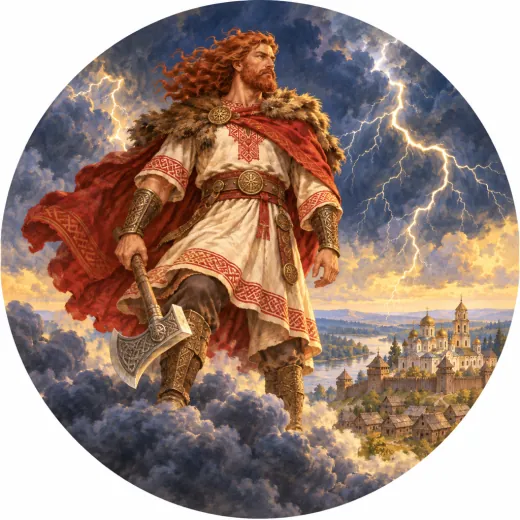
Perun
Perun, in Old Slavic
a little scary
Perun was the god of thunder and lightning of the ancient Slavs, the most important of their gods. The historian Procopius tells that the Slavs believed in one god, lord of lightning and of everything, and sacrificed oxen to him. The princes of the Rus swore oaths by him, laying down their weapons and shields. The Primary Chronicle tells that in Kyiv there was a wooden statue of him with a silver head and a golden moustache.
Did you know? In many Slavic languages the word for “lightning” or “thunder” still recalls his name, like “piorun” in Polish.
The story
In the year 980, in Kyiv, on the hill outside the prince's palace, there stood an enormous wooden statue.
It was Perun. He had a silver head and a golden moustache, and he could be seen from far away, gleaming in the sun. Prince Vladimir had had him placed there along with other idols: Khors, Dazhbog, Stribog, Simargl, Mokosh. But Perun was the tallest, and when the townsfolk passed at his feet, they lowered their voices.
Because Perun was the lord of the lightning.
Everyone knew it, from long before Kyiv. More than four hundred years earlier, a Greek called Procopius had written that the Slavs believed in a single god, the one who sends the thunderbolt down from the sky, and held him to be lord of all things. They offered him oxen and other animals, and the best of everything they had. When a storm came, the peasants stopped work, gathered under their roofs and spoke in low voices. To them, thunder was not a noise: it was a footstep.
They say Perun rode the black clouds, and that his chariot rumbled along roads no human eye could see. Where he came down, the earth shook. Where he passed, the air smelled of iron and rain.
He was also the god of oaths.
When the princes of Kyiv made a treaty with the Greeks of Constantinople, the pagan warriors laid their swords, their shields and their gold rings on the ground, and swore by Perun. If they broke their word, they said, the sword would strike them, death would take them, and the god of lightning would know them. One prince, Sviatoslav, swore “by Perun and by Volos, the god of cattle”. Perun did not strike bargains.
The old folk of the village told another story too, and they told it in summer, when the sky turned purple.
Under the roots of a great tree, they said, there lived a serpent. Long, cold, hidden in the earth. It stole cattle, and when it had eaten its fill it slept in the dark. Then Perun climbed up onto the clouds, chased it, and struck it with his lightning. The serpent fled into the trunk of an oak, into a stone, into a house. But the lightning always found it. That, they said, is why storms last so long: the god does not stop until he has found it.
A boy from Kyiv had heard that story a thousand times. Every summer he climbed the hill with his father and brought a honey cake to the foot of the statue. He looked up at the silver face. He waited for the thunder.
The boy grew, and the statue stayed where it was. Every year it seemed taller to him, and he seemed smaller in front of it. Once, during a violent storm, he saw a bolt of lightning strike the far side of the hill, and the whole statue blazed with light, as if the light had come out of it. He went home without a word.
Eight years went by.
In 988, Prince Vladimir was baptised. He had become a Christian, and he wanted the whole city to become Christian too.
The news ran through the streets in a single day. At supper the boy's father said nothing; he broke the bread and ate it, staring into the fire. Nobody in that house asked what would happen to the statue. They all knew.
One sunny morning, men with ropes came up the hill. The boy, by now as tall as his father, saw them from far off and ran up the slope.
They tied the statue by the legs and fastened it to a horse's tail. The horse moved off. Perun fell. There was a sound of splitting wood, and a dull thud. The statue began to go down, dragged along the steep road that led to the river, banging against the stones.
Twelve men followed it with sticks and beat it at every step. Not because the wood could feel anything, they said, but to insult the demon who lived inside it. The people at the sides of the road watched in silence. Some made the sign of the cross. Others covered their faces with their hands.
Nobody said a word. All the way down, the boy heard the wood knocking against the stones, like a drum with no rhythm that never stopped, and he knew that from that day on the sound would follow him everywhere.
When they reached the Dnieper, the wide grey river, the men lifted the statue and threw it into the water. The current took it. The silver head went under, then came up again. The soldiers were given an order: to stay along the bank and push the wood away with poles whenever it drifted close, until the rapids had carried it far away.
And so they did. And as the wood turned slowly in the current, carried off towards the rapids, the Chronicle records a detail that is surprising from a Christian chronicler: the people wept.
The boy stayed on the bank until evening. He watched the wood grow small, then become a dark speck, then nothing. He didn't cry. He kept looking at the river. Every now and then the wind brought a smell of rain, but the sky was clear and the thunder did not come.
When it was dark, he asked himself two questions, without saying them out loud. He wondered whether a god like that could really end up in a river. He wondered whether, somewhere behind the clouds, someone was still watching.
That night, for the first time in many months, the sky filled with clouds. It began to rain. Then, far away, out towards the steppe, a flash of lightning lit up the dark.
He didn't have to count to ten to hear the thunder.
The Chronicle does not say what became of the boy. It says only that on the hill where the statue had stood, Vladimir had a church built: the Church of Saint Basil. But names are sometimes tougher than wood. In Polish, even today, a thunderbolt is called piorun. In other Slavic languages, the word for thunder has a sound that is much like it.
Every time the sky turns black, somebody, somewhere, says his name without knowing it.
Relatives around the world
In the trails
Listen / Read next
- Music to read by: Cinematic JourneyEpic film-style music, no lyrics, by Ciro Simone IrmiciSpotifyYouTube Music
Sources
- The Primary Chronicle (12th century)
- Procopius of Caesarea, The Gothic War (6th century)
