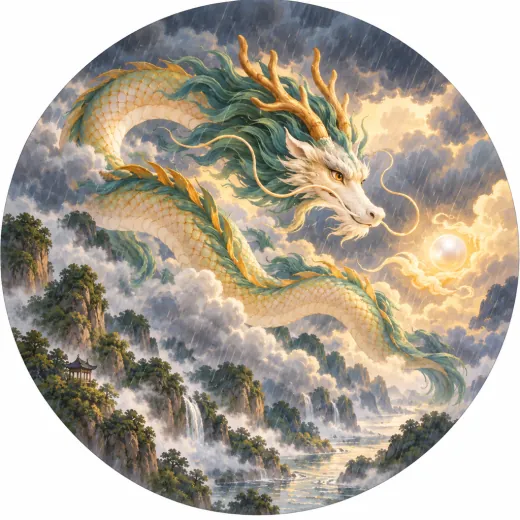
The Chinese Dragon
龍, “lóng”
not scary at all
The Chinese dragon, the lóng, is not a monster to be defeated: it is a powerful and wise creature that brings rain and good fortune. Its body is very long, like a snake's, and it flies among the clouds, usually without wings. An old text says it is made of nine animals: the antlers of a deer, the head of a camel, the eyes of a demon, the neck of a snake, the belly of a clam, the scales of a carp, the claws of an eagle, the paws of a tiger and the ears of an ox. The Dragon Kings live in palaces at the bottom of the seas and command the rains.
Did you know? A legend says that carp able to swim up a waterfall on the Yellow River, the Dragon Gate, turn into dragons.
The story
For three months not a drop of rain had fallen.
In the village, the earth had split into a thousand thin cracks, like the bottom of an old plate. The river had become a bed of hot stones. Out in the fields the millet plants were turning yellow where they stood, and every morning and every evening the men looked up at the sky, and the sky was always the same: blue, hard, without a single cloud.
In the fourth month, the elders made their decision. They took clay from the bed of the dry river, mixed it into a paste, and with their hands they shaped a dragon.
It took a long time. The men worked in silence, and the children watched from a distance. The dragon had a body as long as a boat, horns like the branches of a deer's antlers, a slightly flattened head, and every scale was made with the tip of a finger. When it was finished, they set it down in the middle of the square, and everyone bowed.
Because the people of that village knew an ancient story. The story of Yinglong.
But to tell it, we first have to explain what a dragon is.
It is not a monster. In China the dragon, the lóng, is not an enemy to be defeated, as in the stories of other countries: it is a powerful, wise creature that brings rain and good fortune. An old book, the Erya yi, says it is made of nine animals put together. It has the horns of a deer, the head of a camel, the eyes of a demon, the neck of a snake, the belly of a clam, the scales of a carp, the claws of an eagle, the paws of a tiger and the ears of an ox. Its body is extremely long, like a snake's, and it flies among the clouds even without wings. It lives in rivers, lakes, the sea and the sky. When it passes, they say, the water follows it.
Yinglong was one of them. He was the dragon with wings, and his name can be translated as “the responding dragon”, because he answered the call of the Yellow Emperor.
In the days when the Yellow Emperor ruled the plain, there was an enemy: Chiyou. He was a warlord at the head of a fierce army, and nobody on the plain had the courage to challenge him. To stop him, the Emperor called on Yinglong.
Yinglong rose up into the sky and gathered all the water he could find. He held it inside himself so that it could not flow, and his presence was so powerful that the rivers drew back and the battlefields became dry.
Chiyou was not frightened. He called on two spirits, the Count of the Wind and the Master of the Rain, and they sent down a storm that lasted for days. The sky filled with black clouds, the rain lashed down sideways, the wind tore up the trees. The Yellow Emperor's army could no longer see a thing.
So the Emperor sent his daughter, Ba, down from heaven. Only one thing was said about this girl: wherever she was, the rain retreated. As soon as she came down to earth, the storm died away. The clouds parted and the light came back. Without his rain, Chiyou was defeated.
Yinglong had won. But victory came at a price.
The old books say that, after the blood spilled in that war, he could no longer return to the clouds. He tried to fly back up to heaven, and his wings could not carry him. He sank down in the lands of the south and stayed there, because he could no longer return up above. And without him, the sky no longer sent rain. That is why, the old books say, the earth dries up from time to time. And when the drought comes, people must do the only thing they can: rebuild Yinglong with their own hands, in the shape of a dragon, and call him.
And that was exactly what the village had done, in the fourth month.
The clay dragon lay in the middle of the square. The elders had lit incense at its feet. The women brought bowls of water, all that was left, and the men beat the drums, one slow beat after another, like a heart. The children, who had not quite understood why, had lined up behind the grown-ups.
For a while nothing happened. The sun went down. In the west, the sky turned red and then purple. An old woman by the well muttered that it had all been pointless, that the gods had better things to do, and others hushed her at once, but without much conviction. The wind had dropped. Even the dogs had stopped barking.
And then a little boy, the smallest in the line, raised his hand and said, “It touched my head.”
A drop. Just one. Then another, on the back of an old man's hand. Then on the roof, a soft pattering.
That was how the rain came, softly, onto the millet and the river and the clay of the dragon, which slowly melted into mud and went back to the river it had come from. Nobody moved. Nobody spoke. Some had their eyes closed and their faces turned upwards. The old woman by the well held out her open hands and stayed like that, without a word, until they were full.
The next morning the river was running again, dark and noisy, and over the fields hung a smell of wet earth that nobody in that village would ever forget.
That is what dragons are like in China: you hardly ever see them, but you can feel when they are there. In the sea, other stories say, the Dragon Kings live in palaces on the sea bed and command the rains, and when a dragon king gets angry, the waves rise. In the rivers, beneath the waterfalls, live other, younger dragons who have not yet risen to heaven.
There is a legend about the Yellow River. Where the water narrows between two walls of rock and falls in a towering waterfall, the Dragon Gate, thousands of carp swim upstream every year. Nearly all of them give up and drift back down, exhausted. But if just one manages the last leap, they say, at the moment it rises over the waterfall a cloud comes down, and the fish changes, scale by scale, into a dragon.
And it rises into the sky, where the rain is waiting for it.
Relatives around the world
In the trails
Listen / Read next
- Music to read by: Cinematic JourneyEpic film-style music, no lyrics, by Ciro Simone IrmiciSpotifyYouTube Music
Sources
- Luo Yuan, Erya Yi (12th century), the description of the nine animals
- Shanhaijing, Classic of Mountains and Seas
