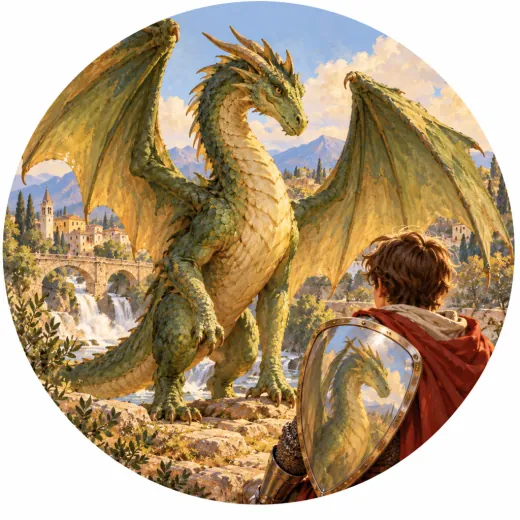
The Dragon of Terni (Thyrus)
Thyrus, the dragon of the coat of arms
a little scary
Thyrus is the green winged dragon on the coat of arms of Terni. The legend says it lived in a lair in the woods, attacked the gates of the city when it was hungry and terrified everyone, so much that people no longer left their homes. The council of elders looked for a hero, but many found an excuse not to go. In the end a young knight faced it: a ray of sunlight, reflected by his shiny armour, blinded the dragon, which was defeated. The dragon, scholars say, stands for the unhealthy marshes that were drained so the city could grow.
Did you know? In Terni the dragon is everywhere: on flags, on banners and carved on the lintels of doors and windows.
The story
In Terni, once upon a time, the streets emptied before sunset.
Not because it was cold. Not because it was late. But because from the wood, beyond the houses, a smell came rising. It was a long, heavy breath, that smelled of dead things, and whoever felt it coming knew they must shut themselves indoors and keep the shutters barred.
The smell was the dragon's.
They called it Thyrus. It had wings, two great wings of skin, but it had no front legs. It walked on the two at the back and dragged behind it a very long tail, covered in spines. It lived in a lair, deep in a thick wood, and nobody had ever had the courage to look for it. When it was hungry, it went towards the city and attacked the gates. Whoever was outside did not come back. And whoever stayed inside felt its breath creeping through the cracks, and did not sleep.
The months went by. The fields lay uncultivated. The children no longer played in the squares.
Then the Council of Elders met in a hall with the shutters closed, by candlelight. The old men talked for a long time. In the end they decided to call men known for their strength and courage, and to ask one of them to kill the monster.
They called them, one after another. And one after another, those strong and courageous men looked at their feet.
One had a sore arm. Another had to leave on a journey. Another had promised to help a relative. Each found an excuse, and each left the hall faster than he had come in.
The Elders were left alone, with the candles burning down.
It was then that a young man stepped forward. A knight, still without fame, of the Cittadini family. He had no long beard and not many battles behind him. He had a lance and a suit of armour that he polished every evening, until he could see his own face in it.
"I'll go," he said.
Nobody laughed. Nobody stopped him. Perhaps at that moment, in that hall, everyone was thinking the same thing: that they would never see him again.
The young man set out at dawn. He crossed the fields, where the grass was high because nobody had cut it for months. He entered the wood. The trees closed over his head and the light turned green, then grey. No bird sang. Not a leaf moved.
The further he went, the stronger the foul breath became. It burned his throat, it made his eyes water. He covered his face with a corner of his cloak and went on.
At a certain point, the sky darkened. Above the trees, the clouds gathered all at once, black, and in the distance thunder rumbled. It seemed that the world itself was telling him to turn back.
He did not turn back.
He found the lair in a clearing, where the trees opened as if to make room for something too big. And the dragon came out.
It was bigger than anyone had told. Its skin was hard as old leather, and dark, and the spiny tail beat on the ground. It opened its mouth, and the monster's breath wrapped around the young man like a fog.
The knight raised his lance and struck. The point bounced off. He struck again, and again. It was like stabbing a rock. That tough hide seemed almost to tickle, and the monster roared, almost laughing at him.
The young man stepped back. He tripped on a root and fell on one knee. Above him, the dragon raised its head and drew breath for the last attack.
The young man thought: it is over.
Just at that moment, a gap opened between the black clouds.
It was small, barely a crack. But through that crack a ray of sun came down, straight and strong, and struck the young man's shining armour. That armour, which he had polished every evening without knowing why, became for a moment a mirror. The light bounced back and hit the dragon squarely in the eyes.
The monster stopped. It shook its head, blinded, and tried to turn.
The young man did not lose an instant. He got up, gripped the lance with both hands and thrust it forward, with all the strength he had, straight into the dragon's heart.
The roar that followed echoed through the whole wood. Then the monster fell to the ground, heavily, and did not move again.
The young man stayed there a long time, panting, with the lance in his hand. Above him, the clouds were opening, and the wood began to breathe again. The air no longer stank.
When he came back to Terni, people ran out of their houses. For the first time in a long while, someone opened the shutters. Someone came out into the street. The Elders opened the gates of the city, and the townspeople held a long feast for the knight, with music and tables laid in the square.
Since then Terni has never forgotten its dragon. It has put it on flags, on banners, on its coat of arms. It has carved it on the lintels of doors and windows, as if a monster like that deserved to stay forever on guard over the houses it once threatened.
Some say that the dragon was the unhealthy air of the marshes, and that the young knight was the labour of those who, long ago, drained them so that the city could be born. Perhaps that is so.
But if you happen to be in Terni on an evening of black clouds, and you see a gap of sunlight suddenly appear on a roof, look at it carefully.
Who knows what it is making shine.
Relatives around the world
In the trails
Listen / Read next
- Music to read by: Cinematic JourneyEpic film-style music, no lyrics, by Ciro Simone IrmiciSpotifyYouTube Music
