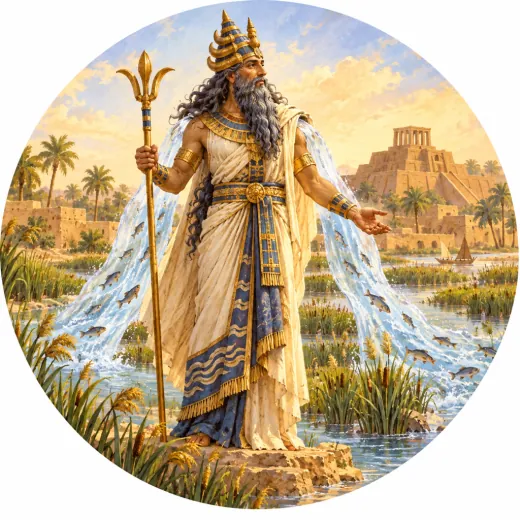
Enki
Enki in Sumerian, Ea in Akkadian
not scary at all
Enki was the god of fresh water, wisdom and the arts. He lived in the Apsu, the ocean of fresh water that was believed to flow beneath the earth, and he filled the rivers Tigris and Euphrates with water, full of fish. Of all the gods, he was the cleverest and the best friend of humans. According to one myth the goddess Nintu shaped them out of clay on Enki's advice, and when the other gods decided to send a flood to wipe them out, he found a way to warn a wise man so that he could build a boat.
Did you know? He was shown with two rivers streaming from his shoulders, with fish swimming in them.
The story
Before there were people, the ones who worked were the gods.
In the land between the two rivers, the three great gods had shared out the world by drawing lots. Anu got the sky. Enlil got the earth. And Enki, the cleverest of the three, got the water: the Apsu, the vast sea of fresh water that flows beneath the ground, where his house stood, at Eridu.
Enlil also got to be in charge, and the hard part of being in charge is making others do the work. The lesser gods, the Igigi, dug the canals, cleared the riverbeds and raised bank after bank. They did it for so long that one day they could not take any more.
One night they burned their tools. Then, torches in hand, they surrounded Enlil's house and stood there in the dark, without saying a word.
It was Nusku, his servant, who woke his master. “Get up. Your house is surrounded.”
Enlil was afraid of nothing, and that night he was afraid. He called Anu. He called Enki. They sat down in council, and they all stared at the ground, because nobody knew what to say.
Enki spoke, and he spoke quietly, like someone who has already thought it all through.
“Why blame them? The work is too heavy, and that is their only fault. Nintu is here beside us, the goddess who knows how to bring creatures to birth. Let her make a human being. The human will carry the load, and the gods can rest.”
Nintu answered that she could not do it alone. “Without Enki I don't know where to begin.”
“I will help you,” said Enki. “Take the clay. I will prepare what is needed.”
Because clay, on its own, is only earth. One god agreed to give what he had inside him, his flesh, his blood and his intelligence. His name was We, and he understood more than the others. From his being, mixed into the clay, came the part of a human that thinks. Nintu worked the paste with her hands. She pinched off fourteen pieces and set them in two rows, seven and seven. From one row came the men, from the other the women. And the lesser gods, for the first time in many years, washed their hands and went to bed.
The people dug the canals. They made fields. They built cities. And they grew in number, and grew again, the way barley grows on wet ground.
Centuries went by, and one day Enlil could no longer sleep.
“The noise,” he said. “These people make an unbearable noise. There isn't a moment of quiet, day or night.”
He sent a plague. People began to die. Then Atrahasis, a wise man who listened to Enki, went to his god. Enki told him what to do: stop praying to all the gods and bring offerings only to Namtar, the god of plague, to make him ashamed. The plague stopped.
The noise came back. Enlil sent a drought, and then famine, more than once. Again Atrahasis went to Enki, and Enki told him to bring offerings only to Adad, the god of rain, and to the goddess of grain. The rain came back. For Enlil it was too much. He called the gods together and said: “No more tricks. We will send a flood that wipes out everything. But none of us must tell a human. Swear it.”
Enki swore too. He was bound, and he knew it. But Enki was not only the god of water and wisdom. He was the god of solutions.
That night Atrahasis was asleep in a reed hut on the riverbank. Enki came close, in the dark, but he did not go to the man. He spoke to the wall.
“Wall of reeds, listen. Hut, listen carefully. Pull down your house and build a boat. Leave all riches behind and save life. Let the boat be roofed over like the Apsu, so that the sun cannot get in. Give it a roof and a deck, and coat it with pitch inside and out.”
He had not broken his oath: he had not spoken to a human. He had spoken to a wall. On the other side, Atrahasis held his breath.
The next morning he started work. The elders of the city came to ask why he was pulling down his house. He told them only that his god had fallen out with Enlil, and that he had to leave. Some people laughed. Others forgot about it.
When the boat was ready, Atrahasis held a feast. They ate, they drank, they sang. He could not keep still: he paced up and down, and his heart was pounding. Then he began to hear a rumble, far away. He went aboard with his family and the animals. He shut the hatch.
The flood came, and it was a darkness that did not end. The storm god howled from the clouds, the winds crashed into one another, the water rose over the houses and the walls. Even the gods, watching from above, were afraid. Nintu wept: “How could I speak of such a thing in front of everyone? I gave life to my children, and now they fill the sea like fish.”
For seven days and seven nights the storm raged. Then it stopped.
The gods were hungry. Without people there was no one left to bring bread, beer and oil to the temples, and they were hungry and thirsty. When the boat touched land and Atrahasis made a sacrifice, the gods came from every direction and crowded round the smell.
When Enlil saw the boat, he was furious. “Someone talked. We swore an oath.”
Enki answered calmly. “I did not break the oath. I said something to a wall. If that man understood, it is not my fault.” And then, more quietly: “We cannot wipe out the ones who feed us. If there are too many people, let some of them die, but not all at once.”
And so, the texts say, it was decided that some children would die, and that people would not be left to multiply without limit: ever since, humans have known that life comes to an end, and they know the difference between one life and another.
Atrahasis lived. Enki went back to his palace of water at Eridu.
Of all the gods of Sumer, he was the only one who had taken the side of humans without asking for anything in return. He had given them life, and then he had saved it, with a wall of reeds and a few words spoken in the dark.
Relatives around the world
Listen / Read next
- Music to read by: Cinematic JourneyEpic film-style music, no lyrics, by Ciro Simone IrmiciSpotifyYouTube Music
Sources
- Atrahasis, Akkadian poem (18th century BC)
- Enki and the World Order (Sumerian text)
