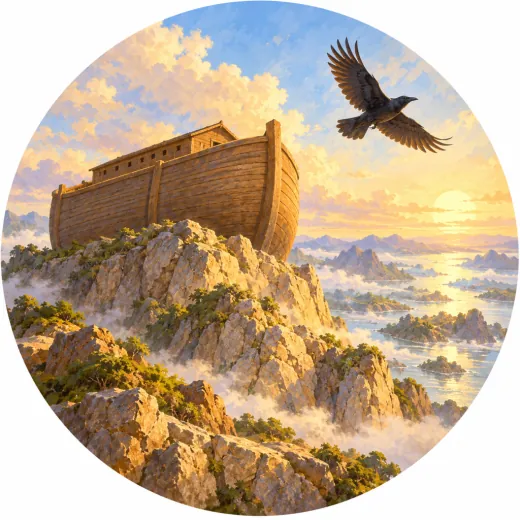
Utnapishtim and the Flood
Utnapishtim, “he found life”
a little scary
On his journey, Gilgamesh met Utnapishtim, the only man to whom the gods had given eternal life. Utnapishtim told him his story: the gods had decided to send a flood, but the god Enki had warned him in secret. So he had built a great boat, put his family, the craftsmen and the animals on board, and survived six days and seven nights of storm. When the boat came to rest on a mountain, he released a dove, a swallow and a raven, to see whether the waters had gone down.
Did you know? The tablet with the flood story was first read in 1872 by George Smith at the British Museum, who is said to have been so excited that he started running around the room.
The story
Gilgamesh had been walking for so long that he no longer even had the strength to be afraid.
His friend Enkidu was dead. The king of Uruk, who had never feared anything, had sat by the body for six days and seven nights, and only then had he understood that death is real and that one day it would come for him too. He had left the city, dressed in lion skins, and set out to find the only man in the world who would never have to die.
After mountains and deserts, and after crossing the Waters of Death in a boat steered by a ferryman, he reached a distant shore. In front of a simple house sat an old man. He was not a giant, or a hero. Gilgamesh looked at him and felt something close to disappointment.
“You are no different from me,” he said. “How did you win a life without end?”
The old man smiled.
“Sit down. I'll tell you a story that no living man has ever heard from someone who was there.”
His name was Utnapishtim, and he came from Shuruppak, a very ancient city on the bank of the Euphrates.
“The gods decided to send a flood,” he began. “They met in council, Anu, Enlil and the others, and they swore to tell no one. But Ea was there too, the god of fresh waters, and Ea could not bear the thought that everyone had to die.”
He lowered his voice.
“Ea did not speak to me. He spoke to the reed wall of my hut. That night, in the dark, I heard: ‘Wall, wall. Hut, hut. Listen, man of Shuruppak, son of Ubar-Tutu. Tear down your house and build a boat. Leave your riches and save life. Take onto the boat the seed of every living thing.’”
Gilgamesh had moved closer.
“And what did you do?”
“I answered: ‘I understand, my lord. But what shall I tell the city, the elders?’ And Ea told me: ‘Tell them that Enlil is your enemy, and that this is why you must go and live on the waters, near your god.’”
A breath of wind came in over the threshold, and the fire flickered.
“On the fifth day I laid the hull. It had seven decks, and each deck had nine rooms. I coated it with pitch outside and in. My workers worked and feasted together, drinking wine and oil as if it were water. They knew nothing. I loaded everything I owned. Then I brought aboard my family, my relatives, the best craftsmen, and the animals of the field, wild and tame.”
“And then?”
“Shamash, the sun god, had set a sign. When the evening of the rain came, I was to go in and shut the door. The day came. The sky was beautiful to look at, but I was afraid to look at it. I went in and shut the door.”
Utnapishtim stopped. His hands were trembling slightly, and Gilgamesh thought that the fear was all still there, after countless years.
“At dawn a black cloud rose from the horizon. Inside it, the storm god thundered. The winds clashed like armies. Day turned into darkness. Even the gods were frightened, and fled all the way up to the heaven of Anu, curled up against the wall like dogs. For six days and seven nights the wind and the flood blew. On the seventh day the storm stopped.
“I opened a little window. The light fell on my face. I looked at the sea: it was as flat as a roof. Everywhere, silence. People had turned back into clay. I knelt down and wept.”
The gods had wept too, he said. The goddess Ishtar cried out like a woman about to give birth: “How could I speak evil words among the gods? I gave birth to those people, and now they fill the sea like fish!”
“Far away, a mountain rose out of the water, Mount Nimush. The boat stopped there and did not move for six days. On the seventh I let out a dove. It flew off, but came back: it had found nowhere to land. So I let out a swallow. It came back too. Last of all I let a raven go. The raven saw that the waters had gone down. It pecked, it cawed, and it never came back.”
The old man shrugged, with half a smile.
“Then I opened all the doors. The animals went out to the four winds. On the top of the mountain I made a sacrifice, and burned reed, cedar and myrtle. The gods smelled the sweet smoke and gathered round the offering like flies.”
Then Enlil had arrived, he said, and seen the boat, and flown into a rage: no human was supposed to escape. But Ea had stopped him. “Do not punish the innocent. If you want fewer people, send a lion, a wolf, a famine. Not another flood. And I did not give away the secret: I only sent a dream to a very wise man, and he understood.”
Enlil climbed aboard the boat. He took Utnapishtim and his wife by the hand, made them kneel and touched their foreheads. “Until now you were only human. From today you two will be like us gods. You will live far away, at the mouth of the rivers.”
The fire had burned low. The house was full of long shadows.
“So you are not immortal because you were the best,” Gilgamesh said quietly.
“I don't know if I was the best. I know that someone, in the dark, took pity on me.” Utnapishtim looked at him for a long time. “And you, son of Uruk? Who will give you eternal life? I'll put you to the test: stay awake for six days and seven nights. If you can't even do that, how could you defeat death?”
Gilgamesh sat down on the threshold, his arms on his knees. A soft mist came down over his eyes. He tried to fight it. A moment later his chin dropped onto his chest.
He slept for a long time. Every morning Utnapishtim's wife baked a loaf and set it down beside him, without a sound. One on the first day, one on the second. In the end there were seven loaves in a row, and the first ones were already as hard as stones.
When the old man shook him, Gilgamesh opened his eyes.
“I only closed my eyes for a moment,” he said.
Utnapishtim pointed to the loaves, one by one. “This one is from the first day. This one from the second. Look how dry it has gone.”
Gilgamesh counted them. He said nothing, with a hard loaf in his hands.
He understood that death cannot be beaten, not even by sleep, and that the old man had given him the answer in two ways: with the story of the flood, and with the bread.
Relatives around the world
In real history
Listen / Read next
- Music to read by: Cinematic JourneyEpic film-style music, no lyrics, by Ciro Simone IrmiciSpotifyYouTube Music
Sources
- Epic of Gilgamesh, Tablet XI
- Atrahasis, Akkadian poem
