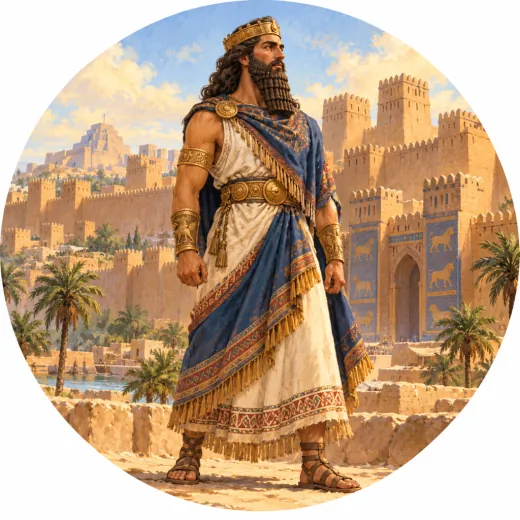
Gilgamesh
Bilgames, in Sumerian
a little scary
Gilgamesh was the king of Uruk, two-thirds god and one-third man, extremely strong and, at first, a bully to his people. The gods created a rival for him, Enkidu, who instead became his best friend. Together they lived great adventures, until Enkidu fell ill and died. In despair, Gilgamesh set out to find the secret of immortality. He found a plant that gave back youth, but while he was bathing in a spring a snake stole it from him. He returned to Uruk and understood that what people build, like the great walls of his city, is what lasts.
Did you know? The Epic of Gilgamesh is one of the oldest works of literature in the world: its first versions are more than four thousand years old and were written on clay tablets.
The story
After his friend died, Gilgamesh no longer wanted to be king.
He left the walls of Uruk, his city, and wandered the open plain with a lion skin on his shoulders, his hair tangled, his face filthy with dust. The people he met did not recognise him. To all of them he said the same thing: “I will die too, like Enkidu. Terror has got into my belly.”
It was strange, in a man like him.
Gilgamesh was two-thirds god and one-third man. He was tall and strong, the most handsome and the bravest of all. He was also a bully, and his people complained to the gods. So the gods took a little clay and made Enkidu out of it, a wild man who lived with the gazelles, to stand up to the king.
The two of them wrestled, and ended up embracing. From then on they were never apart. Together they went to the Cedar Forest to defeat the monster Humbaba, and together they also killed the Bull of Heaven, sent by the goddess Ishtar. But the gods decided that one of the two had to pay.
Enkidu fell ill. He lay in bed for twelve days. Gilgamesh stayed by his side, and when his friend died he wept for him for six days and seven nights. He waited until he understood that Enkidu would never get up again.
Then he decided to seek out the only man who had not died: Utnapishtim the Faraway, who had seen the flood and been given eternal life by the gods.
The road led to the mountains of Mashu, where the sun goes in at night to pass through the earth. The entrance was guarded by two scorpion-men.
“No man has ever passed this way,” they said. “The tunnel is twelve double-hours long, and it is dark all the way.” But they let him in.
Gilgamesh walked in the dark. He could see nothing ahead and nothing behind. He walked and walked, and time did not pass. When at last he reached the end, a garden of gems opened in front of him: the trees bore fruit of carnelian and leaves of lapis lazuli.
Further on was the sea, and on the shore a tavern. Inside lived a woman named Siduri. She saw a man in a lion skin, thin and starving, and she locked herself in.
“Where are you rushing, Gilgamesh?” she called through the door. “The life you are looking for, you will not find. When the gods made human beings, they gave them death, and kept life for themselves. Fill your belly, dance and celebrate, day and night. Wear clean clothes, wash your hair, look at the child holding your hand, and let your wife be happy in your arms. This is what it means to be human.”
Gilgamesh did not listen. He asked for the way.
The way was the sea, and on the far shore was Utnapishtim. On this shore was the boatman Urshanabi, and the water in between was the waters of death: any man who touched them with his hand would die. “Cut a hundred poles or so,” the boatman told him. “One for each push, and don't let the water touch you.” Gilgamesh cut them. When the poles ran out, he opened his clothes and used them as a sail.
On the far shore an old man was waiting.
“Why are you so tired?” asked Utnapishtim. “Why is your face worn away with grief?”
Gilgamesh told him about Enkidu. Then he asked, “How did you win eternal life?”
Utnapishtim smiled and told him a story. One day the gods decided to send a flood. The god Ea warned him by speaking to a wall of reeds: “Wall, listen! Build a boat, and take with you the seed of every living thing.” For six days and seven nights the storm raged. When it calmed down, the boat came to rest on Mount Nimush. Utnapishtim sent out a dove, then a swallow, then a raven. The raven did not come back. So he went out and made a sacrifice, and the gods, who had smelled it, came to eat. The god Enlil blessed him and his wife and said, “Before, you were human. Now you will be like us.”
“But who will gather the gods for you?” he finished. “Try instead to stay awake for six days and seven nights.”
Gilgamesh sat down. At once, like a mist, sleep took him. He slept for seven days. Every day Utnapishtim's wife baked a loaf of bread and set it beside his head. When Gilgamesh woke up, he said, “I dozed off for a moment, and you touched me.” “Look at the loaves,” Utnapishtim replied. The first was dried out, the second as hard as leather, the last still warm.
Gilgamesh put his head in his hands. “Where shall I go now? Death is in my bed, and wherever I set my foot, I find death.”
Before he left, Utnapishtim's wife persuaded her husband to give him a secret. “There is a plant at the bottom of the sea that looks like a thornbush. It pricks your hands like a rose. If you get it, an old man becomes young again.”
Gilgamesh tied two stones to his feet and let himself sink to the bottom. He tore up the plant, even though it cut his hands, cut the stones loose and rose to the surface.
“Look, Urshanabi,” he said. “This plant will give us back our youth. I will take it to Uruk and give it to the old people to eat. Then I will eat it too.”
They walked for many leagues, towards home. At one point they saw a pool of cool water, and Gilgamesh went down into it to bathe. He left the plant on the bank.
A snake smelled its scent. Silently it slid out and took it. Then, as it went back, it shed its skin.
Gilgamesh noticed too late. He sat down and wept, and the tears ran down his face. “For whom have I toiled? For whom have I spent my heart's blood? I have gained nothing for myself. I have done a favour for the snake, the lion of the ground.”
They went back to Uruk. In front of the walls Gilgamesh stopped and looked at them for a long time, and he pointed them out to Urshanabi.
“Go up onto the wall of Uruk and walk along it. Look at the foundations, touch the bricks. Are they not baked bricks? Was it not the Seven Sages who laid the foundations?”
The king had not found eternal life. But around him stood a great city, with its walls, which would still be there after he was gone. And that is how the poem ends.
Relatives around the world
In real history
Listen / Read next
- Music to read by: Cinematic JourneyEpic film-style music, no lyrics, by Ciro Simone IrmiciSpotifyYouTube Music
Sources
- Epic of Gilgamesh, Nineveh version, Tablets I–XII (library of Ashurbanipal, 7th century BC)
