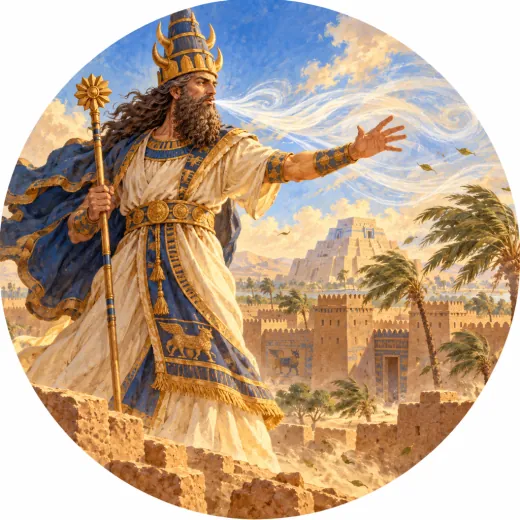
Enlil
“lord wind”, in Sumerian
a little scary
Enlil was the god of wind, air and storms, and for many centuries the chief of the Sumerian gods. In the Sumerian creation poems it was said that he was the one who had separated the sky from the earth. He kept the “tablets of destiny”, which gave power over everything: once a giant bird, Anzu, stole them, and it took a warrior god to get them back. Enlil was stern and short-tempered: in the poem of Atrahasis he decides to send the flood because humans, grown too many, made a noise that would not let him sleep.
Did you know? His great temple was at Nippur, a city that was never a capital but was the religious centre of all Mesopotamia.
The story
In Nippur, in the heart of the land between the two rivers, there was a house on a mountain that was not a house for humans.
It was called the Ekur, and Enlil lived inside it. He was the god of wind and storms, and the Sumerians called him “lord of the air”. It was said that he had pulled the sky away from the earth, when the two were still one. Beneath his throne lay the Tablets of Destiny, which give power over all things. Once a giant bird called Anzu had stolen them, and a warrior god had to win them back.
Enlil did not like surprises. He liked order, quiet, and time passing slowly.
And more than anything, he liked to sleep.
In the beginning there were only a few humans. The gods had made them, mixing clay with the blood of a god, to work the land in their place. They worked the fields, dug the canals and brought offerings. Nobody noticed them.
But the humans multiplied.
Centuries went by, and then more centuries. Cities grew inside their walls. The streets filled with carts, merchants, shouting children, wives calling out, smiths hammering copper. The world began to hum like a beehive.
And one night, in his house on the mountain, Enlil woke up.
The noise rose from the earth like the bellowing of bulls. Millions of voices, footsteps, doors, quarrels. Enlil rolled onto his side and pulled the sheet over his head. It did no good. The noise got into his ears, filled his room, pounded inside his skull.
He got up. He paced up and down in the dark.
When day came, he called the other gods together.
“I can't stand it any more,” he said. “The humans' racket won't let me sleep. Their numbers must be cut.”
First he sent a plague.
The sickness swept through the cities like a cold wind. People died, and the world grew quieter, but not quiet enough for Enlil. At the edge of a village lived a very wise man called Atrahasis, who was a friend of Enki, the god of water and of cleverness. Enki loved humans and could not bear to see them suffer. He spoke to Atrahasis in secret.
“Tell the elders,” he advised, “to stop making offerings to the other gods. Let them bring bread only to Namtar, the god of plague. Let them beg him with a gift. A god who receives a present rarely refuses.”
Atrahasis obeyed. The plague god, flattered, withdrew. The sickness stopped.
But soon the humans were noisy again.
Enlil had not slept for months. Everyone in the Ekur could see the foul mood in his eyes. He called Adad, the god of rain, and ordered him to hold back the water. For six years the sky stayed shut, the fields dried up, and hunger roamed the streets. Again Enki told Atrahasis what to do, and again the humans were saved by a whisker.
That was when Enlil lost his patience.
He gathered the gods and made them swear. One by one, they swore not to reveal to the humans what was about to happen. He wanted a flood. A great, high water to wash every voice off the earth.
Enki swore. But he swore the way clever people swear, with exactly the right words.
That night Atrahasis was sleeping in a hut made of reeds. Enki came close, and he did not speak to him: he spoke to the wall.
“Reed wall, listen to me,” he said. “Hut, hear my words. Pull down your house and build a boat. Leave your riches and save your life. Make it big, with a roof, and coat it with pitch inside and out.”
Atrahasis heard it in his sleep. And in the morning he got to work.
The day of the flood came without warning. The sky turned black. Adad roared. The dykes burst, the rivers swelled, and the water came down in a single mass, as if the world had been turned upside down. Atrahasis boarded the boat with his family and the animals. He sealed the door.
For seven days and seven nights the storm showed no mercy. Inside the boat, the water beat on the hull like a thousand fists. Outside, the world was a grey expanse, without a voice, without a house. At last there was silence.
Enlil heard that silence from his throne.
He ought to be happy, he thought. He could sleep. And yet, through the longest night, something gave him no peace. The gods beside him were weeping. The great goddess who had created the humans sat alone, in mourning. Nobody was left to bring him bread or offerings. The gods were hungry, and the sky was empty of prayers.
When the water drew back, Atrahasis's boat came to rest on a mountain. Atrahasis stepped out and offered a sacrifice. The scent rose to the sky, and the hungry gods crowded round it like flies.
Enlil arrived last.
He saw the boat. He saw the living humans.
“Who broke the oath?” he roared. “Nobody was supposed to survive!”
Enki answered calmly. He had revealed nothing to anybody, he said: he had only spoken to a wall, and a wise man had listened. Wiping everyone out had been too much, and that a world without humans was a world without bread for the gods. Then he offered a bargain: the humans would stay, but fewer of them. From time to time they would die, of sickness or of old age. Some women would have no children. So the world would never be too noisy again.
Enlil was silent for a long time.
In another version of this story, the one the scribes put into The Epic of Gilgamesh, Enlil himself climbed aboard the boat at the end. He took the survivor by the hand, touched his forehead and blessed him: he told him he would be like the gods, and sent him to live far away, at the mouth of the rivers. Nobody knows whether he did it out of pity or out of tiredness.
Perhaps both.
Enlil went back to his house on the mountain in Nippur. He lay down on his bed. He closed his eyes.
Only a few sounds rose from the earth now. A voice or two, a footstep, a dog barking far away. A smaller, calmer world, which knew it had to be careful.
The lord of the air sighed, and at last he slept.
Relatives around the world
Listen / Read next
- Music to read by: Cinematic JourneyEpic film-style music, no lyrics, by Ciro Simone IrmiciSpotifyYouTube Music
Sources
- Atrahasis (18th century BC)
- The Myth of Anzu
- Jeremy Black and Anthony Green, Gods, Demons and Symbols of Ancient Mesopotamia, British Museum Press (1992)
