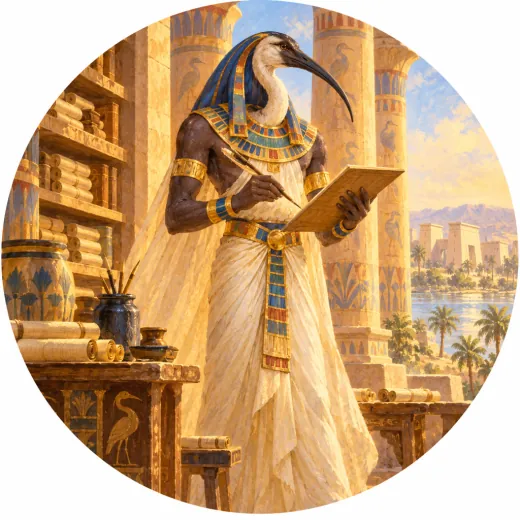
Thoth
Ḏḥwtj, in Egyptian
not scary at all
Thoth was the god of writing, mathematics and the moon, with the head of an ibis, a bird with a long curved beak. The Egyptians believed he had invented hieroglyphs and was the scribe of the gods: at the weighing of the heart he was the one who wrote down the result. He knew everything, and he announced the verdict. One myth tells that he won a small part of the moon's light from her in a game, and with it made five extra days, and so the year went from 360 to 365 days.
Did you know? The Greek writer Plutarch called him Hermes, like a god of the Greeks.
The story
Once upon a time, the year had only three hundred and sixty days.
It was a neat, round year of twelve equal months, and nobody had ever known any other kind. But there was a problem, and it concerned the goddess Nut, who was expecting children.
The god Ra, the sun, was angry with her. He spoke a curse: “Nut shall not give birth in any month or in any year.”
It was a terrible command, because every day of the year belonged to a month, and every month to a year. Where could those children possibly be born? The gods listened in silence. Nobody dared to contradict Ra.
Except one.
It was Thoth, and his home was in Hermopolis, the city the Greeks would later name after their own Hermes, because they thought the two gods were alike.
He had the head of an ibis, with a long curved beak, and two watchful eyes that always noticed two things more than anyone else. He was the god of writing, of numbers, of the calendar and of the Moon: he could read the sky and count the days like no one else. The Egyptians believed he had invented hieroglyphs. Whenever there was a problem in Egypt, people said, “Ask Thoth.” And he would think it over, unhurried, with his reed pen in his hand.
If that was the curse, he thought, then the problem wasn't Nut. It was the calendar.
So he went to the Moon, who had always loved board games, and said to her, “Shall we play a game?”
The Moon agreed. They sat down facing each other on the shore of the sky and began to move the pieces. They played slowly, without speaking. Thoth moved with his beak pointed at the board, and the Moon laughed, and lost a little of her light with every move. Then another game. Then another.
When at last they stood up, Thoth had won. From the light the Moon had lost, he had gathered lots of little pieces, and he held them in his hand. He made them into five days. Five brand-new days that belonged to no month and had been cursed by no one, and he placed them at the end of the year.
That is how the year came to have three hundred and sixty-five days. And on those five days Nut was able to give birth: Osiris, Horus the Elder, Seth, Isis and Nephthys were born, one each day. Ra could say nothing. His words had been obeyed: no month, no year. It was just that time, in Thoth's hands, had found some extra room.
That was who Thoth was. When a law cannot be broken, he understands it better than the one who made it, and finds a place to hide an extra day.
That is why the Egyptians gave him a special place among the gods, the most delicate place of all.
After death.
In the papyrus of a man named Ani, a temple scribe, you can still see what it was like.
Ani had not long been dead. He was walking down a long, silent corridor, with his wife Tutu at his side. They didn't know what to be afraid of, because no one has ever come back to tell, and so they walked slowly, almost on tiptoe. Before them opened the Hall of the Two Truths. At the far end, on his throne, sat Osiris, the king of the dead, and around him were forty-two other judges, in a row, with their eyes lowered.
In the middle of the hall stood a great pair of scales.
The god Anubis, with the head of a jackal, took Ani's heart, the heart he had carried inside him since birth and which had gathered up every deed of his life, and placed it on one pan. On the other pan he put a feather. It was the feather of Maat, the goddess of truth and justice. Light as anything. And yet a single wrong weighing on the heart was enough to make it rise.
Crouching under the scales was Ammit, the Devourer: a creature with the head of a crocodile, the body of a lion and the hind legs of a hippopotamus. She was waiting, with her mouth open. If the heart weighed more than the feather, she would eat it, and for Ani there would be no other world.
Ani looked at his heart. And that was when he spoke.
“My heart, heart of my mother,” he said in a low voice. “Do not rise up against me. Do not bear witness against me before the court.”
It was an ancient spell, one that scribes learned by heart. Then, one after another, Ani declared to the judges the wrongs he had not done: I have not stolen, I have not lied, I have made no one weep, I have not taken bread from the hungry.
The scales swayed. The two arms went up and down, slowly, and the silence was so thick you could almost hear the wood of the scales breathing.
Then they stopped.
The two pans were level.
Off to one side, in front of a small palette and with a reed in his hand, stood Thoth. He had watched everything without moving. He was the secretary of the gods, the scribe of the court, the one who sets down on papyrus the word that will last. And now that the scales were still, he wrote.
The pen scratched across the papyrus. One sign. Another. Then Thoth raised his beak towards the judges and spoke in a clear voice.
“Hear this judgement. The heart of Ani has been weighed, and his soul has stood as witness for him. He has been found true. No fault has been found in him.”
The gods answered together: “What comes out of your mouth, Thoth, is true. Ani is just.”
Ammit closed her mouth and slunk away. Horus, the falcon god, took Ani by the hand and led him before Osiris, down the length of the hall, between the judges who watched him pass.
Thoth stayed where he was, and finished writing.
The Egyptians said that Thoth never made mistakes. That he knew everything, and could mend anything, even the wounded eye of Horus. When they showed his gaze, it was never harsh. It was simply attentive.
Because he did not judge. He wrote down what was true.
And no one, not even a god, could change what Thoth had written.
Relatives around the world
Listen / Read next
- Music to read by: Cinematic JourneyEpic film-style music, no lyrics, by Ciro Simone IrmiciSpotifyYouTube Music
Sources
- Book of the Dead, Papyrus of Ani
- Plutarch, On Isis and Osiris (the five days)
