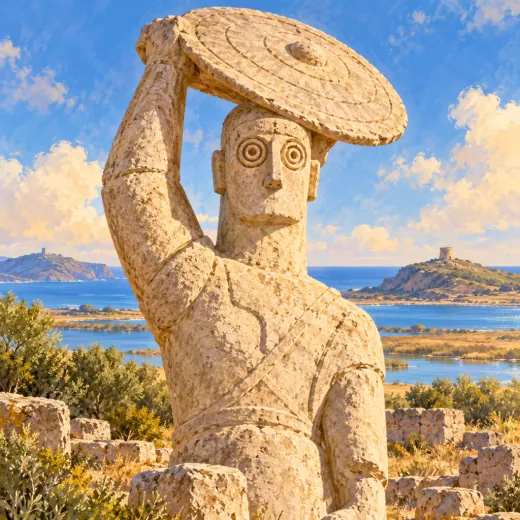
The Giants of Mont'e Prama
the hill of dwarf palms
not scary at all
In March 1974 two farmers were ploughing a field near Cabras when the plough began to turn up pieces of stone: the owner recognised a carved head. It was the beginning of an incredible discovery: thousands of fragments of statues more than two metres tall, boxers, archers and warriors. They are sculptures of the Nuragic age, carved in limestone. There is no ancient legend here: the name “giants” is modern, and the story is real archaeology.
Did you know? In the 2014 and 2022 excavations more stone boxers were found: the giants keep coming out of the ground.
The story
March 1974. In a field of the Sinis, near Cabras, in Sardinia, two farmers are preparing the earth for sowing.
Their names are Sisinnio Poddi and Battista Meli. The field belongs to Giovanni Corrias. The plough moves slowly over the dark soil. There is no other sound but its own and, perhaps, the wind coming from the lagoon.
Then something turns over out of the earth. A stone, perhaps. Then another. The plough stops and starts again, and each time it brings to the surface pale stones, worked, too smooth to be field stones.
The two men stop. The owner comes down. He bends over a heap of earth and stones, and looks more closely.
There is a head.
Not a real head, of course. A stone head, round, which had lain under the ground for almost three thousand years. Giovanni Corrias understands that this is not a field like the others. He has an archaeologist informed, Giuseppe Pau.
Beneath those furrows lay a forgotten cemetery.
The excavations, in the years that followed, brought out a whole world. Not one statue: ten thousand pieces, more or less. Arms, legs, shields, heads, bits of torsos. Between 1975 and 1979, thousands of them were recovered. All were made of local stone, a pale, soft stone called calcarenite.
The experts packed them into crates and began the most patient work in the world. A stone puzzle, with a frightening number of pieces. They took them to Li Punti, near Sassari, where restorers worked for years, between 2007 and 2012, to rebuild the pieces that fitted together.
When they succeeded, in front of them stood men about two metres tall, and some taller. Warriors, and archers, and boxers.
The boxers were bare-chested, with a short pointed kilt and an armoured glove on the right arm, while with the other arm they held a shield raised above the head. The archers had a short tunic, a helmet with horns, and a bow held with a protected left arm. The warriors wore the tunic and a horned helmet, and carried a round shield.
Among the pieces there were also stone models of nuraghi, small carved towers, as if someone had wanted to bring their own home into the cemetery too.
They were big. They were still. And they looked out, with a stern air that even today inspires awe.
Those who see them today, in the museum, say they have something hard to explain: they still seem to stand guard.
But over whom? And since when?
Here begins the honest part of this story, the one where the facts end and the questions remain.
The facts are these. The statues come from the Nuragic age, the civilisation that built in Sardinia the great stone towers called nuraghi. They stood near a necropolis, a cemetery. There was no legend telling of them: the people who had carved them had vanished centuries before, and nobody remembered any more what they were. Even the name "giants" came later. The scholar Giovanni Lilliu also called them by a Greek word, Kolóssoi, the colossi.
Then come the hypotheses.
When were they carved? Here the scholars do not agree. A page of the Region says in the eighth century before Christ. Others propose a period running from the ninth to the thirteenth century BC, and recent dating brings the beginning of the necropolis towards the late Bronze Age. It is a difference of centuries, and the discussion is still open.
What were they for? Perhaps to form an avenue, two rows of guardians accompanying those who went towards the tombs, perhaps of a very powerful warrior family. Perhaps to celebrate the necropolis. Perhaps, beside the necropolis, there was a Nuragic sanctuary. That is an idea of some scholars, but it is not confirmed. Between 2013 and 2015, with a radar that looks inside the earth, the archaeologists explored an area of at least six and a half hectares. In the 2014 excavations they found new tombs, a stone foot with the sandal still on its base, two new forms of boxers. But nobody yet has certain proof.
Why were they broken? The pieces were scattered far from one another, and this suggests a deliberate destruction, and a burial on the slope of a hill at a difficult moment in the island's history, perhaps the end of an era. But what really happened, nobody knows.
And the giants have not finished coming out.
On 4 April 2022 a new dig began, by the Superintendency of Cagliari and Oristano, in the same necropolis. Torsos and fragments of two more statues appeared. Alessandro Usai, who directed the dig, recognised them at once: they were two boxers, because of the long shield that wraps around the left arm and flattens over the belly. The limestone, he explained, is easy to work and for that very reason breaks easily. As to when they were made, and what they were for, the Ministry says there is still much to be defined.
Today, in Cabras, in the civic museum, some statues await visitors. Others are in Cagliari, in the national archaeological museum.
If you go there, stand in front of one of the boxers. Look at the shield, the glove, the raised arm. Think that someone, three thousand years ago, took a stone and drew from it a man bigger than himself.
We do not know who he was. We do not know what name he gave him.
But the stone has kept him in mind.
Relatives around the world
In the trails
In real history
Listen / Read next
- Music to read by: Cinematic JourneyEpic film-style music, no lyrics, by Ciro Simone IrmiciSpotifyYouTube Music
- The words of the dialect: SardinianNonnese, the dictionary of Italian dialects
