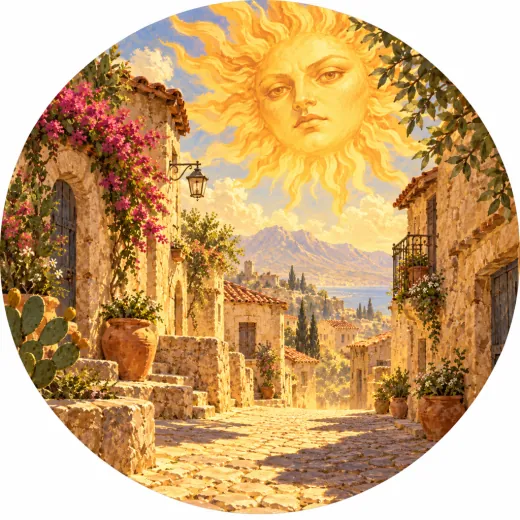
Sa Mama 'e su Sole
“the mother of the sun”, in Sardinian
a little scary
In summer, from after midday until four in the afternoon, Sardinian children had to stay indoors. Anyone who tried to go out heard: “Careful, sa Mama 'e su Sole will get you!” She was a figure said to wander the sunny streets and fields at exactly those hours, ready to chase disobedient children, touch their foreheads and give them a fever. She was not really wicked: she served to protect little ones from a real danger, the fierce summer sun. Sardinia had many “mothers” like this, one for each danger.
Did you know? There was also sa mama 'e su bentu, the mother of the wind, sa mama 'e su frittu, the mother of the cold, and sa mama 'e su fogu, the mother of fire.
The story
In July, in certain villages of Sardinia, the longest hour is not the night. It is the early afternoon.
The streets empty. The shutters are closed halfway. The sun falls on the stone like a hammer, and the air above the asphalt trembles. Even the dogs, under the gateways, stop breathing hard.
In that hour, said the old people, you do not go out. It is a Sardinian tradition of which few accounts survive.
"Why?" asked every child.
"Because she passes by," answered the grandparents.
And if the child asked "who?", nobody answered in the same voice. Their expression changed, their eyes lowered. Then came the name.
Sa Mama 'e su Sole. The Mother of the Sun.
In a house at the edge of an ordinary village, there was a boy who had heard this story a hundred times and did not believe it one bit. He was eight years old, with a deflated football and a great need to run. That summer, moreover, his friends were all away: some at the sea, some at their cousins'. Only he remained, with his grandmother.
"After lunch we sleep," said the grandmother.
"I am not sleepy."
"We do not go out."
"But there is sun," he said, with the air of saying something clever.
"Exactly," said the grandmother.
She sent him to his room with a glass of water, and sat down to knit in the cool room, with the door ajar and the rustle of the needles.
The boy waited. He looked at the ceiling, at the flies motionless on the wall, at the strip of light that came through the shutter and crept slowly across the floor. He counted the ticks of the old clock. When his grandmother began to breathe softly, with her head resting on the back of the chair, he slid off the bed, without a sound, opened the front door and went out.
The heat hit him in the face like a scalding cloth.
For a moment he felt he had got the wrong world. The street was empty. There were no children, no cats, not a single shadow, except his own. The houses seemed suspended. Even the silence had a sound: a thin buzz, on the skin, in the ears.
He bounced the ball. The noise seemed enormous.
He bounced it again. He ran after it a little, laughing alone. It was good. It was the most his own street he had ever had.
Then he stopped.
At the end of the road, where the asphalt ended in a white light, there was someone.
It was a woman. He saw her in pieces, because the heat made the air waver. She was tall and straight, and her dress seemed not to touch the ground. He could not make out her features, but one thing he understood at once: she was the most beautiful woman he had ever seen. And this, who knows why, frightened him more than anything else.
She did not move. She seemed to be waiting.
The boy took a step back. The ball slipped from his hands.
The woman raised an arm, barely, as if to call him. And she walked.
He did not think. He ran. He ran with the sun on his head and sweat in his eyes, without turning. He heard the footsteps behind him, light, regular, unhurried, and understood that she did not need to hurry to reach him. The front door was ten metres away, five, two.
Something brushed his forehead.
It was a light touch, barely warm. And in that instant the street spun around him, and when he opened his eyes he was in the hallway, on the cool tiles, and his grandmother was kneeling beside him.
"I told you not to go out," she whispered. She was not angry. Her hands were steady and her voice full of fear.
The boy's forehead was burning.
The grandmother picked him up, though he weighed little and burned like a brick in the sun, and carried him to the coolest room in the house. She closed the shutters. She wet a towel in the jug. Meanwhile, outside, in the street, the ball stayed where it was, still in the middle of the light, and nobody went to fetch it.
He stayed in bed three days, with a fever that rose and fell. He was constantly thirsty. He dreamed of white roads that never ended, and of a voice that said nothing but kept an eye on him. His grandmother kept a wet cloth on his head and did not say a word. He, every time he opened his eyes, saw outside the window the white road, still, and had the feeling that someone, at the far end, was waiting.
On the fourth morning the fever passed. The boy ate a piece of bread with oil. Then he asked, in a low voice: "Was it her?"
The grandmother looked at the window.
"In Sardinia there are many mothers," she said. "There is the one of the wind, the one of the cold, the one of the fire. One for everything that can hurt you. They are not wicked. They are all there to tell you the same thing."
"What?"
"That when it is too hot, you must stay in the shade. The afternoon sun, in July, is no joke. It makes children dizzy and makes them ill, and once there was no other way to explain it than with a story."
The boy thought for a long time, looking at the ceiling.
"Then she did not want to harm me."
The grandmother smiled for the first time in three days.
"She cared for you in her own way," she said. "Like me."
The next afternoon, the boy really slept. Not because he was sleepy, but because now he knew what was waiting outside. And the street, outside, stayed empty until four.
Relatives around the world
Listen / Read next
- Music to read by: Cinematic JourneyEpic film-style music, no lyrics, by Ciro Simone IrmiciSpotifyYouTube Music
- The words of the dialect: SardinianNonnese, the dictionary of Italian dialects
Sources
- L'Unione Sarda, «Janas, cogas e Mommotti: la Sardegna fantastica in un libro per i più piccoli»
- Dolores Turchi, «Maschere, miti e feste della Sardegna»
