The Janas
“the fairies”, in Sardinian · Sardinia
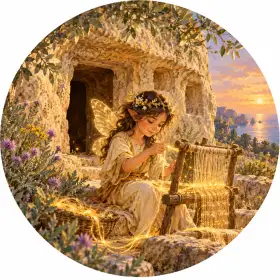
They are tiny fairies who live in the “domus de janas”, the fairy houses carved into the rock thousands of years ago. By day they stay in their rock houses weaving cloth of gold on golden looms. They can be generous with those who respect them and spiteful with those who enter their homes without permission. In Sardinia almost every village has its own janas story. The fairies are a legend, but their houses are real: they are prehistoric tombs, often carved like homes, with doors and pillars.
Did you know? More than 2,400 domus de janas have been found in Sardinia, and since July 2025 seventeen sites with these tombs have been UNESCO World Heritage Sites.
Sources: UNESCO World Heritage Centre, «Funerary Tradition in the Prehistory of Sardinia, the domus de janas» (2025); ENIT, italia.it, «Domus de janas, patrimonio UNESCO»
Sa Musca Macedda
“the macedda fly”, in Sardinian · Sardinia
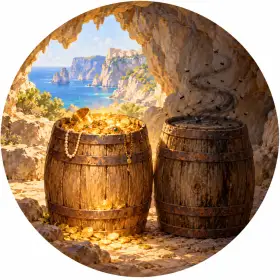
In many villages of Sardinia people said that two identical barrels were hidden underground. One was full of gold and jewels; the other was full of musche maceddas, giant flies as big as a sheep, with a terrible buzz. Whoever found the barrels had to choose without knowing which one was right: open the wrong barrel, and the swarms would invade the world. So nobody dared to dig. Scholars think the flies were the face of the epidemics that struck the island.
Did you know? The linguist Gino Bottiglioni collected the most complete versions of this legend in 1922, and almost every village put the treasure in a different place.
Sources: Gino Bottiglioni, «Leggende e tradizioni di Sardegna» (1922); Pantaleoni e Bagella, studio sulla Musca macedda, Università di Sassari (2021)
The Mamuthones of Mamoiada
Mamuthones and Issohadores · Sardinia
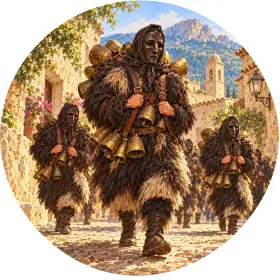
In Mamoiada, in the heart of Barbagia, mysterious figures come out into the street: the Mamuthones. They wear a black wooden mask with a gloomy expression, dark sheepskins and lots of cowbells on their backs. They walk with small, heavy steps, and at a sign from the head Issohadore they all make three quick jumps together to ring the bells, as if they were one big beast. They are accompanied by the Issohadores, with red jackets and white masks, who throw a rope to catch someone in the crowd. Where they really come from, nobody knows.
Did you know? There are twelve Mamuthones and eight Issohadores, and they parade in two lines on 16 and 17 January, for Saint Anthony the Abbot.
Sources: Paolo Piquereddu, «Il Carnevale di Mamoiada» (1989); ENIT, italia.it, «Mamoiada»
Sa Mama 'e su Sole
“the mother of the sun”, in Sardinian · Sardinia
In summer, from after midday until four in the afternoon, Sardinian children had to stay indoors. Anyone who tried to go out heard: “Careful, sa Mama 'e su Sole will get you!” She was a figure said to wander the sunny streets and fields at exactly those hours, ready to chase disobedient children, touch their foreheads and give them a fever. She was not really wicked: she served to protect little ones from a real danger, the fierce summer sun. Sardinia had many “mothers” like this, one for each danger.
Did you know? There was also sa mama 'e su bentu, the mother of the wind, sa mama 'e su frittu, the mother of the cold, and sa mama 'e su fogu, the mother of fire.
Sources: L'Unione Sarda, «Janas, cogas e Mommotti: la Sardegna fantastica in un libro per i più piccoli»; Dolores Turchi, «Maschere, miti e feste della Sardegna»
The Giants of Mont'e Prama
the hill of dwarf palms · Sardinia
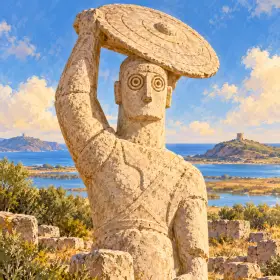
In March 1974 two farmers were ploughing a field near Cabras when the plough began to turn up pieces of stone: the owner recognised a carved head. It was the beginning of an incredible discovery: thousands of fragments of statues more than two metres tall, boxers, archers and warriors. They are sculptures of the Nuragic age, carved in limestone. There is no ancient legend here: the name “giants” is modern, and the story is real archaeology.
Did you know? In the 2014 and 2022 excavations more stone boxers were found: the giants keep coming out of the ground.
Sources: Sardegna Turismo, Regione Sardegna, «Mont'e Prama, patria di Giganti»; Ministero della Cultura, «Il parere degli esperti sui due nuovi Giganti di Monte Prama»