The Grootslang
“great snake”, in Afrikaans
scary
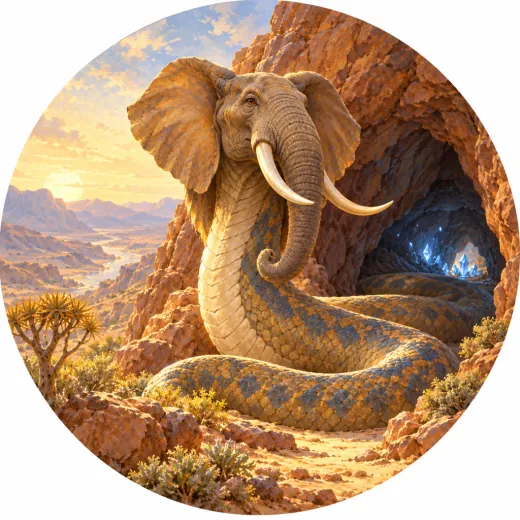
In South Africa, in some versions in the Richtersveld, a dry and rocky region, people tell of a gigantic monster that is half elephant and half snake: the Grootslang. According to the legend it is one of the first creatures of the world, so strong and cunning that, it is said, the gods, regretting they had made it, split it in two, giving rise to elephants and snakes. But one Grootslang managed to escape. It lives in a very deep cave that some call the “Bottomless Pit”, full of diamonds, and lures the curious with its precious stones.
Did you know? The Richtersveld, with its red mountains and strange plants, has been a UNESCO World Heritage Site since 2007.
The story
In the Richtersveld, in the driest corner of South Africa, the earth is red and the mountains look as if they were made of hot iron. By day the sun beats down on the rocks and the snakes sleep in the shade. By night the cold comes down from the sky, and the only sound is the wind blowing between the stones.
It is said that in that place there is something that should not be there.
They say that at the beginning of the world, the gods made a creature stronger and cleverer than all the others. It had the head and trunk of an elephant and the body of a snake, long, thick and silent. It was a wonderful creature. And the gods, looking at it, grew afraid of what they had made. So they split it in two: from one half came the elephants, from the other the snakes.
But one creature, they say, managed to escape before the cut. Its name is the Grootslang, the Great Snake. It still lives underground, in a cave as deep as a starless night. And it has a habit: it loves diamonds.
That cave is full of stones. The walls, they say, are crusted with light. When the midday sun strikes the entrance, a blue gleam rises from the hole and makes your head spin. Over the years, a few people have gone to look. Few came back.
What follows is the story of one of them.
There were two of them, a man and his brother, diamond prospectors. They had travelled up the Orange River for days, with two donkeys, a tent and a pile of ropes. They slept under the stars and drank water that tasted of iron. One afternoon, following a goat track, they came to a spot where the rock opened into a round hole, narrow as a well, black as ink.
The younger brother leaned over and shouted into it. The echo came back after a long time, without his voice in it: a sort of long breath.
“Can you feel the air?” he said. “It’s warm.”
“I don’t like it,” said the other.
But at the bottom, at a depth nobody could guess, something glittered. A spark. Then another. Then a kind of carpet of tiny stars, moving ever so slightly, like the water of a lake under the moon.
The younger brother said nothing more. He took the longest rope, tied it to a boulder, and began to climb down.
The elder brother stayed at the top, the rope in his hands, watching the hole swallow a head, then shoulders, then a lamp that grew smaller and smaller. He counted the metres: ten, twenty, thirty. The rope ran smoothly. At a certain point his fingers noticed something: the rope had grown warm.
After what felt like a very long time, his brother’s voice rose out of the hole, thin and far away, twisted by the stone.
“They’re everywhere,” it said. “The walls, the floor… they never end. They’re as big as eggs.”
“Come back up.”
“Just a moment more. I’ll take only one.”
The elder brother looked at the rope. Outside, the sun was setting, and the shadows of the rocks stretched like fingers across the red sand. There was not a single bird left in the sky. There was not even any wind.
Sounds were coming up from the bottom of the pit. First the wheeze of a man breathing. Then a lower sound, and a slower one. Frrrr. Frrrr. Like sand poured over a stretched skin. Like a very long body shifting, one coil after another, across stone.
“Is everything all right?” shouted the elder brother, and his voice was lost.
No answer.
Then the rope gave a jerk so hard it almost tore itself out of his hands. There was a cry, a short cry, and the lamp far below flickered and went out.
The elder brother did not move. He stayed there, listening. He could hear his own heart, and underneath it, in the dark, the sound of something coming up. Frrrr. Frrrr. Closer. Closer. He caught the smell: wet stone, dust, and beneath that something ancient, something old, like a stable abandoned for a thousand years.
Then a shape appeared at the mouth of the hole.
He did not see it clearly. He only saw that the shadow in the pit was blacker than the pit itself. That something big, soft and long was moving slowly, like a trunk feeling the air. And that inside that shadow two small, shining eyes, with the same light as the diamonds, were watching him.
There was no cruelty in that gaze. There was only an immense hunger, and an even greater patience.
The elder brother pulled on the rope with all his strength. It came up light, far too light, and at the end there was no one: only his brother’s belt pouch, torn clean off. He clutched it to his chest. He fell backwards onto the rock, got up again, ran. He did not slow down until he saw the river. The donkeys had broken their ropes and fled, braying. He ran on without them, without the tent, without water, until his legs gave way.
He reached a village two days later. His tongue was swollen and his eyes were the eyes of someone who has seen too much. He told them everything, and nobody believed him. They took him in out of pity.
In the pouch, though, there was a single thing. One stone, the one his brother had wanted to take in “just a moment more”. It was a diamond as big as a walnut, clear, with a blue light inside it. He looked at it for a long time. Then he wrapped it in a rag and buried it under a rock, far from the village, and told no one where. He never went back to the river. When people asked whether he would ever make that journey again, he shook his head and looked at his hands, which did not stop trembling for a whole season.
Those who tell this story never say whether it is true. They only say that prospectors still go there, now and then, drawn by the voice of the stones. And that at night, on the edge of the desert, you can sometimes hear a slow, long rustling, an enormous body moving underground, coil after coil.
It is not the wind. The wind does not breathe.
A living tradition, told with respect: how we tell myths.
Relatives around the world
Listen / Read next
- Music to read by: Cinematic JourneyEpic film-style music, no lyrics, by Ciro Simone IrmiciSpotifyYouTube Music
Sources
- collections of legends from the Richtersveld, South Africa
- UNESCO World Heritage Centre, Richtersveld Cultural and Botanical Landscape
