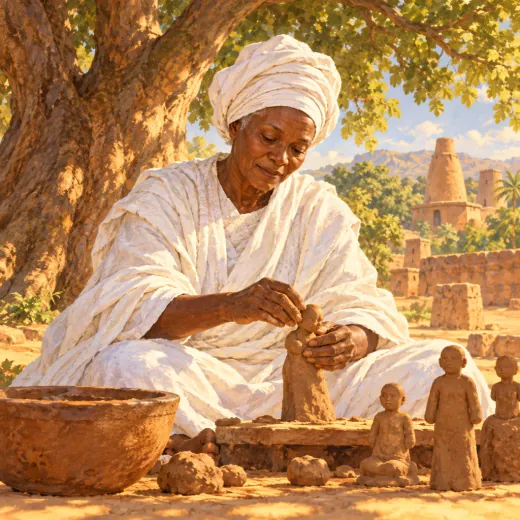
Obatala
Ọbàtálá, “king of the white cloth”, in Yoruba
not scary at all
In the Yoruba religion, Obatala is the orisha of purity, calm and wisdom, always dressed in white. Tradition tells that he shaped the bodies of human beings out of clay, before Olodumare gave them breath. One day, however, tired and thirsty, he drank too much palm wine, and the figures he moulded came out different from the others. When he realised, he promised never to drink again and to protect for ever the people born with a different body. That is why his devotees avoid palm wine.
Did you know? In Brazil and Cuba Obatala is revered as Oxalá or Obatalá, and his followers dress in white on the days devoted to him.
The story
When Yoruba elders tell of Obatala, they begin like this: It is said. It has always been said. Because these are not fairy tales made up for children. They are sacred stories, and they must be listened to calmly.
In the beginning, they say, there was no land under the sky. There was water, and mud, and a grey expanse that never ended. Higher up, in the sky, lived Olodumare, the Lord of everything, whom nobody has ever seen and from whom all things come. The orisha, the divine beings around him, lived with him.
One day Olodumare decided that under the sky there should be dry land, where creatures could live. He called Obatala, the wisest and calmest of the orisha, the one who dresses in white.
“Go down,” he told him. “Make the land.”
He gave him what he needed. A long chain, to climb down. A little earth, shut inside a shell. A hen with five toes on each foot. A palm nut. Obatala took it all with respect, and began the descent.
The air grew cooler, then damper. The chain swayed. The hen, held tight against his chest, now and then shifted her feet and grumbled softly, as if she too had an opinion about the journey. There was no sound around him, only the clinking of the links. Below him the world was a grey expanse with the faintest shine. It was long work. It was hot, and at a certain point Obatala found a palm tree full of sap, the kind people make wine from. He was tired, he was thirsty. He drank. Then he drank some more. Then, his head heavy and a smile on his lips, he fell asleep.
That was when Oduduwa stepped forward.
At this point the versions do not all say the same thing. In some, Oduduwa was another orisha who saw Obatala sleeping and thought: what if I did his job? In others, the land had been his from the very beginning, and Obatala had nothing to do with it. But in the best-known story, Oduduwa took what Obatala had left behind and went down in his place.
He poured the earth onto the water. Then he let the hen go. Scratching and pecking with her five-toed feet, the hen scattered the earth in every direction, and wherever she went the mud turned solid. A hill. A valley. A plain. To be sure the ground would hold, Oduduwa sent a chameleon ahead, which put down one foot, then another, very carefully, and said it was fine. The place where it all began is called Ile-Ife.
When Obatala woke up, the work was done.
For a long time he said nothing. Around him the grass, already tall, moved in the wind. Then, little by little, he noticed something strange: he was not angry any more. Or perhaps he was, but under the anger there was something else, a kind of peace. When he went back up, Olodumare did not punish him. He said only, “You have another task, and it will be a finer one.”
“Which one?”
“Making people.”
So Obatala went down again, and this time he stayed at Ile-Ife. He took clay. He kneaded it with water, patiently, with the broad, slow hands he had. They say a single body took him a whole day, and that the god was never in a hurry. He made the first body and laid it on the ground, still cold, still lifeless. He never made the same nose twice, or the same hand. Then another. Then another still. When the figures were ready, Olodumare came down and gave each one breath. The fingers moved. The eyes opened. And on the new earth, for the first time, there was someone who could speak.
Day after day, the work went on. Obatala was happy. And it was in those very days that it happened to him again.
One evening, at the end of the day's work, his hands caked in clay and his back tired, someone brought him palm wine. Obatala drank it. He liked it. He drank some more. When he went back to his shaping, his fingers were slower and his touch less sure, and the figures that came from his hands were not all like the others. One had a curved back. Another a paler colour than usual. Another would not walk like the rest, another would never see the light.
The next morning, with a clear head, Obatala looked at what he had made.
He did not reject them. He did not hide them. He sat down among them, on the still-damp earth, and said the words his devotees have repeated for centuries.
“I will never drink again. And whoever was born different, because my hand slipped, will stay under my protection for ever.”
He kept his promise. That is why, even today, those who follow Obatala avoid palm wine. That is why it is said that anyone born with a body different from others is dear to the god, and that to offend them is to offend him.
People, after all, were made like this: with clay, with a god's hard work, with breath given by another. No two are alike. Obatala says his hand slipped; but for those who tell the story, none of his figures is a mistake.
In the story, Obatala is remembered as the orisha of calm, purity and wisdom. That is why he dresses in white. That is why his faithful, in Nigeria and across the ocean in Brazil and Cuba, where they call him Oxalá and Obatalá, wear white clothes on the days dedicated to him, prepare pale foods, and speak softly.
If one day you happen to pass near one of these ceremonies, you will see men and women dressed in white, standing still, their eyes lowered. Do not make a noise. And if someone offers you palm wine, decline it kindly.
There is a god, somewhere, who made a promise, and keeps it.
A living tradition, told with respect: how we tell myths.
Relatives around the world
Listen / Read next
- Music to read by: Cinematic JourneyEpic film-style music, no lyrics, by Ciro Simone IrmiciSpotifyYouTube Music
Sources
- E. Bolaji Idowu, Olódùmarè: God in Yoruba Belief, Longmans (1962)
- Pierre Verger, Orixás (1981)
